
Water Softener FAQ: Questions and Answers
Water softener FAQ in short: look at the salt about monthly, expect each regeneration to take 60 to 120 minutes, clean the brine tank about every 3 years, and judge softening with a hardness test, never a TDS meter.
By the Water Softener Guide editors · Updated
On this page
- How long does a water softener regeneration take?
- How often should you check the salt in a water softener?
- How long does water softener resin last?
- What size water softener does a household need?
- Where does a softener go on a private well?
- Can softener discharge go into a septic system?
- How often should the brine tank be cleaned?
- How much bleach does it take to sanitize a softener?
- What water pressure and temperature can a softener handle?
- Can a TDS meter tell whether a softener is working?
Key takeaways
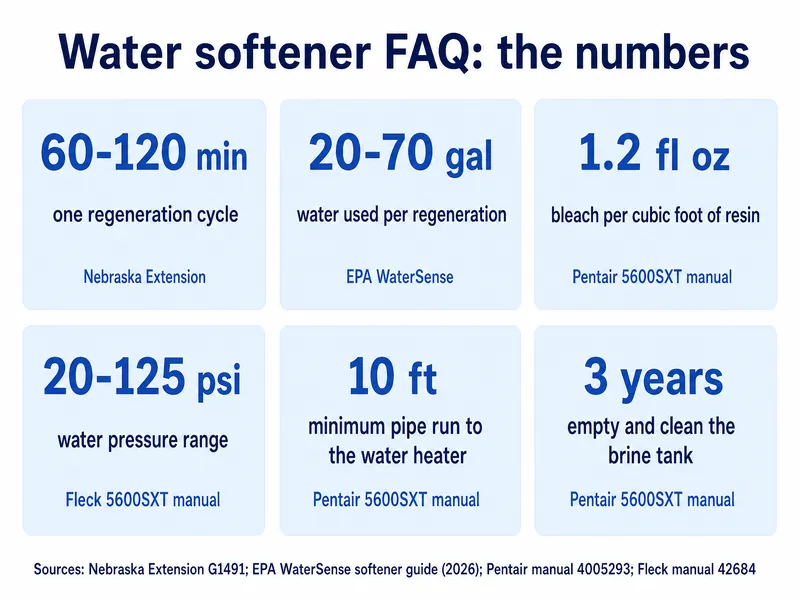
- Nebraska Extension G1491 says brining and flushing generally take 60 to 120 minutes before soft water returns.
- The EPA WaterSense softener guide puts a typical regeneration at 20 to 70 gallons of water, and up to 200 on some larger systems.
- Pentair's 5600SXT manual doses 1.2 fl oz of 5.25% bleach per cubic foot of resin and says to empty and clean the brine tank every three years.
- In Penn State Extension's sizing example, 4 people on 10 gpg water use 3,000 grains daily, and a 20,000-grain unit then runs 6 to 7 days per regeneration.
- The Fleck 5600SXT service manual needs at least 20 psi to regenerate and caps pressure at 125 psi and water temperature at 110 F.
- Montana State Extension notes softening does not lower total dissolved solids, so a TDS meter cannot show whether a softener works.
The numbers behind these answers
- 60-120 minTime for brine to pass through and flush the tankNebraska Extension G1491
- 20-70 galWater a typical softener uses per regenerationEPA WaterSense
- 1.2 fl ozBleach per cubic foot of polystyrene resinPentair 5600SXT manual
- 3 yearsInterval Pentair gives for emptying and cleaning the brine tankPentair 5600SXT manual
Each answer names the manual, extension service or store guide it comes from. When two sources give different numbers, both appear here, and the manual for your own valve settles it. For a fault happening right now, such as hard water, a flooded brine tank or a leak, the linked guides go step by step.
How long does a water softener regeneration take?
About one to two hours: Nebraska Extension's G1491 says 60 to 120 minutes are generally needed for the brine to pass through the unit and flush the tank. SoftPro's reset page narrows a manual cycle to 60 to 90 minutes, and the step times Quality Water Treatment programs on its 32,000-grain Fleck 5600SXT (10 minutes backwash, 60 brine draw, 10 rapid rinse, 12 brine fill) add up to 92 minutes. Pentair's manual warns that a single-tank softener lets untreated water into the house while it recharges, which is why valves are usually set to run in the small hours. Water use matters too:
| Source | Time per regeneration | Water per regeneration |
|---|---|---|
| Nebraska Extension G1491 | 60 to 120 minutes | About 50 gallons |
| EPA WaterSense guide (2026) | Not given | 20 to 70 gallons, up to 200 on larger systems |
| Penn State Extension | Not given | About 50 gallons |
| SoftPro reset page | 60 to 90 minutes (manual cycle) | Not given |
| Quality Water Treatment Fleck settings | 92 minutes of programmed steps | Not given |
The regeneration guide explains what happens in each step.
How often should you check the salt in a water softener?
About once a month: SoftPro's maintenance table says monthly, and the EPA WaterSense guide says every 4 to 6 weeks. Keep the salt above the water, with the tank somewhere between one-quarter and one-half full; the EPA says never let it drop under a quarter, and Pentair says its tank performs best below half because a taller pile of pellets can bridge. Your manual's level wins over both. For the salt itself, the Fleck manual rules out granulated and rock salt, so buy pellets or solar crystals. The salt quantity guide covers how much to pour in.
How long does water softener resin last?
Usually years rather than months, though no maker manual here prints a fixed lifespan; SoftPro's resin guide puts most resin at 5 to 10 years, shorter with very hard water or heavy use. Penn State Extension adds that red, oxidized iron clogs resin and that some resin cannot be washed clean and has to be replaced. The EPA WaterSense guide calls for cleaning the beads once a year to keep them efficient. If soft-water capacity keeps shrinking with correct settings and plenty of salt, rule out a salt bridge, a dirty injector and a wrong hardness entry before buying new resin. The resin replacement guide covers the job.
What size water softener does a household need?
One that lasts about a week between regenerations at an efficient salt setting, which you can work out from people × 75 gallons a day × hardness in gpg, the method Penn State uses. For 4 people on 10 gpg water that comes to 3,000 grains daily, which a 20,000-grain unit covers for about 6 to 7 days. Keep in mind that rated capacity depends on the salt dose: Pentair rates its 1.0 cu ft system at 11,900 grains with a 3 lb salt dose and 31,100 with 9 lb. The WQA's softener booklet warns against oversizing and asks for 4,000 grains removed per pound of salt. The regeneration interval guide runs the numbers for other households.
Where does a softener go on a private well?
After the pressure tank. SoftPro's Elite install guide says a softener placed before the pressure tank will not operate properly, and it cuts in after any irrigation branch too. Pentair's manual wants any chlorinator, neutralizer or sediment, iron or odor filter ahead of the softener, plus at least ten feet (three meters) of total pipe to the water heater, which keeps heated water from backing into the valve. Penn State notes that toilets and outside spigots can stay on hard water. The placement guide covers garages, basements and loops.
Can softener discharge go into a septic system?
It depends on your local rules, because the sources disagree. University of Maryland Extension says the softener's backwash pipe should not connect to the septic tank. Purdue Extension explains that Indiana's rule requires softener recharge to pass through a soil absorption field, though not necessarily the tank. The WQA's septic toolkit, summarizing a Virginia Tech study the industry funded, reports that efficiently run softeners improved septic tank performance while very inefficient ones may harm the drain field. Penn State estimates about 50 gallons per regeneration, which may or may not overload a system. Read softeners on septic systems before choosing.
How often should the brine tank be cleaned?
Inspect it every year and give it a full clean whenever sludge or grit collects on the bottom; Pentair's 5600SXT manual sets every three years as its own interval. The store schedules are shorter: SoftPro's maintenance table lists every 6 to 12 months and Quality Water Treatment's maintenance page says annually. Tanks on iron-rich or dirty water, or ones that have begun to smell, usually need it sooner. Put the softener in bypass before emptying the tank. The steps are in how to clean a brine tank.
How much bleach does it take to sanitize a softener?
Roughly 1 to 2 fl oz of plain, unscented household bleach for every cubic foot of resin; the figure in your own manual comes first. Pentair's figure for 5.25% bleach on polystyrene resin is 1.2 fl oz per cubic foot, so a 1.5 cu ft system takes about 1.8 fl oz; SoftPro and Quality Water Treatment both work from about 2 fl oz. Pour it into the brine well with water already in the tank, never into the resin tank, then let a regeneration draw it through; SoftPro asks for at least an hour of contact. SoftPro suggests sanitizing every 3 to 12 months and Quality Water Treatment every 6 to 12. The sanitizing guide covers the rinse afterward.
What water pressure and temperature can a softener handle?
For the Fleck 5600SXT, 20 to 125 psi: the Fleck service manual needs at least 20 psi for the valve to regenerate, caps pressure at 125 psi and water at 110 F, and says the unit must never face freezing conditions. Pentair's system manual gives the same 20 to 125 psi range and lowers the ceiling to 100 psi in Canada. Clack, SoftPro and other valves publish their own ratings, so check yours. If pressure falls after an install, see low water pressure after a softener; the installation guide covers these checks before you cut in.
Can a TDS meter tell whether a softener is working?
No. Montana State Extension explains that softening exchanges calcium and magnesium for sodium or potassium without reducing total dissolved solids, so the TDS reading barely moves. Measure hardness instead: Nebraska Extension says test kits and dip strips give a good estimate, and it classes 7 to 10.5 gpg as hard. Test cold raw water and cold softened water side by side with one kit on one day; a wide gap means the resin is doing its job. The test kit guide helps you pick one.
How we put this page together
These answers draw on Pentair's 5600SXT system manual (4005293) and the Pentair-hosted Fleck 5600SXT service manual (42684), the EPA WaterSense softener guide (May 2026), the WQA's softener booklet and septic toolkit, extension publications from Nebraska, Penn State, Montana State, Maryland and Purdue, and the SoftPro and Quality Water Treatment pages and install guides covering the systems they sell. Every source was opened again in October 2026. The old sizing chart by household size was removed because no primary source backs it. Forum advice, store cost estimates and any testing of our own were left out.
More help: see our water softener guides.