
Install
Water Softener Air Gap Requirements
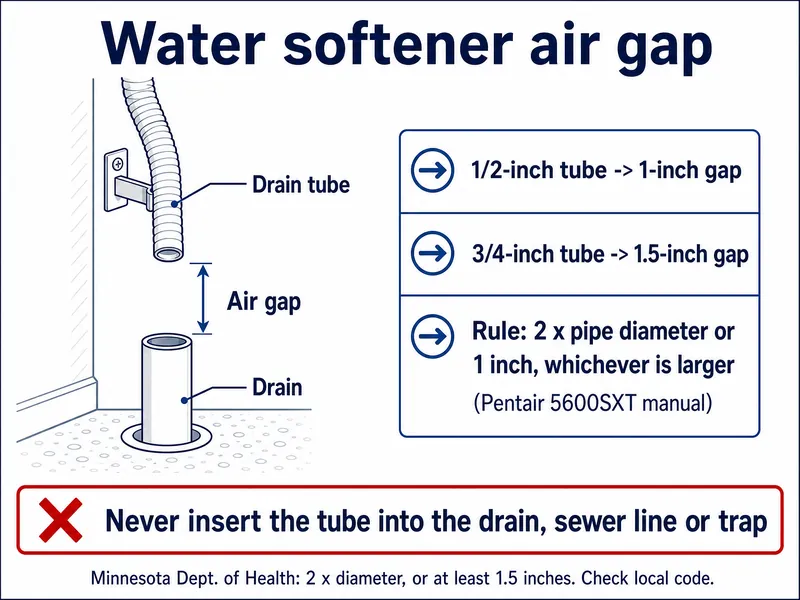
A water softener air gap is open space between the drain tube's end and the drain: Pentair's manual requires at least 2 pipe diameters or 1 inch, whichever is larger.
By the Water Softener Guide editors · Updated
On this page
Key takeaways
- Pentair's 5600SXT manual sets the gap at 2 pipe diameters or 1 inch, whichever is larger; QWT's and SoftPro's install guides repeat it.
- A 1/2-inch drain line therefore needs at least 1 inch of open air; a 3/4-inch line needs at least 1.5 inches.
- The Fleck 5600SXT manual calls for a 3/4-inch line when backwash flow tops 7 gpm or the run is longer than 20 feet.
- Minnesota's Department of Health asks for twice the discharge pipe's diameter, or at least 1.5 inches.
- Massachusetts code 248 CMR 10.12 requires an air gap on drains and overflows from the water distribution system.
- The brine tank overflow is a second, separate line with its own gap, per Pentair.
Air gap numbers from the sources
- 1 inchminimum air gap on a 1/2-inch drain linePentair 5600SXT manual 4005293
- 2×pipe diameter: the gap rule in the manuals and in Massachusetts code248 CMR 10.12
- 1.5 inminimum air gap in Minnesota's guidanceMinnesota Department of Health
- 7 gpmbackwash flow above which Fleck calls for a 3/4-inch drain lineFleck 5600SXT manual 42684
What is a water softener air gap?
A water softener air gap is a stretch of open air between the end of the drain tube and the drain that receives it. During a regeneration the drain line ties your drinking-water system to the sewer for an hour or more. If the tube sat inside a drain that clogged or backed up, waste water could be held against it with a path back toward the control valve.
The gap breaks that path. Pentair's manual says to "always allow an air gap" so that sewage cannot be back-siphoned into the softener. Anything in the drain would have to rise past the tube's end and overflow before it could reach it, and you can see a backed-up drain at a glance.
Minnesota's health department says field sanitarians have found contamination traced to softener drains installed without one. For tubing length and lift, see the drain line guide; the full job is in the installation guide.
How big does the water softener air gap need to be?
The gap must be at least twice the drain line's diameter and never less than 1 inch. Pentair, Quality Water Treatment (QWT) and SoftPro print the same rule in their install documents. The EPA's Cross-Connection Control Manual defines an air gap the same way: twice the supply pipe's diameter, never less than one inch.
Most home softeners use 1/2-inch tubing, which is the minimum Pentair allows, so 1 inch is the usual working figure. Larger lines need more. The Fleck 5600SXT manual moves you to 3/4-inch tubing when backwash flow exceeds 7 gpm or the run is longer than 20 feet, and two diameters of 3/4 inch is 1.5 inches.
| Drain line | When the manuals use it | Minimum gap |
|---|---|---|
| 1/2-inch tubing | Standard residential line (Pentair, Fleck, SoftPro) | 1 inch |
| 3/4-inch line | Fleck: backwash over 7 gpm or run over 20 ft | 1.5 inches |
| Any size in Minnesota | State health department guidance | 2 × diameter, or at least 1.5 inches |
Measure from the end of the tube down to the highest point the drain water could reach. For a floor drain, Minnesota says to measure from the high point of the floor rather than the strainer, since water pools across the floor before it rises in the drain.
What do plumbing codes require for a softener drain?
Local code decides, and it can be stricter than the manuals. Pentair's drain section opens with a note that local codes may require changes and to check with local authorities before installing.
| Source | What it requires |
|---|---|
| Pentair, QWT and SoftPro install documents | 2 pipe diameters or 1 inch, whichever is larger; never insert the line into a drain, sewer line or trap |
| Massachusetts, 248 CMR 10.12 | Drains, overflows and relief lines from the water system discharge through an air gap at least twice the effective diameter of the drain served |
| Minnesota Department of Health (Rule 4714, section 611.2) | Air gap discharge for water conditioning equipment; twice the discharge pipe diameter above the flood rim, or at least 1.5 inches |
QWT's guide tells Massachusetts installers to follow 248 CMR. We did not verify other states' wording, so treat the manual figure as a floor and confirm the local rule with your building department. If you are not comfortable working on drain piping, have a licensed plumber make the connection.
Which air gap fittings work with a softener?
Any setup works if the tube end is fixed in place and clear of the water. SoftPro's Elite parts list includes drainpipe connection and air gap fittings, and its guide notes that an air gap kit may be available. Minnesota adds that an air gap must be rigidly mounted and built from approved plumbing parts.
These are the drain points SoftPro's Elite guide accepts, with how the gap is kept:
- Floor drain. SoftPro says to end the tube at the mouth of the drain; clip it to a bracket or post so the end stays above the grate.
- Laundry tub or sink. Drain into the open bowl, with the tube clipped well above the rim.
- Washing-machine standpipe. SoftPro allows sharing the washer's drain and suggests an optional air gap kit so the tube ends above the opening.
- Sanitary sewer line. Only with a P-trap and a riser, plus the gap; a standpipe-style air gap fitting sits on the riser.
- Pre-plumbed loop drain. QWT notes that a builder's drain stub at a softener loop will usually already have an air gap.
Pentair adds one more step: secure the discharge end so the line cannot move. A tube that whips during backwash can drop into the drain and close the gap.
Does the brine tank overflow need its own air gap?
Yes. Pentair treats the overflow as a separate drain run: 1/2-inch tubing from the overflow fitting to a drain, sewer or tub, never raised above the fitting, never tied into the control valve's drain line, and ending with an air gap. SoftPro's guide adds a general rule not to tee into any other existing drain line.
The overflow only carries water when something has failed, such as a stuck brine valve. If you find water on the floor near the brine tank, our leaking water softener page covers the usual causes.
Common water softener air gap mistakes
Mistakes that close the gap
Tube pushed down the drain
All three install documents forbid inserting the line into a drain, sewer line or trap. Minnesota lists this among the incorrect installs it finds.
Gap sized for the wrong tube
Two diameters grows with the line. A 3/4-inch line needs 1.5 inches, not 1.
Overflow teed into the valve drain
Pentair requires a direct, separate overflow line with its own gap.
Tubing left loose
An unfastened end can whip during backwash and fall into the drain.
Closing the gap to stop splashing
Minnesota warns that efforts to stop splashing during recharge can create a cross-connection.
If water backs up at the drain after a regeneration, start with the troubleshooting guide, and check where the softener sits relative to the drain.
How we put this page together
This page is based on Pentair's 5600SXT Softener System manual (4005293), the Fleck 5600SXT service manual (42684), Quality Water Treatment's Fleck 5600SXT install guide, SoftPro's Elite install guide, Massachusetts plumbing code 248 CMR 10.12 and the Minnesota Department of Health cross-connection guidance, all checked in October 2026. We left out store blog figures that do not quote a code, the Illinois rule (its server could not be reached), and any model-code text we could not read at the source.
Common questions
How do you measure a water softener air gap?
Measure straight down from the open end of the drain tube to the flood rim of the receptor, the highest point water could reach. For a floor drain, Minnesota says to measure from the high point of the floor, not the strainer.
Is an air gap the same as an air-break?
No. Massachusetts code treats them separately: with an air-break the pipe may extend below the receptor's rim, while an air gap leaves open space above it. The code requires an air gap for drains and overflows from the water distribution system.
Can a softener drain into a laundry tub?
Yes. SoftPro's guide allows draining into the open sink bowl. Clip the tube so its end stays above the tub's rim by at least the gap your line size needs.
Does the softener drain need its own trap?
No. Massachusetts code says indirect waste must not be trapped ahead of the air gap. The trap belongs on the receiving drain; SoftPro asks for a P-trap with a riser when you connect to a closed sewer line.
Is 1 inch enough on a 3/4-inch drain line?
No. Two diameters of 3/4 inch is 1.5 inches, which is the larger figure, so the manuals' rule requires at least 1.5 inches.
Can the air gap be closed up to stop splashing?
Not by covering or sealing the gap. Minnesota warns that attempts to control splashing during recharge can create a cross-connection. A fitting made for the purpose keeps the gap open while guiding the water.
Who checks whether the air gap meets code?
Your local building or plumbing department sets the rule and inspects it where a permit is needed. Confirm it before you finish, and use a licensed plumber if unsure.
Related guides

More help: see our water softener maintenance and repair guides.