
Install
Where to Install a Water Softener
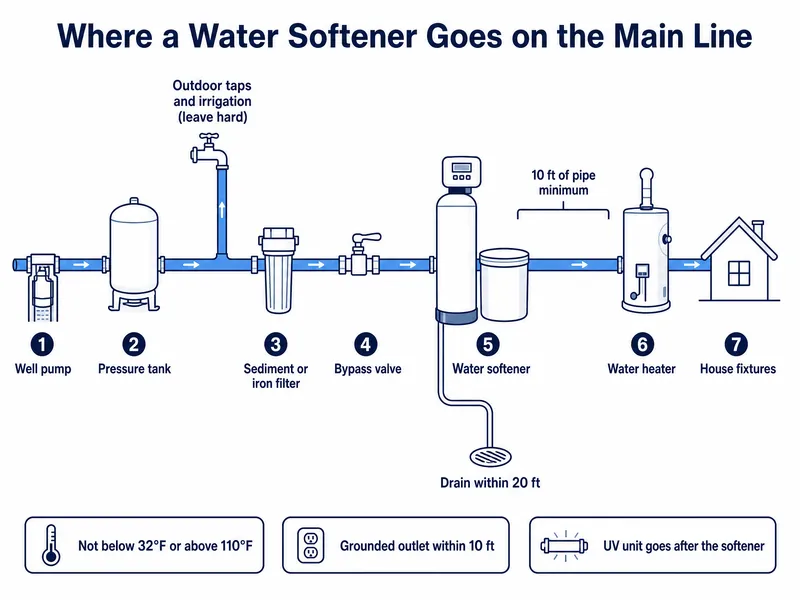
Where to install a water softener? On the main line where water enters the house, after any well pressure tank and filters, before the water heater, with a drain and grounded outlet close by.
By the Water Softener Guide editors · Updated
Disclosure: watersoftenerguide.net is owned by the team behind SoftPro Water Systems and Quality Water Treatment, which sell some of the parts and systems we link to. Our steps follow the makers' manuals and published instructions, checked October 2026. Always check your own model's manual first. Ownership disclosure
View at SoftPro
On this page
- Where should a water softener be installed?
- What comes before and after the softener on the line?
- Where does a softener go in a well home vs a city home?
- Can you install a water softener in a garage, basement or outside?
- What does the install spot need nearby?
- Which taps should stay on hard water?
- Common questions
Key takeaways
- SoftPro's Elite install guide says a well softener goes after the pressure tank and after any irrigation lines.
- Pentair's 5600SXT manual wants at least 10 feet of pipe to the water heater and the unit no more than 20 feet from the drain.
- The Fleck 5600SXT service manual rules out spots that drop below 32 F or rise above 110 F, and direct sunlight.
- The EPA WaterSense guide suggests placing the softener after the branch to outdoor hose bibs and irrigation where possible.
- Penn State Extension says toilets, outside spigots and basement sinks can be bypassed.
- SoftPro asks for a grounded outlet within 10 feet, with no extension cord.
Placement limits from the manuals
- 10 ftMinimum pipe run between softener and water heaterPentair 5600SXT manual
- 20 ftFarthest the unit should sit from the drainPentair 5600SXT manual
- 32-110°FTemperature range for the install spaceFleck 5600SXT service manual
- 10 ftLongest distance to a grounded outlet, no extension cordSoftPro code checklist (our store)
Where should a water softener be installed?
A whole-house softener sits on the main supply line, close to where that line enters the house and ahead of the branches that feed your fixtures. Quality Water Treatment's Fleck guide says to place it as close as possible to the water supply source and to a floor or laundry-tub drain.
The water heater comes after the softener, not before it. Quality Water Treatment's guide says temperatures above 120 F damage softeners, and Pentair's manual sets a total minimum pipe run of 10 feet to the heater to keep hot water from backing up into the system. If the heater sits right beside the main, extra pipe can make up the distance.
What comes before and after the softener on the line?
Other treatment goes upstream, with one exception. Pentair lists chlorinators, sediment filters, neutralizers, iron filters and taste-and-odor filters ahead of the softener. SoftPro's Elite guide says the same about whole-house filters, iron filters and pH neutralizers and calls the softener the final treatment step, except for a UV disinfection unit, which goes after it. The EPA WaterSense guide also puts the softener after a whole-house filter, so chemicals and sediment are removed first.
| Equipment | Position | Source |
|---|---|---|
| Well pressure tank | Before the softener | SoftPro Elite install guide |
| Branch to irrigation or outdoor taps | Before the softener, where possible | EPA WaterSense; SoftPro |
| Sediment, iron or taste-and-odor filter | Before the softener | Pentair 5600SXT manual |
| pH neutralizer | Before the softener | Pentair; SoftPro |
| Water softener | After the treatment above | All sources |
| UV disinfection unit | After the softener | SoftPro Elite install guide |
| Water heater | After the softener, 10 ft of pipe minimum | Pentair 5600SXT manual |
Where does a softener go in a well home vs a city home?
Well homes. The softener goes after the pressure tank. SoftPro's Elite guide says the unit will not operate properly if installed before the tank and has you cut in after it and after any irrigation lines, so the pump and tank deliver steady pressure and sprinkler water never passes through the resin. Wells often carry iron, and the Fleck manual says piping clogged with iron calls for a separate iron filter ahead of the softener, so leave room on the line for one. Quality Water Treatment's guide adds that the well pump's rate must at least equal the softener's backwash flow; Pentair lists 2.0, 2.4 and 3.5 gpm for its three 5600SXT sizes.
City homes. Most city mains enter through a basement wall, a crawl space or a garage, often near the water heater. That usually puts the softener between the meter side of the main and the heater, with any whole-house filter just upstream.
In both cases, check your pressure. The Fleck 5600SXT manual gives 20 to 125 psi and calls for a pressure-reducing valve when daytime pressure exceeds 80 psi; a different valve has its own limits.
Can you install a water softener in a garage, basement or outside?
Yes, if the spot stays within the manual's temperature range and out of the weather.
Basement. A basement is usually the easiest place: the main often enters there, the floor is level, and a floor drain or laundry tub is close.
Garage. Garages work in mild climates and are common in homes with a loop. The limit is cold. The Fleck manual says not to install where temperatures may drop below 32 F or rise above 110 F, and Quality Water Treatment adds that freezing damage voids its warranty. If a garage can freeze, choose another spot or plan to winterize.
Outside. Quality Water Treatment's guide says not to install where the unit is exposed to wet weather or direct sunlight unless you protect it, because the sun's heat can soften and distort plastic parts. Pentair says the 5600SXT power supply is for dry locations unless you use a listed outdoor Class 2 supply. Where an outdoor install suits the climate and your valve maker allows it, cover the control valve. For the SoftPro Elite valve, SoftPro sells an insulated outdoor valve cover (sold by SoftPro, our store) that is water and UV resistant and has a flap for reading the LCD screen, from $49 (October 2026).
What does the install spot need nearby?
Four practical needs decide the exact spot:
- A drain. Regeneration water has to go somewhere. Pentair wants the unit above the drain and no more than 20 feet from it; see the drain line guide for lift limits and the air gap guide for the gap at the end.
- Power. The control needs constant power: Fleck specifies an uninterrupted outlet, Pentair rules out switched outlets, and SoftPro's code checklist (SoftPro, our store) sets a 10-foot limit for a grounded plug with no extension cord.
- A firm, level base. The Fleck manual says to set the tank level on a firm base, and Pentair says not to let the plumbing carry the system's weight.
- Room to work. Pentair asks for room to reach the equipment for maintenance and adding salt.
Many newer homes already have a pre-plumbed softener loop, which settles the location for you. If yours does not, the installation guide covers cutting into the main.
Which taps should stay on hard water?
Not every line in the house needs soft water, and leaving some hard saves salt and resin capacity. SoftPro's Elite guide and Quality Water Treatment's Fleck guide both say to plumb a bypass for water feeding a geothermal heat pump, lawn sprinkling, out-buildings and other high-demand lines. The WQA's softener booklet asks installers to bypass outside sill cocks whenever feasible, and Pentair's softened-water diagram leaves the outside faucets on hard water.
Penn State Extension adds that toilets, outside spigots and basement sinks can be bypassed, while showers, sinks and laundry hookups probably should be softened.
Some households also keep one kitchen tap unsoftened. NDSU Extension says about 8 mg/L of sodium is added for every grain of hardness removed and suggests leaving one kitchen tap unsoftened for drinking and cooking. NDSU also covers potassium chloride as a sodium-free regenerant.
How we put this page together
Placement rules here come from the Pentair and Fleck 5600SXT manuals, the install guides from SoftPro and Quality Water Treatment, SoftPro's code checklist, the EPA WaterSense softener guide (May 2026), the WQA's Getting Smart with Softeners booklet, and Penn State and NDSU Extension, checked October 2026. The outdoor cover price is from SoftPro's product page. We left out attic and crawl-space rules, which no source covers, and did not survey installers.
Common questions
Can a water softener go in the attic or on an upper floor?
The sources do not cover attic installs. Pentair wants the unit above the drain and within 20 feet of it, the Fleck manual rules out freezing and heat over 110 F, and an attic often breaks those limits. Pick a ground-level spot where you can.
How far from the water heater should the softener be?
Pentair's figure for the 5600SXT is a total minimum pipe run of 10 feet between the two. Other valve makers may give a different distance, so read your own manual.
Should the softener feed the outdoor hose bibs?
No need. The EPA suggests installing after the branch to exterior hose bibs where possible, the WQA asks installers to bypass outside sill cocks, and both store guides plumb irrigation around the softener.
Is it fine to install the softener in direct sunlight?
Avoid it. Quality Water Treatment and the Fleck manual both say to keep the softener out of direct sunlight; Quality Water Treatment says the heat can soften and distort plastic parts.
Does a UV light go before or after the softener?
After it. SoftPro's Elite guide treats the softener as the final treatment step except for a UV disinfection system, which goes downstream of it.
Can the softener go before the well pressure tank?
No. SoftPro's Elite guide says the softener must be installed after the pressure tank and will not operate properly if placed before it.
Related guides
 InstallInstalling the softener
 InstallPutting the unit in bypass
 InstallDraining softener water to a septic tank
 TestTesting your water hardness
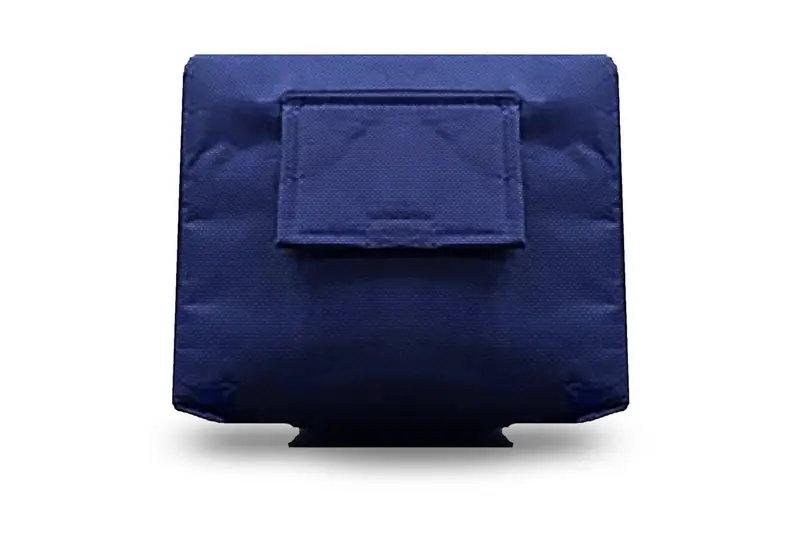
Parts for this job
Outdoor Softener Valve Protective Cover - For SoftPro Elite - Water & UV Resistant
Check current options and prices at SoftPro.
View at SoftProwatersoftenerguide.net is owned by the team behind SoftPro Water Systems and Quality Water Treatment, which sell some of the parts and systems we link to. Ownership disclosure
More help: see our guide to water softener care.