
Maintain
How to Clean a Water Softener Brine Tank
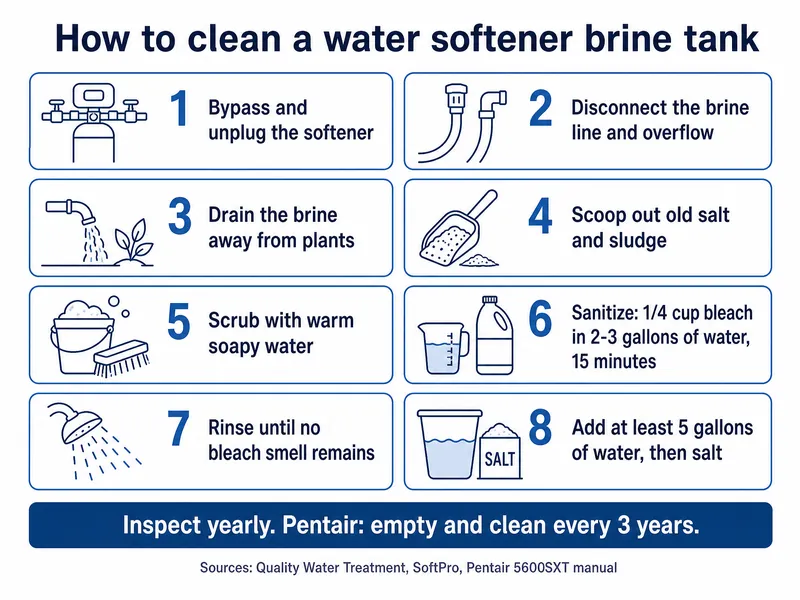
How to clean a water softener brine tank: bypass and unplug it, drain the brine, scoop out old salt and sludge, scrub, sanitize with 1/4 cup of bleach in 2-3 gallons for 15 minutes, rinse and refill.
By the Water Softener Guide editors · Updated
Disclosure: watersoftenerguide.net is owned by the team behind SoftPro Water Systems and Quality Water Treatment, which sell some of the parts and systems we link to. Our steps follow the makers' manuals and published instructions, checked October 2026. Always check your own model's manual first. Ownership disclosure
View at Quality Water Treatment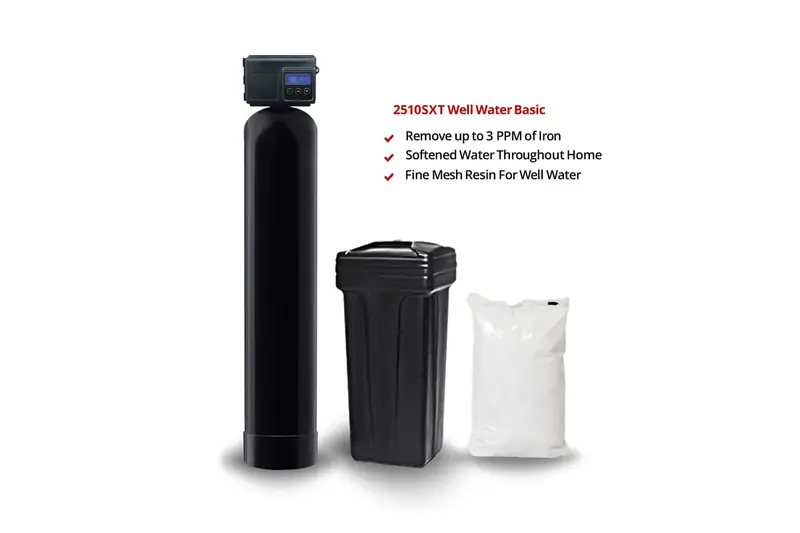
On this page
- How often should you clean a water softener brine tank?
- What signs say the brine tank needs cleaning?
- What do you need to clean a brine tank?
- How to clean a water softener brine tank, step by step
- How do you refill and restart after cleaning?
- Does cleaning the brine tank sanitize the resin?
- Common questions
Key takeaways
- Pentair's 5600SXT manual says to empty and clean the tank every three years; inspect it yearly and clean sooner if sludge builds up.
- The sanitizing soak is 1/4 cup of bleach in 2 to 3 gallons of water for 15 minutes, per Quality Water Treatment (Quality Water Treatment, our store) and SoftPro.
- QWT adds at least 5 gallons of fresh water before the salt goes back in.
- SoftPro refills with at least two 50-lb bags of salt after a cleaning.
- The CDC says never to mix household bleach with any other cleaner or disinfectant.
- Nebraska Extension ties cleaning frequency to the type and amount of salt and to your water.
Brine tank cleaning by the numbers
- 3 yearsPentair's interval to empty and clean the salt tankPentair 5600SXT manual 4005293
- 1/4 cupBleach mixed into 2 to 3 gallons of water to sanitize the tankQuality Water Treatment (our store)
- 15 minContact time for the bleach solution before the second scrubSoftPro (our store)
- 5 galMinimum fresh water QWT adds before refilling saltQuality Water Treatment (our store)
How often should you clean a water softener brine tank?
Inspect the brine tank once a year and clean it whenever you find sludge, dirt or a crust on the bottom. Pentair's 5600SXT manual sets a full empty-and-clean every three years even when nothing looks wrong. The owned stores suggest shorter gaps, so treat three years as the outer limit rather than the target.
Nebraska Extension's NebGuide G1491 explains why there is no single number: how often you clean depends on the type and amount of salt you use and on the water being treated. NDSU Extension adds that salt purity drives it, and that your operator's manual usually gives the bleach method.
| Source | What it says |
|---|---|
| Pentair 5600SXT manual | Empty and clean the tank every three years |
| A. O. Smith AOW-S400/S500 manual | Inspect and clean annually, or when sediment is present |
| SoftPro | Clean every 1 to 2 years; inspect quarterly for sludge, odor or bridges |
| Quality Water Treatment | Drain and scrub every 6 to 12 months |
| Nebraska Extension G1491 | Frequency depends on salt type, salt amount and your water |
What signs say the brine tank needs cleaning?
Clean the tank early when brine can no longer form properly. Dirt from salt bags and insoluble material settle on the bottom, and salt can turn into a soft sludge called mushing. Either one weakens the brine, and Pentair notes that weak brine leaves the resin only partly recharged, so hard water passes through.
Clean ahead of schedule if:
- The salt level has not dropped for weeks and breaking the top layer does not help. Rule out a salt bridge first.
- A layer of mush sits on the bottom. SoftPro says mushing means emptying and cleaning the whole tank.
- The tank smells. SoftPro links a rotten-egg odor to sulfur-reducing bacteria in stagnant brine; our softener smell guide covers other causes.
- Water stands high in the tank. Check the brine tank full of water guide first, because a blocked injector or line is the usual cause, not dirt.
What do you need to clean a brine tank?
You need a way to remove water, a scoop, soap, bleach and protective gear. Gather these before you start:
- A bucket, a wet/dry vacuum or a length of hose to siphon brine
- A scoop or small plastic container for old salt
- Warm water, dish soap and a non-abrasive brush (QWT's list)
- Plain, unscented household bleach and a measuring cup
- Rubber gloves and eye protection; the CDC says to check whether a bleach product calls for them and to keep the room well ventilated
- Fresh pellet or solar-crystal salt to refill
Some tanks have a salt grid on legs in the bottom; it lifts out for cleaning. QWT sells an 18 inch round brine grid with legs (BG184) (sold by Quality Water Treatment, our store) from $59.00 (October 2026), a raised platform that sits under the salt in a round tank. Grids are sized to the tank, so measure yours before ordering.
How to clean a water softener brine tank, step by step
These steps follow QWT's cleaning guide; SoftPro's brine tank guide (SoftPro, our store) uses the same bleach strength and soak time.
- Bypass the softener. Turn the bypass to its bypass position so the house still has water. Our bypass valve guide shows each type.
- Turn off and unplug the control valve. This stops a regeneration from starting while the tank is empty.
- Disconnect the lines. Pull the brine line from the brine well fitting and the overflow tube from the side of the tank. Note how each one attaches.
- Drain the brine. Siphon, scoop or vacuum out the water. QWT says to keep it away from plants and soil because of its salt content.
- Remove the old salt. Scoop out loose salt and any sludge. Lift out the brine well and grid if they come free.
- Scrub the tank. Wash the inside with warm, soapy water and a non-abrasive brush, along with the brine well and grid. Rinse out every trace of soap before any bleach goes in.
- Sanitize. Mix 1/4 cup of bleach in 2 to 3 gallons of water, slosh it over the walls and bottom, and let it stand for 15 minutes. Scrub again.
- Rinse thoroughly. Rinse until no soap or bleach smell remains, and drain the rinse water.
Safety. Use bleach on its own. The CDC says never to mix household bleach with any other cleaner or disinfectant, and A. O. Smith's softener manual warns that bleach and commercial resin cleaner can react dangerously. Keep vinegar out of the tank too: QWT advises against it inside the brine tank and allows diluted vinegar only for small parts you have removed.
How do you refill and restart after cleaning?
Reassemble the tank, add water first, then salt, and return the softener to service slowly.
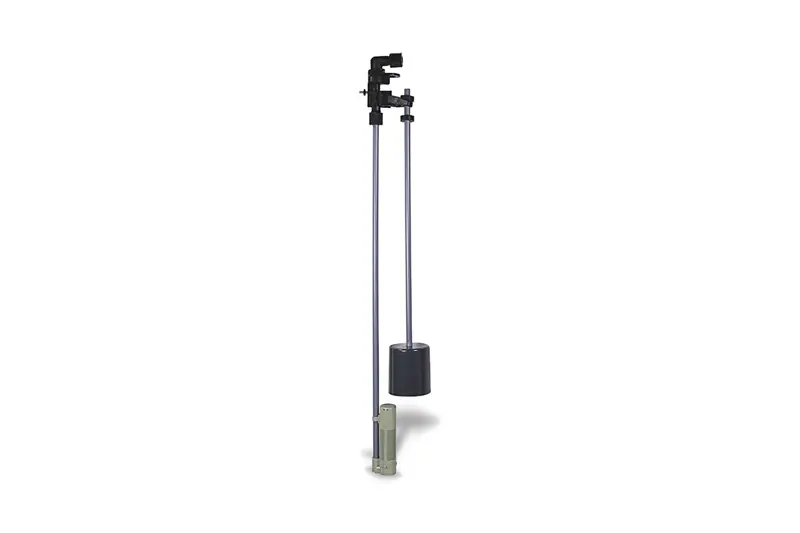
- Reassemble. Refit the grid and brine well, then reconnect the brine line and overflow tube. Check that the float in the brine well moves freely.
- Add water. QWT's steps call for at least 5 gallons of fresh water before the salt. Some valves refill the tank themselves on a timed fill; on a Fleck SXT the refill comes from the brine fill (BF) time. Your manual is the final word.
- Add salt. SoftPro suggests at least two 50-lb bags after a cleaning. Keep the salt above the water line and the tank roughly one-quarter to one-half full. The Fleck 5600SXT service manual says not to use granulated or rock salt, so buy pellets or solar crystals. Our salt level guide covers how much.
- Let brine form. The A. O. Smith manual says to wait two hours for saturated brine when the salt had been below the water before refilling.
- Plug in and return to service. Plug the valve back in, check the time of day, and turn the bypass back to service slowly. Put the lid back on; Pentair says to keep the brine tank covered.
- Watch the salt level. Over the next few weeks it should drop. If it never moves and hard water returns, see water softener not using salt.
If the tank is cracked or the float assembly is worn out, replacement is often simpler than repair. QWT sells a round 18x33 brine tank (BT1833R B2310) (sold by Quality Water Treatment, our store) from $149.00 (October 2026); the store lists it with a cover, a 4-inch brine well, a brine overflow, 3/8-inch by 4-foot tubing and a Fleck 2310 safety valve, with a 375 lb capacity. Check your softener's manual for the right size before buying.
Does cleaning the brine tank sanitize the resin?
No. Washing the tank removes sludge and bacteria from the salt side only; the resin sits in the other tank. If you are dealing with an odor or a bacteria problem, follow up with the sanitizing procedure, which carries a measured bleach dose through the resin during a regeneration.
Brine tank care is one line on the full water softener maintenance schedule. Nebraska Extension also recommends cleaning and inspecting the brine valve and float at least once a year, which fits neatly into the same job.
Related guides
 MaintainThe full softener maintenance schedule
 MaintainHow much salt to add after cleaning
 FixWhen the salt level never drops
 SettingsSoftener parts explained
How we put this page together
This guide is based on the cleaning steps published by Quality Water Treatment and SoftPro, the Pentair 5600SXT and Fleck 5600SXT manuals, the A. O. Smith AOW-S400/S500 manual, Nebraska and NDSU Extension publications, and the CDC's bleach guidance, all checked in October 2026. Where the sources give different cleaning intervals, the table shows each one. We left out forum tips, home remedies such as lemon juice, and any soak time or dose not printed by a store or maker; we did no lab testing.
Common questions
Can a brine tank be cleaned without draining it completely?
You can break a crust or scoop out some sludge with water in the tank, but a proper cleaning needs it empty. Sludge settles on the bottom under the water, and you cannot scrub or sanitize the walls until the brine is out.
Where should the old brine go when draining the tank?
QWT says to keep it away from plants and soil because of the salt. A floor drain or laundry sink is the usual choice; check local rules if you are on a septic system.
Does the brine well need to come out during cleaning?
If it comes out easily, yes. Dirt collects around the brine well and float. Note how it sat and how the brine line connected so you can put it back the same way.
Is it normal to find dirt in the bottom after a few years?
Some sediment is normal, and NDSU Extension links cleaning frequency to salt purity. A thick layer of dirt or mush is a reason to clean more often and to stay with pellets or solar crystals.
Can vinegar replace bleach in the brine tank?
QWT advises against putting vinegar in the brine tank and limits diluted vinegar to small parts cleaned separately. Use the bleach solution your manual names, and never combine the two.
How long does the bleach solution need to sit in the tank?
QWT and SoftPro both give 15 minutes for 1/4 cup of bleach in 2 to 3 gallons of water, followed by a second scrub and a full rinse.
Should a regeneration run right after cleaning the brine tank?
Give the new salt time to make brine first. A. O. Smith says to wait two hours when the salt had dropped below the water, and Pentair's bridge advice uses the same two-hour wait before a regeneration.
More help: see our water softener how-to guides.