
Maintain
How to Sanitize a Water Softener
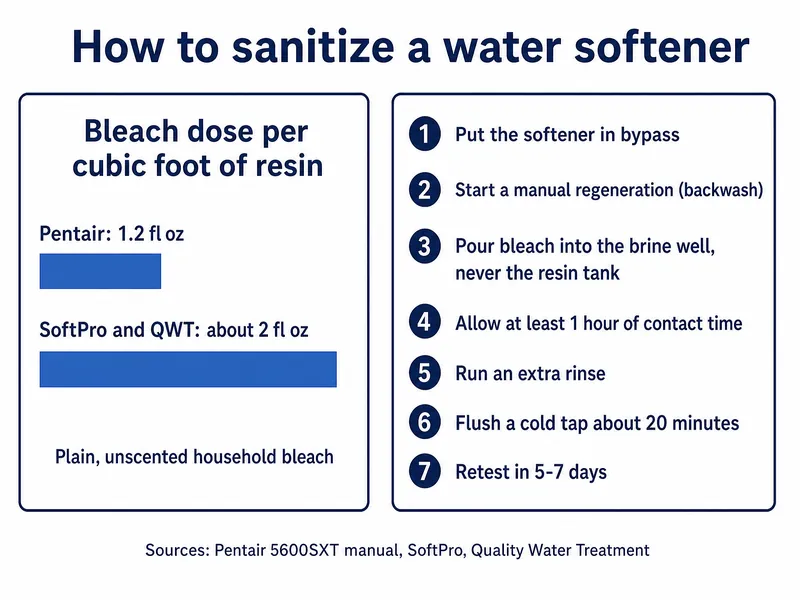
How do you sanitize a water softener? Pour about 1 to 2 fl oz of unscented bleach per cubic foot of resin into the brine well, run a regeneration with an hour of contact, then rinse and flush.
By the Water Softener Guide editors · Updated

On this page
Key takeaways
- Pentair's 5600SXT manual doses 1.2 fl oz of 5.25% bleach per cubic foot of polystyrene resin; SoftPro and QWT use about 2 fl oz.
- The bleach goes into the brine well with water in the tank, never into the resin tank, per SoftPro's procedure (SoftPro, our store).
- SoftPro and QWT both aim for at least 1 hour of bleach contact with the resin.
- After the cycle, SoftPro flushes a cold tap for about 20 minutes and retests in 5 to 7 days.
- Penn State Extension says bacteria and fungi can form mats in resin and that periodic chlorine bleach cleaning removes them.
- Routine intervals differ: QWT says every 6 to 12 months, SoftPro every 3 to 12 months.
Sanitizing numbers from the manuals
- 1.2 fl oz5.25% bleach per cubic foot of polystyrene resinPentair 5600SXT manual 4005293
- 2 fl ozApproximate bleach per cubic foot of resin in the store proceduresQuality Water Treatment (our store)
- 1 hourMinimum bleach contact time during the regenerationSoftPro (our store)
- 20 minCold-tap flush after sanitizing, until the chlorine smell is goneSoftPro (our store)
When should you sanitize a water softener?
Sanitize when the water or the softener develops an off taste or odor, after the unit has sat idle, and on a routine schedule. Pentair's manual explains that a softener can foul with organic matter, or sometimes bacteria, from the water supply, and that some units need disinfection after installation and periodically through their life.
Sanitizing is a different job from a resin cleaner, which removes iron and other fouling (see resin cleaner), and from washing out the brine tank, which removes sludge. Sanitize when:
- The softened water, or the brine tank, smells musty or of rotten eggs. Our softener smell guide helps you rule out other causes first.
- You have just cleaned the brine tank after mushing or a bad odor.
- The softener has sat unused, for example after a long absence. See vacation mode.
- New resin has gone in; SoftPro lists that as a trigger.
- It is time for routine care: Quality Water Treatment suggests every 6 to 12 months and SoftPro every 3 to 12 months.
On a septic system, keep to the dose your manual calls for; our septic guide has more on what reaches the tank.
How much bleach does a water softener need?
Plan on 1 to 2 fluid ounces of unscented household bleach for each cubic foot of resin, following your own manual (Pentair: 1.2 fl oz; SoftPro and QWT: about 2 fl oz). Pentair's figure assumes 5.25% sodium hypochlorite; the CDC notes most household bleach contains 5% to 9%, and Pentair says to adjust the dose for stronger solutions.
| Source | Product | Dose |
|---|---|---|
| Pentair 5600SXT manual | 5.25% bleach, polystyrene resin | 1.2 fl oz (35.5 ml) per cu ft |
| Pentair 5600SXT manual | 5.25% bleach, non-resinous exchangers | 0.8 fl oz (23.7 ml) per cu ft |
| Pentair 5600SXT manual | 70% calcium hypochlorite | About 0.1 oz per cu ft |
| SoftPro | Unscented household bleach | About 2 fl oz per cu ft, or 1 to 2 tbsp per gallon of brine water |
| Quality Water Treatment | Household bleach | About 2 fl oz per cu ft |
| A. O. Smith (AOW-S400 and AOW-S500) | 5.25% bleach | 4.0 fl oz per unit (its own models) |
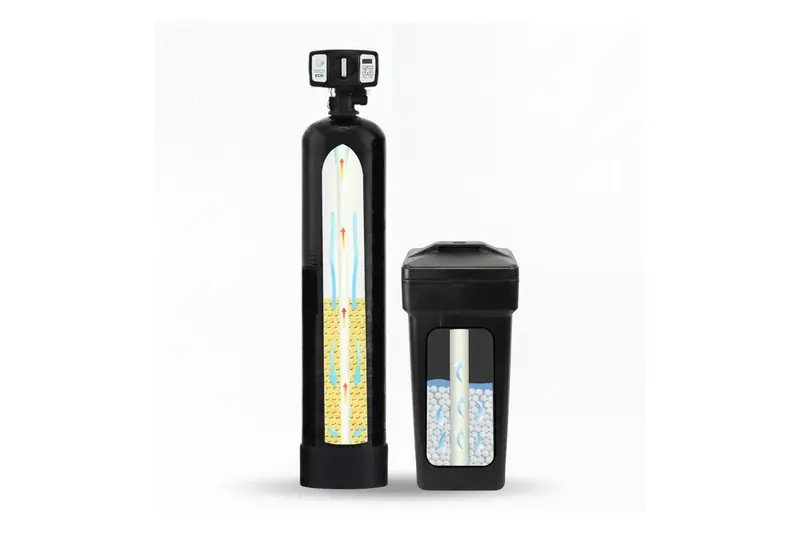
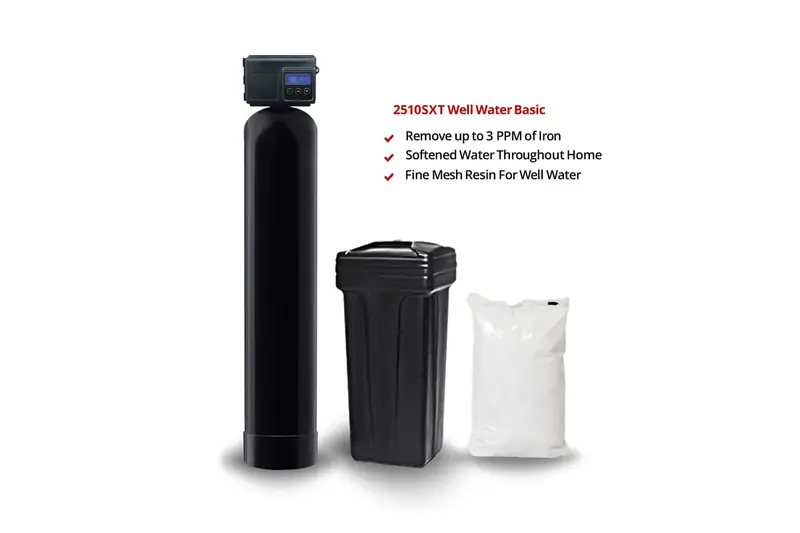
Find your resin volume. The figure is usually on the model label or in the manual. Pentair sells the 5600SXT with 1.0, 1.5 or 2.0 cu ft of resin.
| Resin volume | At Pentair's 1.2 fl oz | At the stores' 2 fl oz |
|---|---|---|
| 1.0 cu ft | 1.2 fl oz | 2 fl oz |
| 1.5 cu ft | 1.8 fl oz | 3 fl oz |
| 2.0 cu ft | 2.4 fl oz | 4 fl oz |
What do you need before you start?
Check that the brine tank has water in it, measure the dose, and gather protective gear. Pentair says the salt tank must hold water so the solution can be carried into the softener; A. O. Smith's manual says the same.
- Unscented household bleach and a measuring cup marked in fluid ounces
- Gloves and eye protection, and good ventilation, as the CDC advises for bleach indoors
- The valve manual, so you know how to start a manual regeneration
Safety. Bleach goes in alone: CDC guidance rules out combining it with other cleaners or disinfectants. A. O. Smith's manual flags a toxic reaction between bleach and commercial resin cleaner, so never add both in the same cycle. Keep vinegar out of the brine tank as well.
How to sanitize a water softener, step by step
The steps below combine Pentair's manual and SoftPro's bleach procedure. Where your manual differs, follow it.
- Check the clock and settings. On a Fleck or Pentair 5600SXT you start an immediate regeneration by holding Extra Cycle for 5 seconds (see the Fleck 5600SXT manual guide).
- Put the house on bypass. SoftPro bypasses the softener so bleach does not reach your taps during the cycle. Our bypass valve guide shows how.
- Start with a backwash. Pentair's procedure begins by backwashing the softener; on the 5600SXT, a manual regeneration starts with backwash as step 1.
- Add the bleach. Pour the measured dose into the brine well, the tube inside the brine tank, not onto the salt and never into the resin tank.
- Let the regeneration draw it in. The brine draw pulls the solution through the resin. Aim for at least one hour of contact. SoftPro puts a full manual regeneration at 60 to 90 minutes; Nebraska Extension gives 60 to 120 minutes.
- Run an extra rinse. SoftPro adds a second rinse, and QWT runs an additional regeneration to flush the bleach out. Run a second manual regeneration if your valve has no separate rinse.
If the regeneration controls are new to you, read our regeneration guide first.
How do you rinse and check the softener afterward?
Return the softener to service, flush the bleach out of the lines, and confirm the problem is gone.
- Return to service. Turn the bypass back to service slowly.
- Flush a cold tap. SoftPro runs a cold tap for about 20 minutes, or until there is no chlorine smell.
- Flush the other cold taps briefly so no bleach-tasting water sits in any branch line.
- Repeat if needed. SoftPro says to repeat the treatment the following day if odor or bacteria signs persist.
- Retest in 5 to 7 days. If the odor comes back, the cause may be the water supply rather than the softener.
- Confirm softening. Check that treated water still tests soft with a hardness test.
Does sanitizing a water softener disinfect your water supply?
No. Sanitizing treats the inside of the softener only. Nebraska Extension's NebGuide G1491 notes that water softening does not remove bacteria or hydrogen sulfide, so a well with bacteria needs its own treatment. Penn State Extension suggests disinfecting the water before it reaches the softener when bacteria keep returning, and says to read the maker's instructions before adding any chemical to the unit.
Keep sanitizing on your regular schedule from the maintenance checklist, and match the dose to your manual each time.
Related guides
 MaintainMonthly-to-yearly upkeep schedule
 MaintainScrubbing out a dirty brine tank
 FixTracking down softener odors
 FixDiagnosing other softener faults
How we put this page together
This guide draws on the disinfection section of Pentair's 5600SXT manual (4005293 Rev B), A. O. Smith's softener manual, the bleach procedures SoftPro and Quality Water Treatment publish, Penn State and Nebraska Extension, and CDC advice on household bleach, reviewed in October 2026. Doses differ between sources, so each is shown with its source. We left out hydrogen peroxide and other alternatives that no manual here doses, and we did no lab or microbiological testing.
Common questions
Can bleach damage softener resin?
Pentair's manual lists 5.25% household bleach as satisfactory for polystyrene resin at 1.2 fl oz per cubic foot, and the stores use about 2 fl oz. Those are small, measured doses for occasional use, so stay within your manual's figure rather than adding extra.
Is it safe to drink the water right after sanitizing?
Keep the softener in bypass until the regeneration and rinse are done, then flush a cold tap for about 20 minutes as SoftPro advises. Once there is no chlorine smell, normal use can resume.
Does sanitizing fix a rotten-egg smell from every tap?
Only if the smell comes from the softener. If taps that bypass the softener also smell, the cause is in the water supply or elsewhere in the plumbing, and sanitizing the softener will not cure it.
Can pool shock or calcium hypochlorite be used instead of liquid bleach?
Pentair's manual allows 70% calcium hypochlorite at about 0.1 oz per cubic foot, added to the brine well like bleach. For any other product, follow its label and your softener maker's guidance, and never mix products.
Should the resin tank be opened to pour bleach in?
No. SoftPro says the bleach goes into the brine tank, never the resin tank. The regeneration carries it through the resin for you.
What if the brine tank is dry when it is time to sanitize?
Add water first. Pentair and A. O. Smith both say the salt tank must have water in it so the solution can be drawn into the softener.
Does sanitizing replace cleaning the brine tank?
No. Sanitizing treats the resin; sludge and dirt in the salt tank still need the empty-and-scrub job, which Pentair schedules every three years.
More help: see our water softener guide.