
Fix
Water Softener and Low Water Pressure
Water softener low water pressure usually comes from a half-open bypass, a clogged pre-filter, fouled resin or an undersized valve; put the softener in bypass, and if pressure returns, the softener is the cause.
By the Water Softener Guide editors · Updated
On this page
Key takeaways
- SoftPro (SoftPro, our store) puts normal household pressure at 40 to 80 psi and says to investigate below 40.
- Pentair rates the 5600SXT at a 14 to 15 psi drop at its full rated flow of 10.0 to 12.0 gpm; at everyday flow the drop is smaller.
- The Pentair and Fleck troubleshooting tables blame lost pressure on iron buildup or plumbing debris plugging the valve inlet.
- Quality Water Treatment says a big pressure loss on day one can mean the tank was shipped on its side; a backwash reclassifies the media.
- Penn State Extension warns that red, oxidized iron clogs softener resin.
- The EPA puts a standard showerhead at 2.5 gpm, so a few fixtures at once can approach a small valve's rated flow.
How do you know the water softener is causing low pressure?
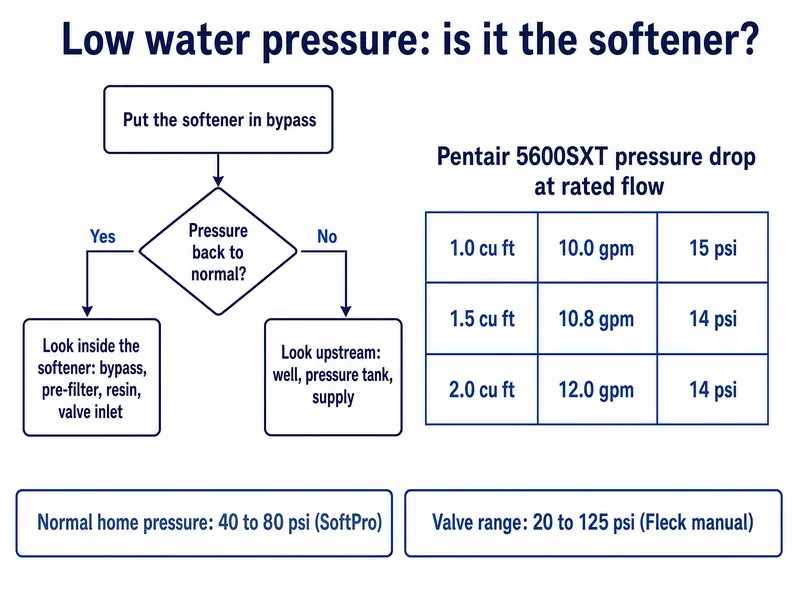
Put the softener in bypass and compare. SoftPro's test is to switch to bypass and open taps around the house; if pressure comes back, the restriction is in the softener or its pre-filter. If pressure stays low in bypass, look upstream: the well pump and pressure tank, the city supply, a failed pressure-reducing valve or a partly closed main valve.
A gauge on a hose bib or laundry tap turns that into numbers. Read it with the softener in service, then in bypass, with the same tap running. SoftPro gives 40 to 80 psi as normal and says readings under 40 psi deserve a closer look. The Fleck 5600SXT service manual adds the other limit: above 80 psi in the daytime, fit a pressure-reducing valve.
Also note when the problem started. Low pressure right after a new install, after plumbing work, after years on iron well water, or only at a few taps each points to a different fix below.
- Bypass the softener. Turn every bypass handle fully to bypass.
- Test several taps. Include a kitchen tap, a shower and an outside spigot.
- Note the result. Normal in bypass means the softener; still low means the supply.
- Return to service slowly. Open the bypass gradually, the way install guides direct at start-up.
How much pressure drop is normal through a softener?
Some drop is built in, because water has to pass through the valve and the resin bed. Pentair's performance data for its three 5600SXT systems lists the drop at each model's full rated service flow.
| Model | Resin | Rated service flow | Pressure drop |
|---|---|---|---|
| VT-11-01 | 1.0 cu ft | 10.0 gpm | 15 psi |
| VT-17-01 | 1.5 cu ft | 10.8 gpm | 14 psi |
| VT-23-01 | 2.0 cu ft | 12.0 gpm | 14 psi |
Those figures from the Pentair 5600SXT manual are the ceiling, measured at maximum flow; at the flow of one or two taps the drop is less. A large loss with a single tap running is the sign of a restriction worth chasing.
What the sources say
- 40–80 psinormal household water pressureSoftPro (our store)
- 14–15 psipressure drop across a 5600SXT at full rated flowPentair 4005293 manual
- 20–125 psiworking pressure range for the 5600SXTPentair 4005293 manual
- 2.5 gpmflow of a standard showerheadEPA WaterSense
- 1.5 gpmmaximum for a WaterSense bathroom faucetEPA WaterSense
Which bypass and valve problems cut pressure?
The simplest causes sit at the valve. SoftPro lists a partly closed bypass, and Quality Water Treatment's Fleck guide says the bypass knobs must be fully open in service or hard water can pass through. With a Fleck plastic bypass, service means both knobs line up with the pipes they control. The bypass valve guide shows each type.
- Check the bypass position. Make sure every handle is fully in the service position, not halfway.
- Check the pre-filter. If a sediment or carbon filter sits ahead of the softener, SoftPro and Quality Water Treatment both list a clogged one. Swap the cartridge and retest; Pentair places filters like these upstream of the softener.
- Look at the valve inlet after plumbing work. Pentair's troubleshooting table says debris broken loose by recent plumbing work can plug the control inlet; the fix is to remove the piston and clean the control. Bypass the softener, unplug it and relieve pressure first, or have a technician do it.
- Check line pressure. Pentair lists 20 to 125 psi as the working range, and when a softener fails to draw brine, its correction for low line pressure is to bring it up to 20 psi. Below that the valve can't regenerate properly.
If the valve itself looks suspect, the control valve guide covers its parts and service.
Can fouled resin or sediment lower water pressure?
Yes. Once the bypass test points at the softener and the bypass and pre-filter check out, look at what is inside the tank. Quality Water Treatment's troubleshooting page (Quality Water Treatment, our store) puts a clogged resin bed at the top of its list for low pressure.
Iron fouling. Pentair's table lists iron buildup in the line or the softener as a cause of lost pressure, and its fix is to clean the control, add a mineral cleaner to the bed and regenerate more often. Penn State notes that red, oxidized iron clogs resin, and NDSU Extension puts the softener limit at about 10 ppm of iron and manganese. The resin cleaner guide covers products and doses.
Biological fouling. Penn State also says bacteria and fungi can form mats in the resin. Sanitizing is covered in how to sanitize a water softener.
Escaped resin. SoftPro lists resin beads that have left the tank, because they collect in aerators and showerheads. If pressure is low only at certain fixtures, unscrew the aerators and look for small dark beads; our guide to resin beads in water explains what to do next.
A packed bed after shipping. Quality Water Treatment's Fleck guide says a severe pressure loss on first start-up can mean the tank was laid on its side in transit, and a backwash settles the media back into layers.
Salt bridges. SoftPro includes bridges and mushing in its list. Check the brine tank as described in the salt bridge guide.
| Symptom | Where to look first |
|---|---|
| Low everywhere, normal in bypass | Bypass position, pre-filter, valve inlet |
| Low at a few fixtures only | Aerators and showerheads for resin beads |
| Low right after a new install | Packed media; backwash to reclassify |
| Gradual loss on iron well water | Iron fouling; clean the resin |
| Low even in bypass | Well, pressure tank or supply, not the softener |
Is the softener too small for your flow?
Grain capacity is only half of sizing; the other half is flow rate. SoftPro lists an undersized softener or control valve as a cause of low pressure, and the symptom is pressure that holds at one tap and sags when several fixtures open at once.
Add up what runs together. The EPA says a standard showerhead uses 2.5 gpm and a WaterSense bathroom faucet no more than 1.5 gpm, so two standard showers and two faucets already ask for 8 gpm before the washer starts. Compare that with the valve's rated service flow; Pentair's figures show the drop climbing to 14 to 15 psi as flow nears the rating, so a larger home may need a larger valve or tank. Our installation guide covers the plumbing around the softener.
Wells add one more limit. Quality Water Treatment's guide says the well pump must at least match the model's backwash flow rate, which Pentair lists as 2.0 to 3.5 gpm across its three sizes. If the softener is simply too small, resizing is the real fix. For anything you can't trace, return to the troubleshooting guide.
Related guides
Common questions
How much pressure loss through a softener is acceptable?
Some loss is normal. Pentair lists about 14 to 15 psi across the 5600SXT at its maximum rated flow, with less at everyday flow. A large drop at a single running tap points to a restriction worth investigating.
Why did pressure drop the day after a new softener went in?
Quality Water Treatment's Fleck guide says media can pack unevenly if the tank was laid on its side in shipping. A backwash reclassifies the bed. Also confirm the bypass is fully in service.
Can a softener lower hot water pressure but not cold?
The softener feeds both, so it usually affects both. Low pressure on hot only points to the water heater or its valves, which a plumber can check.
Does regenerating more often help pressure on iron water?
Pentair's troubleshooting table lists more frequent regeneration, together with cleaning the control and adding a mineral cleaner, as the fix for iron buildup. Shortening the interval alone won't clear a bed that is already fouled.
Will a sediment pre-filter lower pressure on its own?
A clean one adds little, but a clogged cartridge is one of the first causes SoftPro lists. Swap it and rerun the bypass test; if pressure recovers, shorten the change interval.
Is water pressure under 40 psi the softener's fault?
Not necessarily. SoftPro treats under 40 psi as worth investigating, but if the reading stays low with the softener in bypass, the cause is the well, pressure tank or supply line.
Can a pressure-reducing valve make a softener seem restrictive?
Yes, if it is set low or failing, because the whole house sees the lower pressure. The bypass test shows it: pressure stays low in bypass when the problem is upstream of the softener.
How we put this page together
This page is based on SoftPro's low-pressure guide, the Quality Water Treatment troubleshooting article and that store's Fleck 5600SXT install guide, Pentair's 5600SXT performance data and troubleshooting table (manual 4005293 Rev B), the Fleck 5600SXT downflow manual, Penn State and NDSU Extension's softening publications and the EPA WaterSense fixture pages, reviewed in October 2026. We left out a lower normal-drop figure from one store page that conflicts with Pentair's rated data, pipe-sizing rules of thumb we could not trace to a primary source, and any testing of our own.
More help: see our water softener guide.