
Maintain
Water Softener Salt: Pellets vs Crystals
Water softener salt pellets vs crystals: both are clean evaporated salts most manuals accept, so use the type your manual names, avoid rock salt, and stick to one type.
By the Water Softener Guide editors · Updated
On this page
Key takeaways
- Pentair's 5600SXT manual names sodium chloride pellet salt in its text, and its data sheet accepts "pellet or solar salt".
- The A. O. Smith softener manual recommends clean white pellet, cube-style or solar salt and says not to mix pellet with solar salt.
- The Fleck 5600SXT service manual rules out granulated and rock salt.
- Nebraska Extension allows rock salt only if the maker suggests it and impurities average under 1%.
- Quality Water Treatment points owners to pellets of 99.5 to 99.8% purity.
- NDSU Extension prices sodium chloride at about $5 to $10 per 40-lb bag, depending on form, and potassium chloride at up to $25.
Salt type numbers from primary sources
- 99.5-99.8%Pellet purity Quality Water Treatment recommendsQuality Water Treatment (our store)
- <1%Average impurities rock salt should have, and only if the maker suggests itNebraska Extension G1491
- $5-$10Price of a 40-lb bag of sodium chloride, depending on formNDSU Extension
- 13-15%Higher potassium chloride concentration needed for regenerationWater Quality Association
What are the types of water softener salt?
Softener salt comes as evaporated pellets, solar crystals, rock salt and blocks, plus potassium chloride as a sodium-free substitute. Nebraska Extension's NebGuide G1491 says softeners are designed for specific types of salt, so the maker's recommendation comes first.
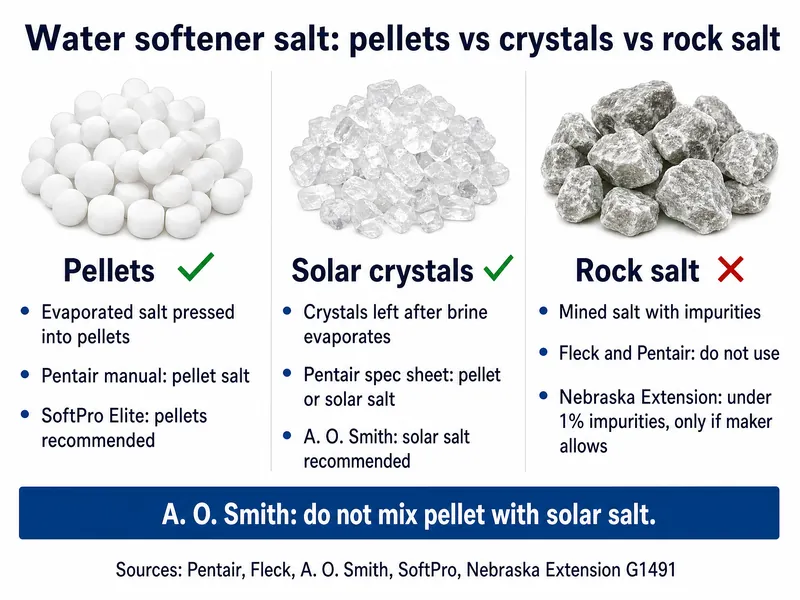
- Pellets. Evaporated salt compressed into pellets, nuggets or beads. Nebraska says the majority of softeners are designed for this type, and that iron-control versions may carry food-grade additives such as citric acid.
- Solar crystals. Salt crystals left after brine evaporates. Pentair's data sheet and the A. O. Smith manual both list solar salt as acceptable.
- Rock salt. Mined salt that, per Nebraska, may carry high levels of soluble or insoluble impurities.
- Blocks. Nebraska says to use blocks only in units designed for them, and only high-grade evaporated salt without additives; livestock blocks may contain incompatible additives.
- Potassium chloride. Regenerates the resin the same way for households avoiding added sodium; NDSU says about 10% more is used per backflush.
What do the manuals say about pellets vs crystals?
Most manuals accept both pellets and solar crystals; a few name pellets first. Check yours before buying, because the wording differs even within one document.
| Source | Pellets | Solar crystals | Rock salt |
|---|---|---|---|
| Pentair 5600SXT manual | Named in the text ("pellet salt") | Accepted on the data sheet | Do not use |
| Fleck 5600SXT service manual | Not named | Not named | Do not use (nor granulated) |
| A. O. Smith AOW-S400/S500 manual | Recommended | Recommended | Do not use |
| SoftPro Elite install guide | Recommended | Extra coarse salt acceptable | Not named |
| Quality Water Treatment | 99.5-99.8% purity pellets | Evaporated or crystal salt | Use pellets instead |
The pattern is clear: neither form is singled out as a problem, but rock salt is excluded by every manual that mentions it. A. O. Smith adds one rule the others do not state: do not mix pellet with solar salt in the same cabinet.
Is rock salt OK for a water softener?
No, not unless your softener's maker specifically allows it. The Fleck service manual says not to use granulated or rock salt, and Pentair says rock or snow-melting salt contains dirt and chemicals that will affect the softener.
Nebraska Extension explains the risk: if the impurities are calcium or magnesium salts, they may significantly reduce how well regeneration works and can plug valves. Even then, it says rock salt is only an option when the manufacturer suggests it, and only grades averaging less than 1% impurities. Insoluble material settles on the bottom of the brine tank, where it adds to the sludge you eventually clean out, and it can foul the brine valve or injector.
How does salt purity affect the brine tank?
Purity sets how much residue builds up and how often you clean the tank; it does not make the water any softer. NDSU Extension says brine tank cleaning frequency depends on the amount and purity of the salt you use.
QWT recommends pellets of 99.5 to 99.8% purity because they leave less residue. When you compare bags, look for the purity figure on the label. Cheap salt with more insolubles costs more in cleaning time later, and the salt's job is only to make brine, so a cleaner bag does the same work with less mess.
Do pellets or crystals bridge and mush more?
The manuals do not rank pellets against crystals for bridging or mushing; how you manage the tank matters more than the form.
- Bridging. Salt cements into a crust above the water, leaving a gap underneath. Pentair links it to overfilling past the halfway mark; A. O. Smith blames damp air or an unsuitable salt. The WQA adds that potassium chloride bridges more readily than sodium chloride. See how to fix a salt bridge.
- Mushing. Salt turns into sludge on the bottom of the tank. SoftPro (SoftPro, our store) says the fix is cleaning out the entire tank.
What the sources agree on is the routine: salt higher than the water, the tank between a quarter and half full, a look every month and any crust broken up. The salt level guide covers the numbers.
Which water softener salt should you buy?
Buy the form your manual names, in the highest purity you can find, and keep to it.
- Start with your manual. If it names a salt type, use that. Pentair's 5600SXT text names pellet salt; A. O. Smith lists pellets, cubes or solar salt; SoftPro's Elite guide recommends pellets.
- Skip rock salt. Every manual in the table above that mentions it says no.
- Prefer high purity. QWT's 99.5 to 99.8% figure is a useful benchmark for pellets.
- Think about sodium. NDSU Extension says about 8 mg/L of sodium is added for every grain of hardness removed, so 10 gpg works out to about 80 mg/L. If anyone in the home is on a sodium-restricted diet, potassium chloride, a bypassed cold tap or a reverse osmosis tap at the kitchen sink are options; check with a doctor. A. O. Smith says not to use potassium chloride if the water has iron or manganese.
- Compare cost per bag. NDSU gives roughly $5 to $10 for a 40-lb bag of sodium chloride, depending on the form, and up to $25 for potassium chloride.
Once you have chosen a type, stick with it so you can judge normal salt use from month to month. Salt checks sit alongside the other jobs in the water softener maintenance checklist.
Related guides
 MaintainMaintenance schedule by month and year
 MaintainBreaking up a crusted salt bridge
 FixSalt use running high
 SettingsSalt and hardness settings
How we put this page together
This comparison draws on what the Pentair, Fleck and A. O. Smith softener manuals say about salt, SoftPro's Elite install guide, Quality Water Treatment's maintenance pages, the WQA's softener booklet, and Nebraska and NDSU Extension publications, checked in October 2026. We did not compare salt brands, quote retail prices beyond NDSU's ranges, or test dissolving rates ourselves.
Common questions
Can pellets and crystals be mixed in the same brine tank?
A. O. Smith's manual says not to mix pellet with solar salt, and not to mix different types of salt in general. If you want to switch, let the tank run low before adding the new type.
Is block salt a good choice for a home softener?
Only if your softener is designed for it. Nebraska Extension says blocks should be high-grade evaporated salt without additives, and warns that livestock blocks may contain additives that do not suit a softener.
Does switching to potassium chloride require new settings?
It can. NDSU Extension says roughly 10% more goes into each regeneration, and A. O. Smith multiplies compensated hardness by 1.12 for it. Your manual or the valve's settings guide shows where to change it.
Will higher-purity salt make the water softer?
No. Softness depends on the resin and the regeneration. Purity affects how much residue builds up in the brine tank and how often it needs cleaning.
Is rust-control salt safe to use in any softener?
Nebraska Extension notes that iron-management salts may contain food-grade additives such as citric acid. Use them only if your softener's manual allows them.
Can table salt or granulated salt go in a softener?
The Fleck 5600SXT manual says not to use granulated salt. Stick to salt sold for water softening, as Pentair's manual requires.
More help: see our water softener guides.