
Install
Water Softener Loop Explained
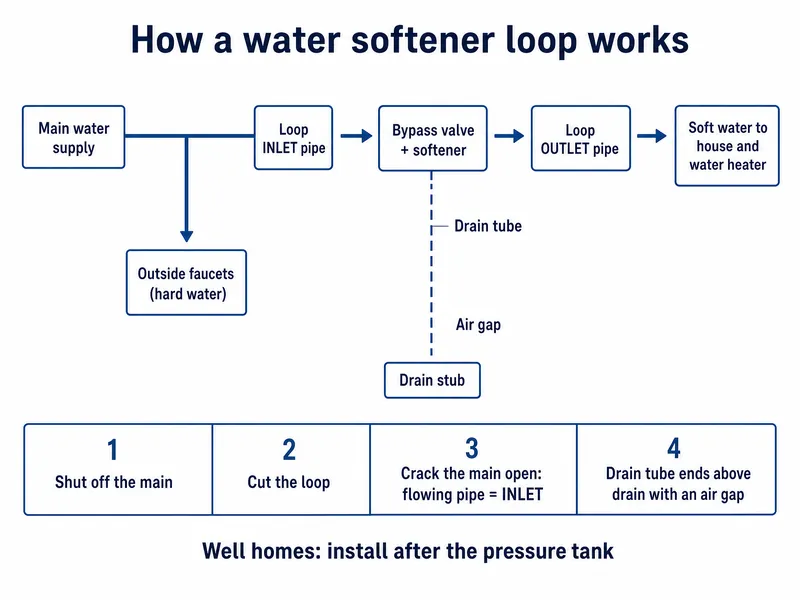
A water softener loop is a pre-plumbed pair of pipes, usually with a drain stub beside them, that lets a softener connect without cutting into the main line elsewhere.
By the Water Softener Guide editors · Updated
On this page
Key takeaways
- SoftPro's Elite install guide describes a typical loop as 2 pipes out of the wall plus a third pipe for the softener drain.
- To tell the pipes apart, SoftPro and Quality Water Treatment both say to crack the main open slightly after cutting the loop: the pipe that flows is the INLET.
- With no loop, QWT says to install one from the main supply line before it enters the home, or have a professional do it.
- On a well, SoftPro's guide places the softener downstream of the pressure tank and of any irrigation tee.
- Pentair's 5600SXT manual wants at least 10 feet of pipe between the softener and the water heater.
- Penn State Extension lists toilets, outside spigots and basement sinks as lines that can skip softening.
Loop numbers from the install documents
- 3 pipesin a typical pre-plumbed loop: inlet, outlet and drainSoftPro Elite Install Guide v2023-6
- 10 ftminimum pipe run from softener to water heaterPentair 5600SXT manual 4005293
- #6minimum copper conductor for a ground clamp across plastic fittingsQWT Fleck 5600SXT Install Guide
- 3-4 hourstypical install time: 3 for a plumber or handyman, 4 for DIYQWT Fleck 5600SXT Install Guide
What is a water softener loop?
A water softener loop is a section of the main water line that the plumber routes out of the wall and back in, so a softener can be cut into it later. SoftPro's Elite guide describes the usual layout as two pipes coming out of the wall, plus a third pipe for the softener's drain, which may be capped or already tied to the loop.
Until a softener goes in, the two ends are usually joined so water flows straight through. Installing a softener means cutting that joint: one end becomes the inlet, carrying water to the softener, and the other the outlet, carrying softened water back to the house.
Builders add a loop for two reasons. It puts the connection somewhere practical, such as a garage or utility room, and it sets which lines get softened. Branches that leave the main before the loop stay on hard water. Pentair's plumbing drawing shows outside faucets fed hard water, and Virginia Cooperative Extension says water for outdoor use does not need softening.
How do you find a water softener loop in your house?
Look on a garage wall, in a utility or laundry room, or in the basement near where the main enters. Signs you have one:
- Two capped or joined pipes coming out of the wall side by side, often with a short connecting piece between them.
- A drain stub nearby, the third pipe in SoftPro's description.
- An outlet within reach, since the control valve needs power.
- Builder labels such as "softener", "in" or "out" on the wall or pipes.
Not every pair of pipes is a loop. Before cutting, shut off the main and confirm the pipes are on the main supply, not a branch to a single fixture. A plumber can confirm it quickly if you are unsure.
Which loop pipe is the inlet?
The inlet is the supply side, and you find it with water, not by guessing. QWT's and SoftPro's guides use the same test: after the loop is cut and a bucket is in place, open the main very slightly. The pipe with water flowing out is the supply; label it INLET and the other OUTLET, then close the main again.
QWT also suggests an optional "T" fitting and hose bib on the soft-water line near the softener, which makes later hardness tests easy. Our guide to testing water hardness explains how to compare raw and treated samples.
How do you connect a softener to a water softener loop?
With a loop in place the job is mostly connection work, which both guides put at about 3 hours for a plumber or handyman and 4 for a DIY install. The full sequence is in our installation guide; here is how SoftPro's pre-plumbed loop route runs.
- Turn off power to the water heater. SoftPro switches off the heater's breaker before draining the lines.
- Shut off the main and drain the pipes. Open sink and tub faucets; SoftPro notes that removing a shower head helps the lines drain.
- Fit grounding straps before cutting copper. If plastic fittings will interrupt a metal pipe run, QWT wants bonding kept with a listed clamp and #6 or heavier copper conductor.
- Cut the loop and open the drain stub. Keep a bucket under the cut and uncap the drainpipe if needed.
- Identify inlet and outlet. Use the cracked-main test above, then shut the main.
- Fit the bypass and connectors. SoftPro offers quick-connect hoses; QWT's guide pairs push-fit fittings with copper, PEX or CPVC and solvent cement with PVC. Pentair says not to use pipe smaller than the main. See the bypass valve guide.
- Connect the drain. Run 1/2-inch tubing to the stub or another approved drain, ending above it with an air gap. Lift and length limits are on the drain line page.
- Turn the water back on slowly. Pentair says to rotate the bypass handles 2 to 3 times first to seat the O-rings. Then follow your system's start-up steps and set hardness with our settings guide.
What if your home has no softener loop?
No loop is common in older homes and does not stop an install. QWT's guide says to install a loop from the main supply line before it enters the home, or have a professional install one. SoftPro's guide lists two other routes: cutting into a water heater loop, or re-routing the home's main supply line to and from the softener.
| Route | Where you cut | Note |
|---|---|---|
| Pre-plumbed softener loop | Builder's loop and drain stub | Least pipework |
| Water heater loop | Untreated cold supply feeding the heater and home | SoftPro checks the untreated return was plumbed |
| Re-routing the main supply | The main where it enters the home | New pipe to and from the softener |
| Private well | Downstream of the pressure tank and irrigation tee | Softener will not work properly before the tank |
Choose the spot before cutting. QWT puts the softener before the water heater, since temperatures above 120°F damage softeners (Fleck's 5600SXT service manual sets a stricter 110°F maximum), and Pentair sets a 10-foot minimum pipe run between the two to keep heated water from flowing back into the softener. The placement guide covers the order of filters and tanks, and installation cost shows what extra pipework adds to a plumber's bill.
Which lines should stay on hard water?
Anything that leaves the main before the new connection stays hard, and that is often what you want. QWT and SoftPro both suggest leaving high-demand lines unsoftened: lawn sprinklers, out-buildings and the supply to a geothermal heat pump. Penn State Extension adds that showers, sinks and laundry hookups probably should be softened, while toilets, outside spigots and basement sinks can be bypassed. Nebraska Extension's G1491 adds a cold line to the kitchen tap that bypasses the softener for drinking and cooking, and advises against repeatedly watering plants, lawns or gardens with softened water because of its sodium.
Fewer softened gallons also means fewer regenerations, which matters on a septic system.
How we put this page together
This page is based on SoftPro's Elite install guide (v2023-6), Quality Water Treatment's Fleck 5600SXT install guide (v2021a), Pentair's 5600SXT Softener System manual (4005293), Penn State Extension's water softening publication and Virginia Cooperative Extension publication 442-664, all checked in October 2026. We left out cost figures for adding a loop (no primary source gives one) and any rules from forums or dealer blogs.
Common questions
What does the third pipe next to a softener loop do?
In SoftPro's description it is the drain for the softener, either capped separately or tied into the loop. Run the drain tubing to it with an air gap, never pushed inside the pipe.
Does a softener loop include the outside faucets?
Often not. Builders tend to branch outdoor lines off before the loop, and Pentair's drawing shows outside faucets on hard water. Test an outside tap for hardness after install to be sure.
Can a loop be added to an existing house?
Yes. QWT says to install one from the main supply line before it enters the home or have a professional do it. SoftPro also describes cutting into a water heater loop or re-routing the main.
Why turn off the water heater before cutting a loop?
SoftPro's guide has you switch off the heater's breaker before the main is shut and the lines drained. Restore power only after the water is back on and the lines are full.
What distance should separate the loop and the water heater?
Pentair asks for a minimum 10-foot pipe run between the softener and the water heater, to stop heated water from reaching the resin tank.
Does a loop on a well home go before the pressure tank?
No. SoftPro's guide says the softener must go after the pressure tank and will not work properly before it. Confirm your loop is on the house side of the tank.
Is a ground strap needed when connecting to a copper loop?
If plastic fittings or a plastic bypass break a metal pipe run that grounds the electrical system, yes. QWT specifies a listed clamp carrying #6 or heavier copper; your local electrical code has the final say.
Related guides
More help: see our guide to water softener care.