
Fix
Fixing a Water Softener Smell
A water softener smell usually starts in the brine tank, where sulfur-reducing bacteria grow in stagnant brine, or in well water carrying hydrogen sulfide; compare taps to find which, then clean, sanitize or filter.
By the Water Softener Guide editors · Updated
On this page
Key takeaways
- SoftPro (SoftPro, our store) traces a rotten-egg brine tank to sulfur-reducing bacteria in stagnant water.
- Pentair's 5600SXT manual says a softener can foul with organic matter or bacteria from the supply, giving off-taste or odor, and calls for disinfection.
- Most people smell hydrogen sulfide well below 0.5 mg/L, according to Penn State Extension.
- The Minnesota Department of Health says to compare hot and cold faucets after a few hours away to find the source.
- Sanitize with about 1 to 2 fl oz of plain, unscented bleach for each cubic foot of resin, following your manual (Pentair 1.2 fl oz; SoftPro and QWT about 2).
- Carbon filters handle hydrogen sulfide under 1 mg/L; stronger odors need oxidizing or chlorination systems ahead of the softener.
What causes a water softener smell?
Odor around a softener has two main sources: the softener itself and the water coming into the house. Inside the softener, Pentair's 5600SXT manual says the materials don't support bacterial growth, but organic matter and bacteria arriving with the supply can foul the unit and leave the water tasting or smelling off.
The brine tank is the usual home for that smell. SoftPro says sulfur-reducing bacteria thrive in stagnant brine, and organic buildup, low-purity salt and sulfur in the supply make it worse.
The other source is hydrogen sulfide in well water, which smells like rotten eggs whether or not a softener is installed. Penn State Extension says most people notice it well below 0.5 mg/L, and that sulfur-reducing bacteria in low-oxygen wells and plumbing produce it.
What the sources say
- 0.5 mg/Llevel below which most people can already smell hydrogen sulfidePenn State Extension
- 1.0 mg/Lhydrogen sulfide level below which carbon filtration worksPenn State Extension
- 1.2 fl oz5.25% bleach per cubic foot of resin to disinfectPentair 4005293 manual
- 6–12 monthsSoftPro's deep-clean interval for an odor-prone brine tankSoftPro (our store)
- 20 mincold-tap flush after sanitizing, until the chlorine odor is goneSoftPro (our store)
How do you find where the smell comes from?
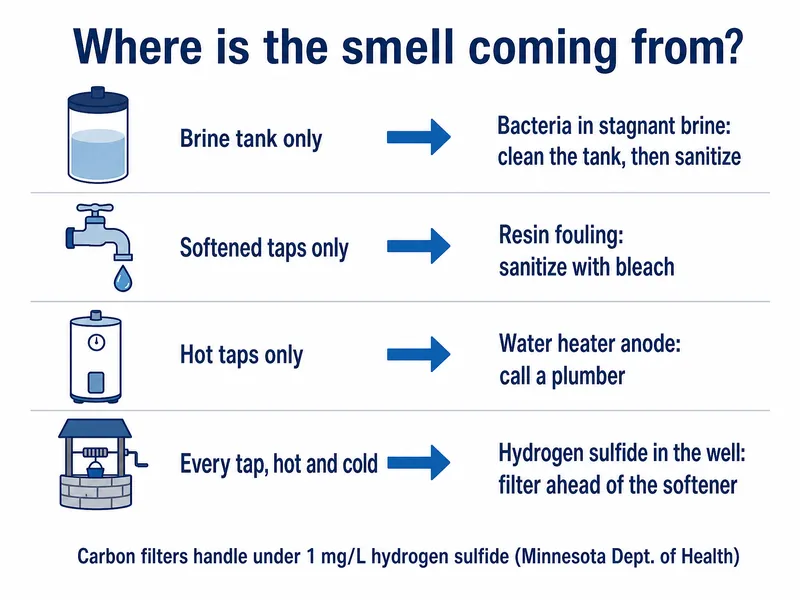
Compare taps before you clean anything. The Minnesota Department of Health suggests waiting until you've been away from home a few hours, then smelling the hot and cold faucets to see which ones carry the odor.
- Smell the brine tank. Lift the lid. A sour, swampy or rotten-egg smell from the salt and water inside points to the brine tank.
- Compare softened and unsoftened taps. Pentair's plumbing diagram leaves outside faucets on hard water, so an outside spigot is often unsoftened. If it smells as bad as a softened cold tap, the source water carries the odor. If only softened taps smell, the softener is adding it.
- Compare hot and cold. Odor only on the hot side points toward the water heater.
- Put the softener in bypass for a day. If the smell at softened taps fades, the softener is the source.
Why does the brine tank smell like rotten eggs?
Bacteria. SoftPro's brine tank odor guide says the rotten-egg smell comes from sulfur-reducing bacteria growing in stagnant water, and long-standing brine, a tank not emptied in years and mushy salt sludge give them a place to settle.
Several habits keep the tank fresh:
- Keep it covered. A lid that stays on is one of Pentair's basic brine tank rules.
- Use clean salt. SoftPro recommends high-purity evaporated salt for an odor-prone tank, and Pentair says to use sodium chloride pellets, not rock or snow-melt salt, which carry dirt. The pellets vs crystals guide compares the clean options.
- Clean on a schedule. Inspect the tank yearly and clean it when sludge or dirt builds up. SoftPro suggests every 6 to 12 months where smells recur; Pentair suggests about every three years for a tank in good condition.
- Watch for mushing. A soft, muddy salt layer under the brine means the tank needs emptying and scrubbing; see the brine tank cleaning guide.
Is rotten egg water a softener problem?
Usually not, if every tap smells. Rotten-egg well water means hydrogen sulfide, and a salt-based softener isn't built to remove it; NDSU Extension notes that hydrogen sulfide can even hinder a softener's performance. Pentair places taste and odor filters, iron filters and sediment filters upstream, so the softener comes after them.
The right filter depends on the level, so test the water first. Penn State's hydrogen sulfide guide gives these working ranges.
| Treatment | Typical use |
|---|---|
| Activated carbon filter | Below about 1.0 mg/L |
| Aeration | Normally not above about 2 mg/L |
| Oxidizing filter | Up to 2–3 mg/L |
| Chlorination | Mainly above 6.0 mg/L, at least 20 minutes contact |
| Shock chlorination of the well | Kills bacteria, but odor usually returns quickly |
A softener can still pick up a smell from sulfur water, because the same bacteria and organics foul the resin and brine tank. Sanitizing helps, but the smell returns until the source is treated. The Minnesota Department of Health also advises testing well water for coliform bacteria and nitrate, since in rare cases the gas comes from sewage or other pollution.
What if only the hot water smells?
Then the water heater, not the softener, is the likely source. Penn State says a heater's magnesium anode rod can chemically turn sulfates into hydrogen sulfide, and an aluminum rod should stop the odor while still protecting the tank. Removing the rod entirely can shorten the heater's life and will likely void its warranty.
The Minnesota Department of Health recommends having a plumber or water system professional do this work unless you know water heaters well, since it means shutting off the water and releasing tank pressure.
| What you notice | Likely source | First fix |
|---|---|---|
| Rotten egg smell at the brine tank only | Sulfur-reducing bacteria in stagnant brine | Clean the tank, then sanitize |
| Musty smell at softened taps only | Organic or bacterial fouling of the resin | Sanitize the softener |
| Rotten egg smell on hot taps only | Magnesium anode in the water heater | Plumber replaces the anode |
| Rotten egg smell at every tap | Hydrogen sulfide in the well | Filter ahead of the softener |
| Chlorine smell after a cleaning | Bleach still in the lines | Flush cold taps until it clears |
How do you clear a water softener smell?
Work from the brine tank to the resin, then flush the house lines. Before starting, switch to bypass and pull the valve's plug.
- Empty and clean the brine tank. Quality Water Treatment's cleaning guide (Quality Water Treatment, our store) covers it: disconnect the lines, drain the brine away from plants, remove the old salt, scrub with warm soapy water and a non-abrasive brush, then let a quarter cup of bleach in 2 to 3 gallons of water stand for 15 minutes, scrub again and rinse fully.
- Refill the tank. Reassemble it, add fresh water (Quality Water Treatment says at least 5 gallons after cleaning) and clean salt.
- Sanitize the resin. Pour plain, unscented household bleach into the brine well, never the resin tank: about 1 to 2 fl oz for each cubic foot of resin, following your manual (Pentair lists 1.2 fl oz, while SoftPro and Quality Water Treatment use about 2 fl oz). Then run a manual regeneration; SoftPro's sanitizing procedure (SoftPro, our store) allows at least an hour of contact time and adds an extra rinse. The full method is in how to sanitize a water softener.
- Flush the plumbing. SoftPro says to run a downstream cold tap about 20 minutes, until the chlorine smell is gone.
- Retest. SoftPro suggests checking again 5 to 7 days later and repeating the treatment if the odor persists.
Skip the vinegar. Quality Water Treatment warns against adding it to the brine tank and keeps a weak vinegar soak for small parts taken off the valve.
If the smell comes back within weeks, look again at the source water, and work through the troubleshooting guide and the maintenance checklist for anything left open.
Related guides

Common questions
Why does the softener room smell like rotten eggs after the unit sat unused?
Water left standing in the brine tank is where SoftPro says sulfur-reducing bacteria grow. A long stretch without regeneration, such as a vacation in bypass, gives them time. Clean the tank and sanitize before putting the softener back in normal use.
Does a smell mean the resin is ruined?
Not by itself. Pentair's manual treats odor from organic or bacterial fouling as something to disinfect away. If smell and hardness both return quickly after sanitizing, the resin may be badly fouled and worth replacing.
Is a bleach smell normal after sanitizing a softener?
Yes, for a short time. SoftPro says to run a cold tap about 20 minutes, until the chlorine smell clears, before using the water normally.
Can potassium chloride stop a brine tank from smelling?
Switching salt type won't remove bacteria already in the tank. The fix is cleaning and sanitizing, then keeping the tank covered and stocked with clean pellets or crystals.
Is rotten egg water safe to drink?
Penn State says the sulfur-reducing bacteria behind the odor don't cause human health concerns, and the Minnesota Department of Health says the smell usually isn't tied to sanitary quality. Because sewage is a rare cause, MDH suggests a coliform and nitrate test on well water.
Will shock chlorinating the well stop the smell for good?
Often not. Penn State says shock chlorination kills the bacteria but the odor usually returns quickly, so a continuous treatment matched to the hydrogen sulfide level is the longer-term fix.
Who gives disinfection steps for bacteria inside a softener?
The Minnesota Department of Health says to contact the installer or the manufacturer for disinfection instructions when bacteria are in the softener, since doses and steps vary by model.
How we put this page together
This page is based on SoftPro's brine tank odor and bleach sanitization guides, Quality Water Treatment's cleaning guide, the Pentair 5600SXT manual's disinfection and salt sections (4005293 Rev B), Penn State Extension's hydrogen sulfide and water softening pages, NDSU Extension and the Minnesota Department of Health's hydrogen sulfide and sulfur bacteria handout, checked in October 2026. We left out home remedies the manuals don't support (vinegar, peroxide or lemon in the brine tank), water heater temperature treatments, forum anecdotes and any testing of our own.
More help: see our water softener how-to guides.