
Maintain
How to Fix a Water Softener Salt Bridge
A water softener salt bridge is a hard salt crust above the brine water that stops salt dissolving; break it with a broom handle, wait 2 hours, then run a regeneration.
By the Water Softener Guide editors · Updated
Disclosure: watersoftenerguide.net is owned by the team behind SoftPro Water Systems and Quality Water Treatment, which sell some of the parts and systems we link to. Our steps follow the makers' manuals and published instructions, checked October 2026. Always check your own model's manual first. Ownership disclosure
View at Quality Water Treatment
On this page
Key takeaways
- Pentair's 5600SXT manual says pellets may bridge when the salt tank is filled above half-full.
- Pentair's fix: break the crust with a broom handle, wait 2 hours, regenerate; a second recharge may be needed.
- The A. O. Smith softener manual blames high humidity or the wrong kind of salt.
- The Water Quality Association says potassium chloride forms bridges more readily than sodium chloride.
- SoftPro says to suspect a bridge when the salt level has not changed for weeks.
- Quality Water Treatment (Quality Water Treatment, our store) keeps the tank at least one-third full with evaporated or crystal salt to prevent bridging.
Salt bridge numbers from the manuals
- 2 hoursWait after breaking a bridge before starting a regenerationPentair 5600SXT manual 4005293
- 1/2 fullSalt level above which Pentair says pellets may bridgePentair 5600SXT manual 4005293
- 1/3 fullMinimum salt level QWT gives to stop bridging before it startsQuality Water Treatment (our store)
What is a water softener salt bridge?
A salt bridge is a crust of salt that spans the brine tank above the water, leaving an empty gap underneath. Pentair's manual describes pellets that wedge against each other and do not fall into the water at the bottom, so eventually no salt reaches the water to make brine.
The softener keeps regenerating on schedule, but it draws weak brine or plain water. Pentair says the unit will recharge but not recondition the media, and untreated water passes through. From the top a bridged tank looks normal, even full, which is why bridges often go unnoticed until spots and scale come back. The hard water checklist lists a bridge among the first things to rule out.
What causes a salt bridge in a softener?
Overfilling, humidity and the type of salt are the causes the sources name.
- A tank filled too high. Pentair says the salt tank works best below half-full and that pellets may bridge above that.
- Humidity or the wrong salt. A. O. Smith's troubleshooting table lists both.
- Potassium chloride. The WQA notes that it forms bridges more readily than sodium chloride, so watch the tank more closely if you have switched for sodium reasons.
- Rock salt. Neither the Fleck nor the Pentair manual allows it, and Nebraska Extension says it may carry high levels of impurities.
How do you check for a salt bridge?
Push a broom handle straight down through the salt and feel for a hard layer with open space beneath it. Signs that point to a bridge:
- The salt level has not changed for weeks. SoftPro's troubleshooting guide (SoftPro, our store) uses this as the first clue; a working softener uses salt as it regenerates.
- Hard water is back even though the tank looks full.
- The surface feels solid when pressed with a hand.
Take the lid off and probe in a few places. If the handle stops on a hard layer and then breaks through into an open space or water, you have found a bridge. If it slides to the bottom without resistance, there is no bridge and the cause lies elsewhere; see water softener not using salt.
How to break up a salt bridge
Work the crust loose gently, give the salt time to dissolve, then regenerate.
- Bypass the softener (optional). Bypassing keeps hard water out of the house plumbing while you work. See the bypass valve guide.
- Break the crust gently. Push the broom handle down through the crust in several spots; Pentair says the pellets will collapse. Do not jab hard, which can damage the brine well, float or tank wall.
- Loosen stubborn pieces with warm water. A. O. Smith suggests hot water around the inside edge, and QWT says warm water helps break a bridge down. Use a small amount so the water level does not climb.
- Wait 2 hours. Pentair's manual allows that long for brine to form before regenerating.
- Run a manual regeneration. Pentair notes a second recharge may be needed to fully restore the resin. Our regeneration guide explains how to start one.
- Top up if needed. SoftPro refills with quality salt after breaking the crust. Keep the salt above the water line.
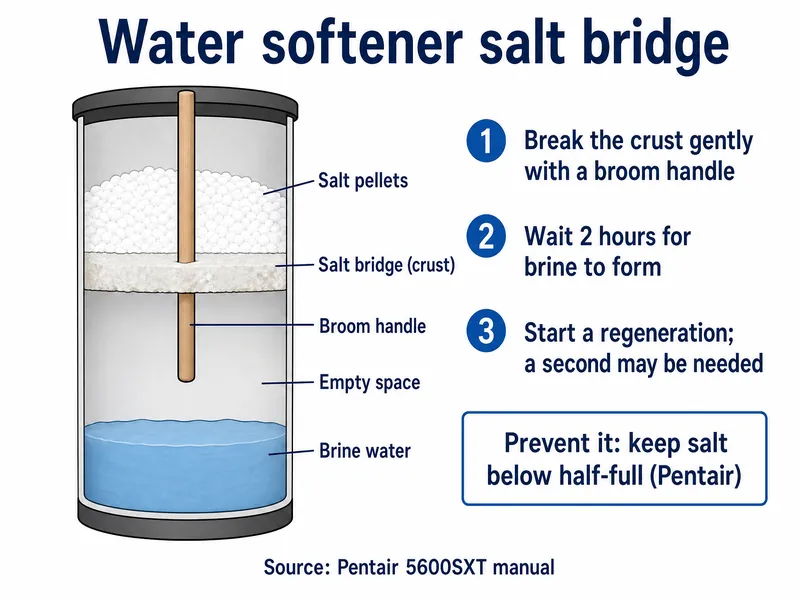
Test the softened water a day or two later with a hardness test to confirm the softener is back to normal.
Salt bridge or salt mushing: how do you tell them apart?
A bridge is hard with an empty space beneath it; mush is soft, thick sludge on the bottom that the broom handle sinks into. SoftPro says mushing means cleaning out the entire tank, and QWT's fix is the same: empty it, scoop out the sludge, sanitize and refill. QWT also flags powdery or clumping salt as an early sign of mushing.
A mushy tank cannot make proper brine and can block the brine well. Our guide to cleaning a brine tank covers the job step by step.
How do you stop salt bridges coming back?
Keep the salt level moderate, use the salt your manual names, and probe the tank on a schedule.
| Source | Guidance |
|---|---|
| Pentair 5600SXT manual | Keep salt below half-full; keep the brine tank covered |
| A. O. Smith AOW-S400/S500 manual | Keep salt at least 1/3 full; clean white pellet, cube-style or solar salt; no rock salt; do not mix salt types |
| Quality Water Treatment | Evaporated or crystal salt; at least one-third full |
| SoftPro | Check salt monthly; keep the tank at least one-quarter full |
| Water Quality Association | Potassium chloride bridges more readily than sodium chloride |
Keep it moderate. Read together, these sources point to a tank somewhere between a quarter and half full, with salt always higher than the water; your own manual's level comes first. More on this in how much salt the tank should hold.
Use the right salt. Fleck and Pentair each exclude rock salt. Our salt type comparison has details.
Probe monthly. A monthly push with the broom handle catches a bridge before it causes hard water. The maintenance checklist puts this alongside the other monthly jobs.
Check the grid. Some brine tanks have a grid plate on legs at the bottom, and the Fleck manual refers to it when giving the start-up water level. If yours needs a replacement, Quality Water Treatment sells an 18 Inch Round Brine Grid w/Legs (BG184) (sold by Quality Water Treatment, our store) from $59.00 (October 2026); measure your tank before ordering, since the listing names only the 18-inch round size.
Related guides
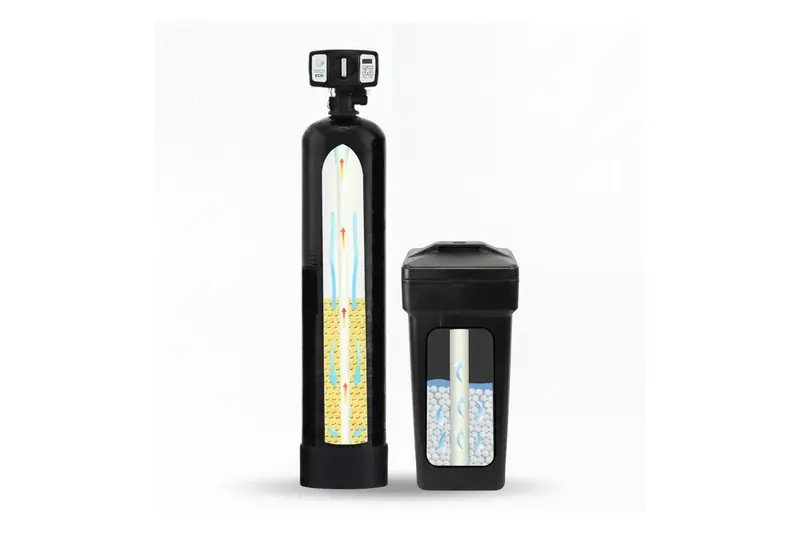 MaintainEvery routine softener job in one schedule
 FixSalt that never seems to go down
 FixStanding water in the brine tank
 MaintainClearing mush out of a brine tank
How we put this page together
This guide is based on the brine tank sections of Pentair's and Fleck's 5600SXT documentation, A. O. Smith's troubleshooting table, the WQA's softener best-practice booklet, Nebraska Extension's NebGuide G1491, and the maintenance pages SoftPro and Quality Water Treatment publish, checked in October 2026. We left out tools and tricks no manual describes, such as power tools or chemicals for breaking crusts, and we did no testing of our own.
Common questions
Can hot water be poured on a salt bridge to melt it?
A. O. Smith suggests hot water around the inside edge of the tank, and QWT says warm water helps. Use it alongside gentle work with a broom handle, and keep the amount small so the brine level does not rise too far.
Does a salt bridge harm the softener itself?
Pentair's manual says the softener keeps regenerating with a bridge in place, but the resin is not reconditioned, so hard water reaches your pipes and water heater until the bridge is broken. That is the reason to fix it promptly.
Why does a bridge keep forming in the same tank?
Pentair links bridging to a tank filled above half, and A. O. Smith to humidity and the wrong salt. Lower the fill level, use the salt your manual names, and keep the lid on.
How long after breaking a bridge does the water turn soft again?
Pentair says to wait about 2 hours for brine to form, then regenerate, and notes a second recharge may be needed. Expect soft water after that regeneration finishes; test it the next day to confirm.
Are salt bridges more common with potassium chloride?
Yes, according to the WQA, which says potassium chloride forms bridges more readily than sodium chloride. If you use it, probe the tank more often.
Can a softener reset clear a salt bridge?
No. SoftPro notes that a reset cannot reach inside the brine tank; the crust has to be broken by hand.
Should the salt go back in right after breaking the bridge?
Only if the level is low. SoftPro refills after breaking the crust, but stop well short of the top, around a quarter to half full, so a new bridge does not form.
More help: see our guide to water softener care.