
Settings
Water Softener Control Valves Explained
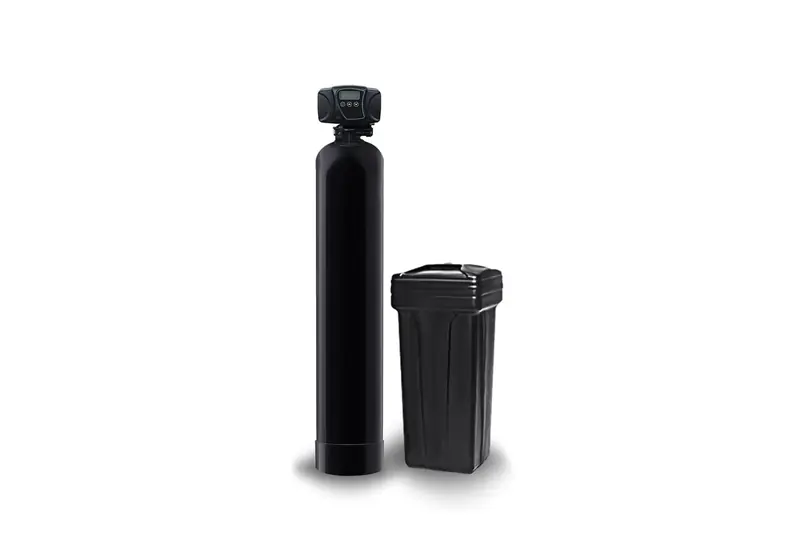
A water softener control valve is the head on the resin tank that sends water through the resin, decides when to regenerate and runs each regeneration step; its seals, piston and board can be replaced separately.
By the Water Softener Guide editors · Updated
Disclosure: watersoftenerguide.net is owned by the team behind SoftPro Water Systems and Quality Water Treatment, which sell some of the parts and systems we link to. Our steps follow the makers' manuals and published instructions, checked October 2026. Always check your own model's manual first. Ownership disclosure
View at Quality Water Treatment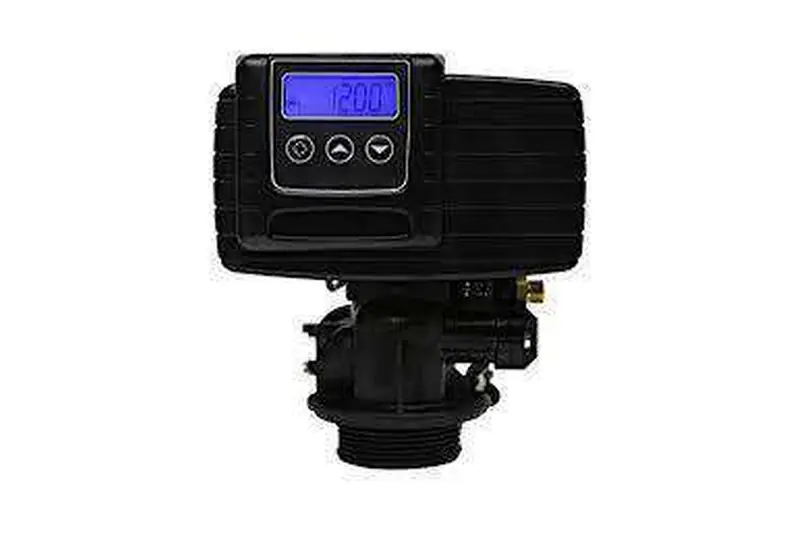
On this page
Key takeaways
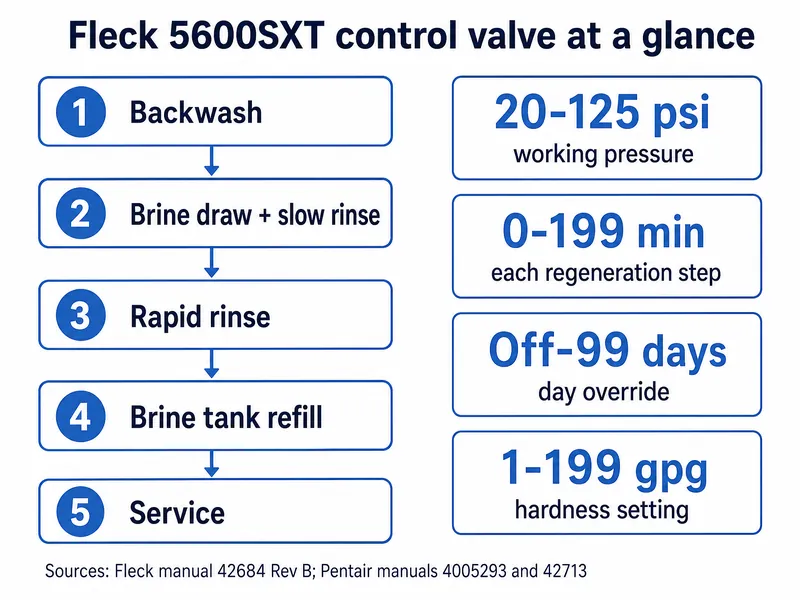
- A Fleck 5600SXT downflow valve steps through backwash, brine draw with slow rinse, a rapid rinse and a refill of the brine tank before returning to service (Fleck service manual 42684 Rev B).
- Every regeneration step on a Fleck SXT control is adjustable between 0 and 199 minutes (Pentair Fleck SXT manual).
- A metered valve divides unit capacity by feedwater hardness, subtracts the reserve and regenerates when that volume is used; a timer counts days instead (Pentair SXT manual).
- Pentair's 5600SXT system manual lists a working range of 20 to 125 psi and a hardness setting of 1 to 199.
- At full rated flow, Pentair measures 14 to 15 psi lost across its 5600SXT systems.
- Quality Water Treatment recommends a yearly service of the piston, seals and spacers with Fleck kit 60010307.
Control valve numbers from the makers
- 20–125 psiWorking water pressure for the 5600SXT systemPentair 5600SXT manual 4005293 Rev B
- 0–199 minAdjustable time for each regeneration stepPentair Fleck SXT manual 42713
- Off–99 daysDay override range, the longest gap between regenerationsPentair 5600SXT manual 4005293 Rev B
- 14–15 psiPressure drop at rated service flow (10.0 to 12.0 gpm)Pentair 5600SXT manual 4005293 Rev B
What does a water softener control valve do?
The control valve directs every flow in the softener: hard water in, soft water out, and the brine and rinse water used to recharge the resin. It sits on top of the resin (mineral) tank and joins your plumbing, usually through a bypass. When the resin is spent, the valve rinses it with brine drawn from the brine tank, then flushes it to drain.
On a Fleck 5600SXT, the service manual (42684 Rev B) gives the downflow order as backwash first, then brine draw with slow rinse, a rapid rinse, a refill of the brine tank, and finally service. Inside the head, a motor moves a piston through a stack of seals and spacers to open each path in turn. An injector creates the suction that pulls brine, and a drain line flow control (DLFC) washer limits the rate to drain.
Pentair's parts list for its 5600SXT softener system shows how the valve is built up: piston kit 60102-71, seal and spacer kit 60125, an injector sized to the tank, brine valve 60032, and DLFC washers of 2.0, 2.4 or 3.5 gpm for the 9x48, 10x54 and 12x52 tanks. That is why the head can be rebuilt rather than thrown away. The parts guide shows where each piece sits in the whole system.
The valve also stores the settings that decide how much soft water you get between regenerations: the hardness figure, unit capacity, reserve, day override and the time of day it regenerates. The settings guide walks through each one.
Metered or timer control valve: what is the difference?
A metered valve regenerates by gallons used; a timer valve regenerates by days, whatever you used. Penn State Extension describes timed models as running on a programmable clock and demand models as regenerating after a set number of gallons. Nebraska Extension's NebGuide G1491 adds that demand-initiated units may use less salt and water overall.
The Fleck SXT board offers four control types, per Pentair's SXT manual:
| Control type | Display code | What starts a regeneration |
|---|---|---|
| Meter immediate | FI | Calculated capacity used up; regenerates at once |
| Meter delayed | Fd | Capacity used up; waits for the set regeneration time |
| Time clock delayed | tc | Days since the last cycle equal the day override |
| Day of week | dAY | Each day set to On, at the regeneration time |
A metered control works out its capacity by dividing the unit capacity in grains by the feedwater hardness and subtracting the reserve. Both meter types also regenerate if the day override passes first, which caps the gap between cycles; Pentair's 5600SXT manual allows Off to 99 days. For choosing an interval, see how often a softener should regenerate.
Which control valve families are common?
Brand names matter only because they tell you which parts and manuals fit. These heads are sold on their own as replacement valves, and the store listings give these details:
| Valve | Control | Store listing details | Price from |
|---|---|---|---|
| Fleck 5600SXT 3/4" | Electronic meter | Replaces the 5600SE; 20 gpm service, 7 gpm backwash; tanks up to 12" | $469 |
| Fleck 2510SXT 3/4" | Electronic meter | Replaces the 2510SE; 19 gpm service, 17 gpm backwash; tanks up to 16" | $715 |
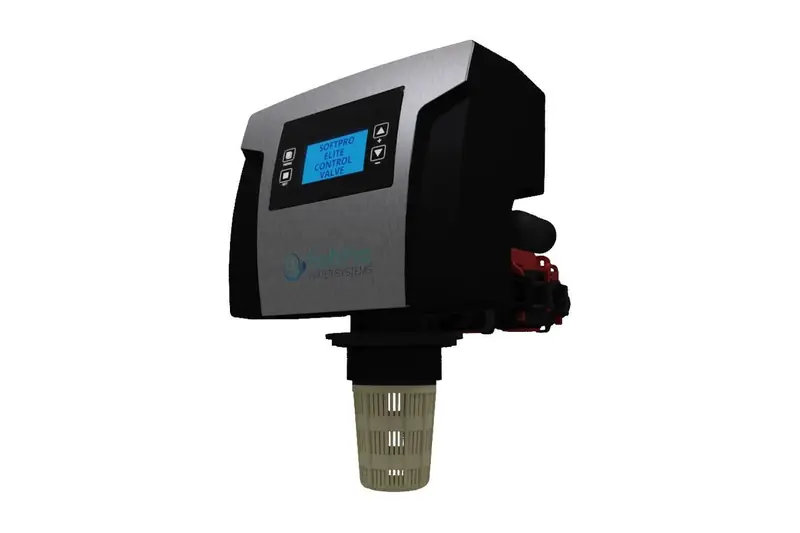
| SoftPro Elite 1" | Electronic meter | 4-line LCD; vacation mode and proportional brining | $493 |
For a Fleck 5600SXT head, the Fleck 5600SXT 3/4" electronic meter valve (sold by Quality Water Treatment, our store) from Quality Water Treatment is listed as a direct replacement for the older 5600SE, from $469 (October 2026). The 42684 manual sets its working range at 20 to 125 psi and advises a pressure-reducing valve when daytime pressure tops 80 psi; keep it away from freezing spots and from anywhere above 110 F. The store's 20 gpm is the valve's own figure; Pentair rates complete 5600SXT systems at 10.0 to 12.0 gpm with 14 to 15 psi lost at that flow, and less at everyday household use. Clack and SoftPro heads carry their own limits in their own manuals.
The SoftPro Elite head uses a 1-inch body. If you are replacing the valve on a SoftPro Elite softener, Quality Water Treatment sells the SoftPro Elite softener control valve (sold by Quality Water Treatment, our store) on its own, from $493 (October 2026), with vacation mode, proportional brining, automatic reserve and variable backwash among its listed settings.
How do you know a softener control valve is failing?
Most valve faults are worn parts, not a dead head. The troubleshooting table in the Fleck manual (42684 Rev B), repeated in Pentair's 4005293, points to the valve in these cases:
- Hard water with salt in the tank. Possible internal leak at the seals, spacers or piston, or a plugged injector screen.
- Drain runs all the time. The valve is not positioning correctly, there is debris in the control, or it leaks internally.
- Fails to draw brine. Check the injector and screen, the DLFC, an internal leak, or line pressure below the manual's 20 psi minimum.
- Error code on the display. Pentair's 4005293 defines Err 0 as a cam sense error, raised when the drive needs more than 6 minutes to move to its following position; Err 2 means no regeneration for over 99 days; Err 3 is a memory failure that needs a master reset. The older 42684 manual words Err 0 differently, so read any code against the manual for your board. The 5600SXT programming guide lists them by manual number.
Clean the injector before replacing anything; the injector cleaning guide has the Fleck steps. The wider troubleshooting guide covers faults outside the head.
Repair or replace the control valve?
Rebuild the valve when the body is sound; replace it when the body is cracked, parts for an old model are hard to find, or a board, motor and seal kit together approach the price of a new head. Quality Water Treatment's 5600SXT install guide calls for a yearly service of the piston, seals and spacers using Fleck kit 60010307, and the store lists a 5600SXT replacement circuit board from $215 (October 2026).
Safety first. Switch to bypass, then, as the Fleck manual directs, briefly advance the control to backwash to bleed off pressure, return it to service and unplug it before you open anything. Pentair says to use only silicone lubricant on O-rings, never petroleum grease. Follow local plumbing code for any pipe changes, and bring in a licensed plumber when in doubt.
When you replace the head, match it to the tank thread, distributor tube, pipe size and bypass. After reassembly, the Fleck manual has you check every seal area for drips, with the drain seal checked while the valve sits in backwash; the leak guide covers what to do if one drips.
Common questions
Can an old timer valve be swapped for a metered one?
Often yes, if the new head fits the tank thread, distributor and bypass on your system. You will need to program unit capacity and hardness, which a timer never used. Check the replacement valve's listing for what it replaces before buying.
How long does a softener control valve last?
None of the manuals cited here gives a lifespan in years. The heads are built to be rebuilt, and Quality Water Treatment recommends a yearly piston, seal and spacer service, so wear parts rather than the whole valve are what normally get replaced.
Why does my control valve hum but not move?
A motor that runs without the valve reaching its next position usually ends in an error code. Pentair's 4005293 manual calls Err 0 a cam sense error after more than 6 minutes; the older 42684 manual calls it a stalled drive motor. Unplug the control and check your manual before going further.
What is the day override on a metered valve?
It is the longest the valve will wait between regenerations, even if the meter says capacity remains. Pentair's 5600SXT manual allows Off or up to 99 days. On a time clock control, the day override is the schedule itself.
Does a bigger valve give better water pressure?
Valve size is only part of it. Pentair rates its 5600SXT systems at 10.0 to 12.0 gpm with 14 to 15 psi lost at that flow; a larger valve such as the 2510SXT is listed at 19 gpm service. The low water pressure guide covers the other causes.
Does the valve need reprogramming after a circuit board swap?
Plan on it. A new board will not carry your unit capacity, hardness, reserve and regeneration time. Record the old settings first if the display still works, then enter them again using your valve's manual.
Is there a standard for water softener performance?
Yes. Virginia Cooperative Extension notes that NSF/ANSI 44 is the established protocol for assessing ion exchange water softeners. Look for that listing on a complete system; a replacement head is a component of it.
How we put this page together
This page is based on the Fleck 5600SXT Downflow Service Manual 42684 Rev B, Pentair's 5600SXT Softener System Operation Manual 4005293 Rev B, Pentair's Fleck SXT Timer Service Manual 42713, Quality Water Treatment's Fleck 5600SXT install guide, Penn State Extension, Nebraska Extension G1491 and Virginia Cooperative Extension 442-664, plus the owned stores' own product listings for prices, all checked in October 2026. We left out lifespans in years (no primary source gives one), power-backup hours, flow claims for valves the stores do not list, and user forum stories; we did no bench work of our own.
Related guides
More help: see our water softener how-to guides.