
Fix
Water Softener Using Too Much Salt
A water softener using too much salt is usually set to a high salt dose, told the water is harder than it is, counting leaked water, or overfilling the brine tank.
By the Water Softener Guide editors · Updated
On this page
Key takeaways
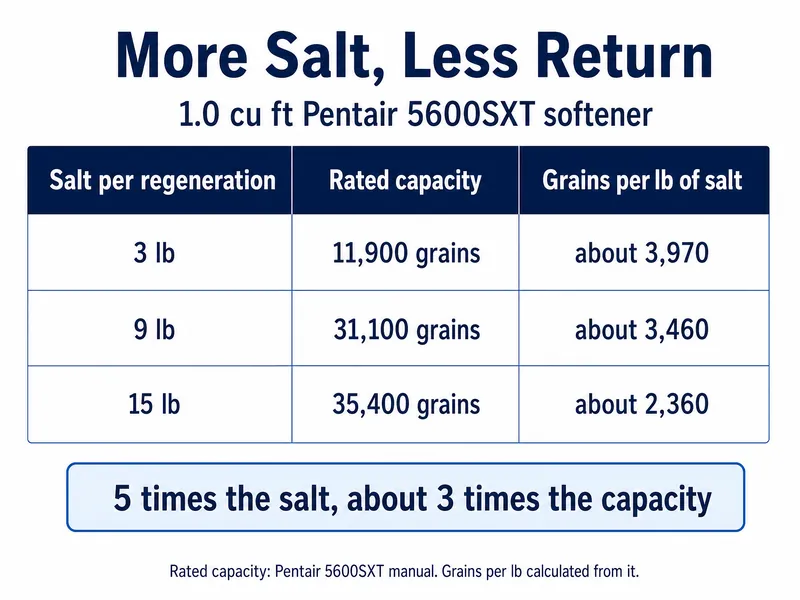
- Pentair's 5600SXT manual rates a 1.0 cu ft unit at 11,900 grains on 3 lb of salt but only 35,400 grains on 15 lb: five times the salt for about three times the capacity.
- The WQA's septic toolkit describes efficient softeners as removing 3,000 to 4,000 grains of hardness per pound of salt.
- The Fleck 5600SXT service manual gives 2 causes of too much salt: an improper salt setting and excess water in the brine tank.
- Pentair allows a safety-factor reserve of 0 to 50% of capacity; Quality Water Treatment programs 15% on its Fleck systems.
- In Penn State Extension's worked example, a 20,000-grain unit for 4 people on 10 gpg water regenerates about every 6 to 7 days.
- NDSU Extension says potassium chloride takes about 10% more per regeneration than sodium chloride.
How much salt should a water softener use?
It depends on the salt setting more than anything else. Pentair's 5600SXT manual rates each resin size at three salt doses per regeneration:
| Resin bed | Low salt | Middle salt | High salt |
|---|---|---|---|
| 1.0 cu ft | 11,900 grains @ 3 lb | 31,100 grains @ 9 lb | 35,400 grains @ 15 lb |
| 1.5 cu ft | 17,900 grains @ 4.5 lb | 46,600 grains @ 13.5 lb | 53,100 grains @ 22.5 lb |
| 2.0 cu ft | 23,900 grains @ 6 lb | 62,200 grains @ 18 lb | 70,700 grains @ 30 lb |
So a 1.0 cu ft unit can burn 3 lb or 15 lb in a single regeneration for the same resin. How often it regenerates sets the rest: Penn State's example works out daily use as people × 75 gallons × hardness, so 4 people on 10 gpg water use about 3,000 grains a day. If you are filling the tank far more often than before with no change in household size, something has shifted.
What the sources say
- 35,400 grainsfrom 15 lb of salt on a 1.0 cu ft 5600SXTPentair 5600SXT manual
- 11,900 grainsfrom 3 lb of salt on the same unitPentair 5600SXT manual
- 3,000–4,000grains removed per lb of salt by efficient softenersWQA septic toolkit
- 10%more potassium chloride than salt per regenerationNDSU Extension
Why does a higher salt setting waste salt?
Because each extra pound recovers less resin capacity than the one before. Working from Pentair's figures for the 1.0 cu ft unit, the 3 lb setting removes about 3,970 grains per pound, the 9 lb setting about 3,460, and the 15 lb setting about 2,360. Pentair rates the lowest setting at 4,400 grains per pound.
A lower dose means the valve regenerates a little more often, but each cycle gets more softening from every pound. That is why sizing aims for a softener that runs about a week between cycles at an efficient setting, rather than a small unit on its maximum dose.
Which settings make a water softener use too much salt?
The Fleck 5600SXT service manual lists an improper salt setting as the first cause of too much salt, and Quality Water Treatment's salt-use page (Quality Water Treatment, our store) adds a hardness setting entered wrong and a system that regenerates too often. Check these in user mode or the programming menu:
- Hardness (H). Enter raw-water hardness in grains per gallon. If your lab result is in mg/L, SoftPro's Elite guide says divide by 17.1 and round up. A figure set far too high makes the valve think capacity runs out early. Retest with a kit; see how to test water hardness.
- Capacity (C). The Fleck manual says the control works out system capacity as unit capacity divided by hardness, minus the reserve. A capacity entered lower than the real unit shortens every cycle.
- Reserve or safety factor. Pentair allows 0 to 50 percent of capacity. Quality Water Treatment programs 15 percent. A large reserve triggers regeneration with plenty of capacity left.
- Day override (DO). This forces a regeneration after a set number of days even if capacity remains. Quality Water Treatment sets 14. A short DO on a light-use home wastes salt.
- Control type. Penn State points out that clock-based models recharge on a calendar even when the resin still has capacity, which costs extra salt and water. If yours is set to time clock and water use has dropped, switch to a metered mode where the valve supports it.
The settings guide and Fleck 5600SXT programming guide show each screen. For target intervals, see how often a softener should regenerate.
Can leaks make a water softener regenerate constantly?
Yes. A metered valve counts every gallon that passes it, including water lost to a running toilet or a dripping faucet. The WQA's septic guidance tells homeowners to look for leaking toilet flappers and valves, alongside choosing demand-initiated units at high-efficiency salt settings.
To check, turn off every tap and appliance. On a Fleck 5600SXT the flow indicator flashes when water is flowing; if it keeps flashing with the house quiet, water is leaking somewhere downstream. The diagnostic screen (hold Up and Extra Cycle for 5 seconds) also shows flow rate and volume used.
If the valve seems to regenerate nonstop, SoftPro's troubleshooting page (SoftPro, our store) says that points to a control valve problem. A drain that runs constantly, per the Fleck manual, comes from a valve not positioning correctly, debris in the control, or an internal leak. For leaks at the softener itself, see water softener leaking.
How do brine refill problems waste salt?
The Fleck manual's second cause of too much salt is excess water in the brine tank. More water dissolves more salt, so each regeneration draws a bigger dose than the setting intends.
- Brine fill time. On a Fleck SXT the BF time sets how much water returns to the tank. QWT sets 12 minutes on a 32,000-grain unit and says larger systems need a different figure. A BF time set too long overfills.
- Brine valve or float. QWT names a blocked brine valve and an overflowing tank among the culprits. A float that sticks lets extra water in.
- Poor brine draw. If the injector is partly clogged, leftover water stays in the tank and adds up. See brine tank full of water.
- Bridges or mush. Quality Water Treatment includes salt bridges in its list; break and clean as needed.
Before opening the brine valve or injector, put the softener in bypass and unplug the control. If none of these explain it, the main troubleshooting guide works through the valve and resin.
How we put this page together
These figures come from Pentair's 5600SXT operation manual (rated capacity table and settings ranges), the Fleck 5600SXT downflow service manual, Quality Water Treatment's and SoftPro's guides for the Fleck and Elite softeners they sell, the WQA septic toolkit, and Penn State and NDSU Extension, reviewed in October 2026. The grains-per-pound figures for each setting are our arithmetic from Pentair's table. We left out store estimates of bags per month and salt-use readings from any home of our own.
Related guides


Common questions
Does a bigger household always mean more salt?
Yes, roughly. Penn State works out daily grains as people times about 75 gallons a day times hardness, so more people means more regenerations at the same setting. Update the settings if household size has changed.
Will turning the salt setting down make my water hard?
Not if the softener is sized with headroom. A lower salt dose removes fewer grains per regeneration, so the valve regenerates a little more often, but each cycle uses salt more efficiently. Retest softened water after any change.
Can iron in my water raise salt use?
Yes. Iron uses up resin capacity, so install guides raise the hardness setting for it, which shortens the time between regenerations. SoftPro's Elite guide adds 3 gpg for iron of 2 to 3 ppm; follow your softener's manual.
Does potassium chloride use more than salt?
Yes. NDSU Extension says about 10% more potassium chloride is used per regeneration, so expect bags to go down faster than with sodium chloride.
Is a timer softener worse for salt than a metered one?
Usually. Penn State Extension says a clock-driven unit recharges on its calendar even with capacity to spare. The WQA notes most softeners sold today are demand-initiated.
Does heavy salt use harm a septic system?
The WQA says softeners running at their efficient ratings will not harm septic systems, while very inefficient ones that use excess salt may. Check local rules and see our septic page for the full picture.
More help: see our water softener maintenance and repair guides.