
Test
How to Test Water Hardness
How to test water hardness at home? Dip a hardness strip or run a drop-count kit on a cold tap sample, or send water to a lab, then read the result in grains per gallon.
By the Water Softener Guide editors · Updated
Disclosure: watersoftenerguide.net is owned by the team behind SoftPro Water Systems and Quality Water Treatment, which sell some of the parts and systems we link to. Our steps follow the makers' manuals and published instructions, checked October 2026. Always check your own model's manual first. Ownership disclosure
View at Quality Water Treatment
On this page
Key takeaways
- Nebraska Extension G1274 says home kits and dip strips give a reasonable estimate and a lab test is the choice when you need more accuracy.
- 1 grain per gallon (gpg) equals 17.1 mg/L of hardness as calcium carbonate (Montana State University Extension).
- Water over 10.5 gpg (180 mg/L) is classed as very hard on the scale Nebraska attributes to the U.S. Department of the Interior and the Water Quality Association.
- Community water systems must send a Consumer Confidence Report by July 1 each year (EPA), and it may list hardness.
- Penn State Extension prices hardness strips at about $15 for 50 and a titration kit at about $40 for 50 tests.
- A TDS meter cannot stand in for a hardness test: Montana State notes that softening does not reduce total dissolved solids.
Hardness testing by the numbers
- 17.1 mg/LEqual to 1 grain per gallon of hardnessMontana State University Extension
- 10.5 gpgThreshold for very hard water (180 mg/L)Nebraska Extension G1274
- 7 gpgBelow this (120 mg/L), hardness generally needs no treatmentVirginia Cooperative Extension 442-664
- July 1Annual deadline for your utility's water quality reportU.S. EPA
How do you test water hardness at home?
Use a dip strip, a drop-count (titration) kit or a laboratory test, and always sample cold water. Hardness is the calcium and magnesium dissolved in your water, reported in grains per gallon (gpg) or milligrams per liter (mg/L), which is the same as parts per million (ppm). You need the number twice: to decide whether to soften at all, and to program the softener. The settings guide shows where that number goes.
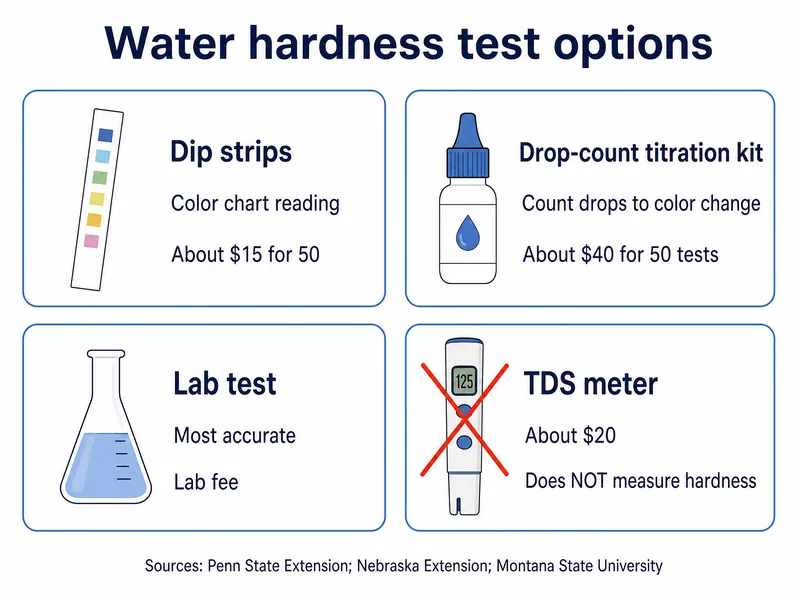
| Method | How it reads | Cost guide | Source |
|---|---|---|---|
| Dip strips | Color matched to a chart | About $15 for 50 strips | Penn State Extension |
| Drop-count titration kit | Drops counted until a color change, read in gpg | About $40 for 50 tests | Penn State Extension |
| Laboratory test | Measured number on a report | For a fee | Nebraska Extension G1274 |
Penn State's water quality toolkit gives those kit prices. Kit types are compared in more depth in choosing a water hardness test kit.
How to test water hardness with test strips
A strip is the fastest test: dip, wait, match the color. The two owned-store guides give slightly different timing, so follow the directions printed with your strips.
- Run the cold tap. SoftPro flushes about 30 seconds to clear standing water; Quality Water Treatment runs the tap at least 5 minutes on well water.
- Collect a cold sample. SoftPro notes that hot water skews strip results.
- Dip the strip. SoftPro holds it in for 3 seconds; Quality Water Treatment says 3 to 5 seconds.
- Wait and read. SoftPro reads the strip against the chart after 20 to 30 seconds.
- Write it down. Note the reading, date and tap so later tests compare like with like.
How do you use a drop-count hardness kit?
Add reagent to a measured sample a drop at a time until the color changes, then convert the count to hardness. Penn State Extension describes this titration as adding precise amounts of reagent until a color change occurs, giving a reading in grains per gallon as calcium carbonate. Laboratories use the same chemistry: the EDTA titration method (AOAC 973.52B) turns an indicator from wine-red to blue once all calcium and magnesium are bound.
Sample size, reagent order and how drops convert to grains differ between kits, so follow the card in the box:
- Fill to the mark. The count only means something if the sample volume matches the card.
- Add reagents in order. Swirl after each drop and watch for the endpoint color.
- Convert the count. Most cards give gpg per drop; multiply by 17.1 for mg/L.
- Restock reagents. Quality Water Treatment sells Hardness #3 solution in 1 oz bottles for the 2401 and 2403 kits, from $7.95 (October 2026).
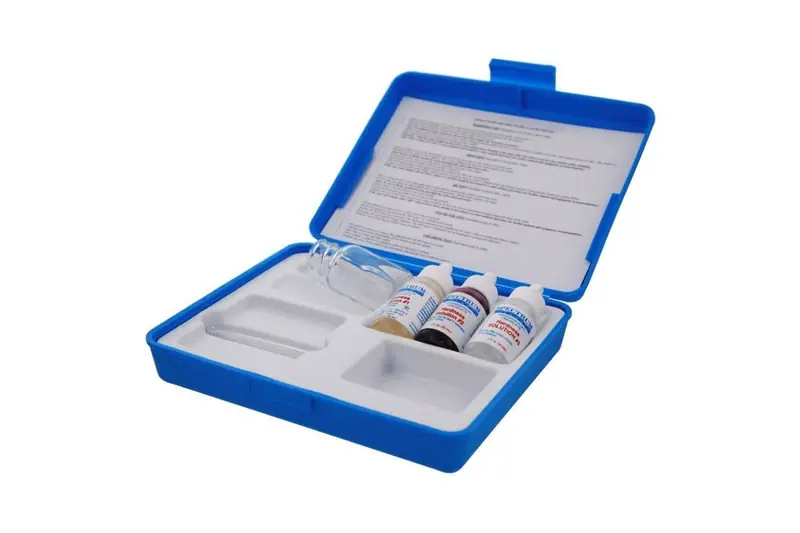
If you want the complete case, the Pro Products 2403 water hardness field test kit (sold by Quality Water Treatment, our store) is sold by Quality Water Treatment for home hardness testing, with Hardness #1, #2 and #3 reagents, a square test bottle and a measuring tube, from $150 (October 2026).
When should you use a lab or your water report?
Use a lab before buying or sizing a softener, and check your utility's report first if you are on city water. Penn State Extension advises a third-party lab test rather than a dealer's free test, noting it is not expensive and protects you from being oversold. Virginia Cooperative Extension also points well owners to qualified, certified laboratories.
City customers can start with the Consumer Confidence Report. EPA requires community water systems to send it by July 1 each year, and Nebraska Extension notes it may include hardness; if it does not, ask the supplier. Private well owners get no report and need to test.
How do you read a water hardness test result?
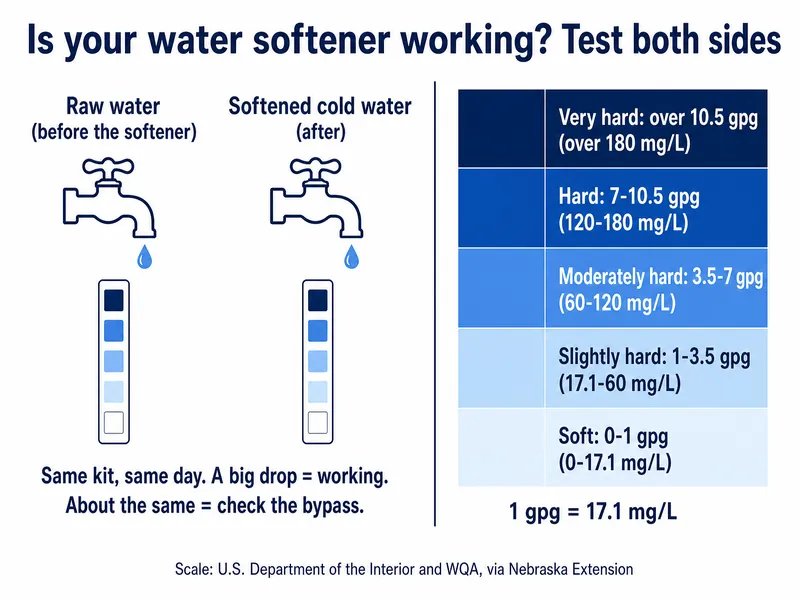
Compare your number with the standard classes below. Montana State Extension notes that 1 gpg equals 17.1 mg/L expressed as calcium carbonate, and that ppm and mg/L are the same unit. To turn a lab's mg/L into gpg, divide by 17.1; SoftPro's Elite install guide rounds the answer up before it goes into the valve.
| Class | gpg | mg/L (ppm) |
|---|---|---|
| Soft | under 1 | under 17.1 |
| Slightly hard | 1 to 3.5 | 17.1 to 60 |
| Moderately hard | 3.5 to 7 | 60 to 120 |
| Hard | 7 to 10.5 | 120 to 180 |
| Very hard | over 10.5 | over 180 |
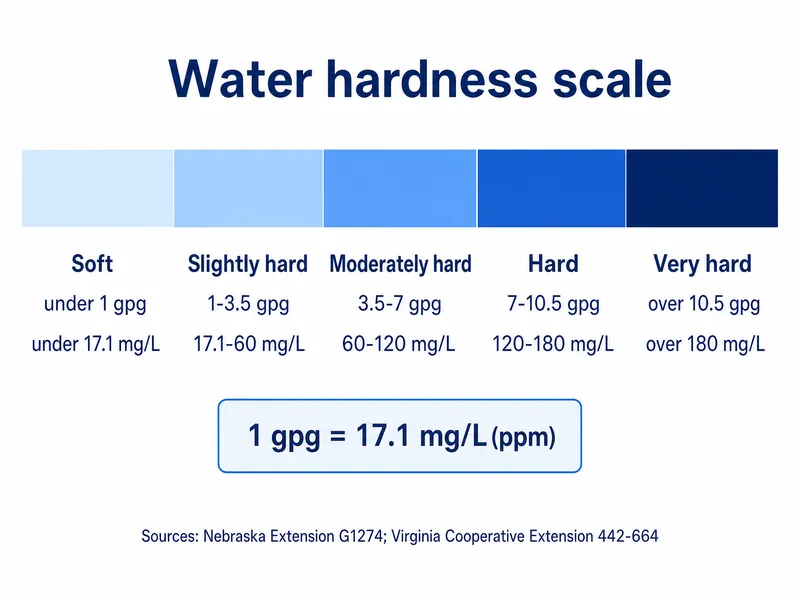
Virginia Tech says hardness under 7 gpg (120 mg/L) generally doesn't need treatment unless it causes a problem. Montana State uses a different scale, calling 121 to 300 mg/L hard and over 300 very hard, so a "hard" label from one source may not match another. Go by the number, not the label.
Iron changes the setting. Clear-water iron uses up resin capacity too, so follow your softener's manual for how to allow for it. SoftPro's Elite guide, for its own valve with no iron filter, adds 3 gpg to the hardness setting for iron of 2 to 3 ppm. Once you have the number, the regeneration frequency guide shows how it combines with water use.
How do you test softened water?
Compare a raw-water reading with a softened-water reading taken minutes apart using one kit. SoftPro's method treats a wide gap between the two as a working softener, while two readings that are almost the same suggest water is bypassing the resin or regeneration has stopped.
- Find a raw-water tap. An outside spigot or a line that leaves the main before the softener usually carries hard water.
- Sample a cold softened tap inside the house, after running it.
- Test both with the same kit within a few minutes of each other.
- Compare. If softened water reads close to the raw sample, check the bypass position, the salt and the hardness setting first; Quality Water Treatment and the Fleck service manual (42684 Rev B) both list those as simple causes.
Watch the salt as well: SoftPro expects the level to fall over the weeks. Do not use a TDS meter for this check, because softening swaps one dissolved mineral for another rather than removing them. The is your softener working guide and the troubleshooting guide take it from there.
Common questions
How often should a well owner retest hardness?
Quality Water Treatment's well-water guide says to test at least once a year, and Virginia Tech recommends annual testing of private supplies. Retest too when you set up or reprogram a softener, after work on the well or pump, and whenever soft water seems to come and go.
Can a lab result in mg/L go straight into the softener?
Not on most valves. Pentair's 5600SXT manual takes hardness in grains per gallon, from 1 to 199, so divide the mg/L figure by 17.1 first; SoftPro's Elite guide rounds the result up. A report of 171 mg/L becomes 10 gpg.
Why do two hardness tests on the same water disagree?
Strips read in color bands, so two strips can land in neighboring bands; drop kits and labs give a finer number. Different flush times also change the result, which is why SoftPro and Quality Water Treatment each specify how long to run the tap.
Is a soap foam test good enough?
Quality Water Treatment's well-water guide mentions a castile soap foam test as a rough check, but it gives no number. Use a strip, kit or lab when you need a figure for the softener.
Does hot water give a different hardness reading?
SoftPro says hot water skews strip results. Take every sample from a cold tap, run for the same time, so results compare from test to test.
Does hard water show up on a city water report?
Often, but not always. Nebraska Extension says the Consumer Confidence Report may include hardness, and suggests asking your water supplier directly if it is missing.
How much sodium does softening add to tested water?
Nebraska Extension, citing the Water Quality Association, puts the added sodium near 8 mg/L per gpg removed, so 10 gpg water fully softened carries about 80 mg/L.
How we put this page together
This page is based on Nebraska Extension G1274, Penn State Extension's water softening guide and water quality toolkit, Montana State University Extension, Virginia Cooperative Extension publication 442-664, the EPA's Consumer Confidence Report page, the AOAC 973.52B EDTA method summary on NEMI, Pentair's 5600SXT manual and the two owned stores' testing guides and product listings, checked during October 2026. Left out on purpose: SoftPro's pass-mark thresholds for softened water (its pages give conflicting figures), kit accuracy claims no primary source makes, forum tips and any testing of our own.
Related guides
Parts for this job
Pro Products Water Hardness Field Test Kit
Check current options and prices at Quality Water Treatment.
View at Quality Water Treatmentwatersoftenerguide.net is owned by the team behind SoftPro Water Systems and Quality Water Treatment, which sell some of the parts and systems we link to. Ownership disclosure
More help: see our water softener guides.