
Install
Water Softeners on Septic Systems
Can a water softener run on a septic system? Usually, but sources disagree on where its roughly 50 gallons per regeneration should go, so check local rules and run it efficiently.
By the Water Softener Guide editors · Updated

On this page
Key takeaways
- Penn State Extension puts each regeneration at about 50 gallons and says that may or may not hydraulically overload a septic system.
- University of Maryland Extension advises against connecting softener backwash to the waste plumbing or septic tank.
- Purdue Extension says Indiana's rule lets recharge water skip the tank but requires it to pass through a soil absorption field.
- The WQA's summary of a 2012 Virginia Tech study it helped fund found efficiently run softeners improved septic tank performance.
- The WQA asks installers to set softeners at 4,000 grains per pound of salt and no more than 5 gallons of water per 1,000 grains.
- Montana State warns that sodium can raise drainfield failure risk in clayey soils.
What the sources measured
- 50 galwater used per regeneration cyclePenn State Extension
- 70 galindoor use per person per day, at the high endEPA SepticSmart
- 3,000-4,000grains per pound of salt at which the WQA says softeners will not harm septic systemsWater Quality Association
- 160-400×dilution of regeneration brine by other household wasteWater Quality Association
- 4,400grains per pound of salt on Pentair's lowest 5600SXT salt settingPentair 5600SXT manual
Can you put a water softener on a septic system?
In most places, yes, but where the discharge may go is a local decision, and the published sources do not agree. Indiana's rule as Purdue describes it allows softener recharge water as long as it passes through a soil absorption field. University of Maryland Extension takes the opposite line for the tank itself. No source we found bans softeners on septic outright.
So the practical answer has two parts. Ask your local health department or septic permitting office where softener discharge may go, and run the softener so it regenerates no more often, and with no more salt, than it needs.
What goes down the drain from a water softener?
Each regeneration flushes brine and rinse water through the resin and out the drain line. The WQA's septic toolkit describes the waste as carrying the calcium and magnesium removed from your water plus some excess sodium. Rinsing dilutes it about sixfold, and other household waste dilutes it further, to 160 to 400 times in total. Our regeneration guide explains each stage.
Volume. Penn State puts a cycle at about 50 gallons. EPA says indoor use in a single-family home can reach 70 gallons per person per day, so for a family of four one regeneration adds about 18 percent to a day's flow (50 of 280 gallons).
Frequency. The total depends on settings. Weekly regeneration sends about 50 gallons a week; every two days sends about 175. Penn State's example household of four at 10 grains per gallon, using 3,000 grains a day against a 20,000-grain softener, lands at 6 to 7 days between cycles. See how often a water softener should regenerate.
Salt. What reaches the tank is set by the salt dose and the number of cycles, and you control both.
What did studies of softeners and septic tanks find?
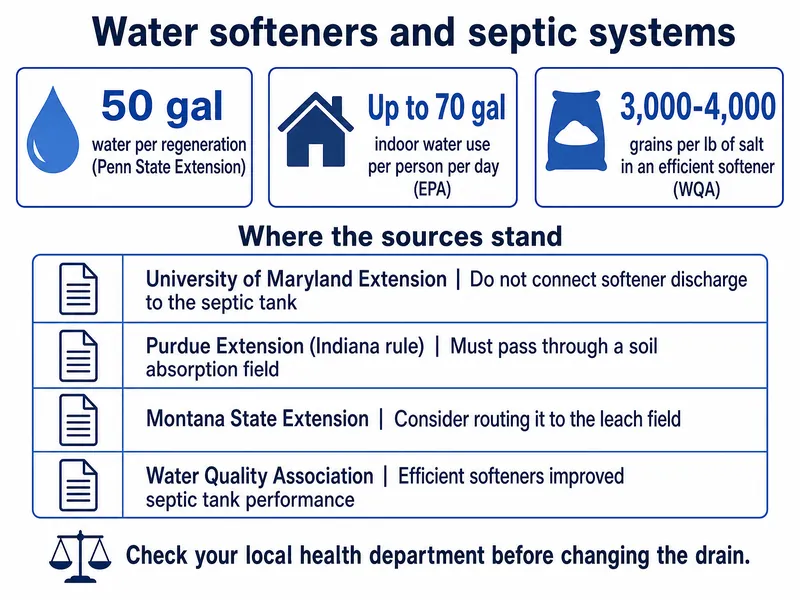
The best-known study is industry-funded, and the extension services read the risk differently, so here are the views side by side.
| Source | Position |
|---|---|
| University of Maryland Extension (FS-1105) | Softener backwash discharge should not be connected to the waste plumbing or septic tank |
| Purdue Extension (HENV-1, Indiana rule) | Recharge water must pass through a soil absorption field but not necessarily the septic tank; not to the soil surface, a field tile or groundwater |
| Montana State Extension | Salt may disrupt solids settling; consider routing recharge water directly to the leach field |
| Water Quality Association (Virginia Tech study summary) | Efficient softeners improved tank performance; very inefficient ones or diverted waste may harm solids settling |
The Virginia Tech study. The Water Quality Research Foundation commissioned Virginia Tech in 2012 to test the question; the WQA reports nearly $100,000 spent over 18 months on lab columns and field case studies. The authors found that efficiently operated softeners improved septic tank performance, while very inefficient softeners may increase solids reaching the drain field. They also found that diverting regeneration waste, or waste carrying excess sodium, may hurt settling. The WQA says softeners at 3,000 to 4,000 grains per pound of salt will not harm septic systems. Keep in mind that the WQA is the industry group summarizing the work.
The extension view. Maryland advises keeping the discharge out of the tank. Montana State adds that in clayey soils the sodium can raise the risk of drainfield failure, and that softening with potassium is a possible alternative.
How do you reduce a water softener's septic load?
Whatever the local rule, a softener that uses less water and salt is easier on any septic system. The WQA and NOWRA list these steps for septic homes:
- Maintain the softener as the maker directs, so it does not regenerate more than needed. Our maintenance checklist covers the routine.
- Use a demand-initiated or high-efficiency unit. A metered valve regenerates by gallons used, not on a calendar. The WQA's best-practice booklet tells installers to avoid time clocks for starting regeneration.
- Set salt at the high-efficiency rating. The WQA's best-practice booklet targets 4,000 grains per pound of salt and no more than 5 gallons of water per 1,000 grains, as certified under NSF/ANSI 44. Pentair rates its 5600SXT systems at 4,400 grains per pound on the lowest salt setting.
- Skip harsh chemicals. Avoid excessive bleach and detergents, strong disinfectants, every-flush toilet tablets and caustic drain cleaners.
- Fix leaks. Leaking toilet flappers and valves add steady flow that can overload the system over time.
Two settings checks help too. Enter hardness from a real test, since a wrong hardness setting is a common cause of excess salt use; see how to test water hardness and water softener using too much salt. And plumb irrigation and outside taps around the softener, so fewer gallons are treated and fewer cycles run.
The WQA notes that high-efficiency ratings assume source water under 2 ppm of iron and 750 ppm of total dissolved solids, so iron-heavy wells may need treatment ahead of the softener to reach them.
What are the alternatives to discharging into the septic tank?
If your local rule or your own preference keeps softener water out of the tank, these are the options the sources name, each subject to local approval:
- A separate soil absorption route. Indiana's rule, per Purdue, allows recharge water to bypass the tank if it still goes through a soil absorption field, never to the soil surface, a field tile or groundwater.
- Direct to the leach field. Montana State suggests considering this route.
- Potassium chloride. Montana State names it as an alternative where sodium and clay soils are a concern. NDSU Extension says about 10% more is used per regeneration and it costs up to $25 per 40-pound bag, against $5 to $10 for sodium chloride.
- No discharge at all. Salt-free conditioners use no salt and no drain. They do not remove hardness; they change it into crystals less likely to form scale, so the water still tests hard.
Any change to where the drain line ends still needs an air gap and has to meet local code. Have a licensed plumber or septic contractor make changes to waste piping. The installation guide covers the rest of the setup.
How we put this page together
This page is based on Penn State Extension's water softening publication, University of Maryland Extension FS-1105, Purdue Extension HENV-1, Montana State University Extension's hardness page, NDSU Extension's ion exchange publication, EPA's septic care page, the WQA septic toolkit and best-practice booklet, and Pentair's 5600SXT manual, all checked in October 2026. We did not read the Virginia Tech report itself, only the WQA's summary, and we left out salt-per-cycle figures for septic loads because no primary source gives one.
Common questions
Will softener brine kill the bacteria in a septic tank?
The sources disagree on the overall effect. The WQA's summary of the Virginia Tech study says efficiently run softeners improved tank performance, while University of Maryland Extension advises keeping the discharge out of the tank. Check local rules and keep the softener efficient.
How much water does a softener add to a septic system each week?
About 50 gallons per regeneration, by Penn State's estimate. At one cycle a week that is about 50 gallons; at one every two days it is about 175 gallons a week.
Do clay soils change the advice?
Montana State says sodium from recharging can raise the risk of drainfield failure in clayey soils and suggests potassium as a possible alternative. Ask your septic designer or health department about your soil.
Is a separate drywell for softener discharge allowed?
That depends on local rules. Purdue notes Indiana requires recharge water to pass through a soil absorption field and bars discharge to the soil surface, a field tile or groundwater, so ask what your area permits.
Does a timer softener load a septic system more than a metered one?
It can. A timer regenerates on a schedule whether or not the resin is used up, while a metered valve waits for actual water use. The WQA tells installers to avoid time clocks.
Should septic homes pump the tank more often if they have a softener?
None of the sources sets a softener-specific schedule. EPA says household tanks are typically pumped every three to five years and inspected at least every three years, so follow that and your inspector's advice.
Does the regeneration brine reach the tank undiluted?
No. The WQA says rinsing dilutes it about sixfold and other household waste brings the total to 160 to 400 times, though the regeneration waste on its own can still be fairly salty.
Related guides
More help: see our water softener maintenance and repair guides.