
Install
Water Softener Bypass Valve Guide
A water softener bypass valve routes incoming water around the softener so the house keeps running water while you work on it; in service, water flows through the resin, and in bypass every tap gets hard water.
By the Water Softener Guide editors · Updated
Disclosure: watersoftenerguide.net is owned by the team behind SoftPro Water Systems and Quality Water Treatment, which sell some of the parts and systems we link to. Our steps follow the makers' manuals and published instructions, checked October 2026. Always check your own model's manual first. Ownership disclosure
View at Quality Water Treatment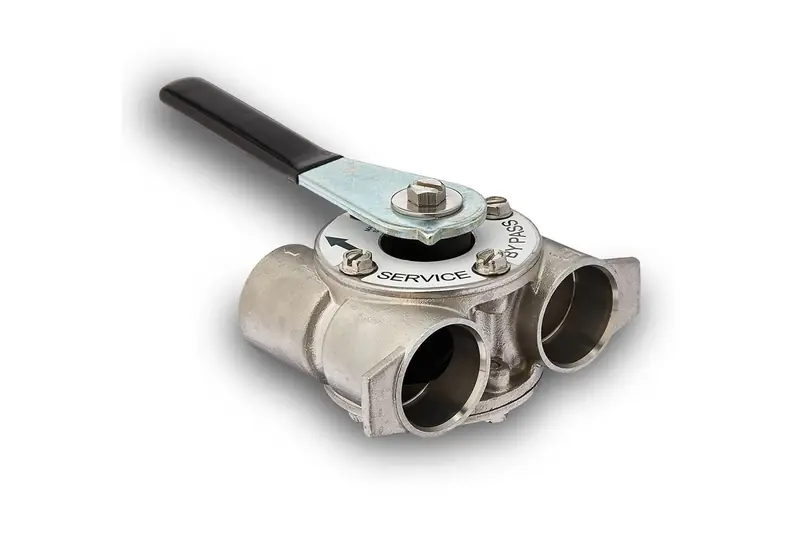
On this page
Key takeaways
- On a Fleck plastic bypass, Quality Water Treatment's guide says to turn both knobs clockwise toward BYPASS until they lock, and counter-clockwise to return to service.
- On a three-valve bypass, the Fleck 5600SXT service manual opens the bypass line first, then closes the inlet and outlet valves.
- Pentair's 5600SXT manual says to rotate new bypass handles 2 to 3 times before turning the water on, to seat the O-rings.
- The EPA WaterSense guide suggests bypassing when you water the lawn, wash the car or fill a pool, then switching back.
- SoftPro suggests keeping a softener in bypass for under 30 days.
- SoftPro's hardness-test page says raw and treated readings within 1 to 2 gpg suggest water is bypassing the softener.
Bypass numbers from the sources
- 2-3 turnsRotate new bypass handles before the water goes onPentair 5600SXT manual
- 30 daysSoftPro's suggested limit for leaving a softener in bypassSoftPro vacation guide (our store)
- 1-2 gpgRaw-to-treated gap that points to water bypassing the softenerSoftPro hardness test guide (our store)
What does a water softener bypass valve do?
A bypass is a small valve assembly between your plumbing and the softener's control valve that decides whether water goes through the resin or around it. In the service position, water enters the softener, passes through the resin and leaves softened. In the bypass position, water goes straight from the supply pipe to the house pipe, so you can work on the softener without shutting off the whole house. While it is in bypass, everything you draw is hard water.
Pentair's 5600SXT manual says bypass valves isolate the softener from the water system and that service or routine maintenance may require bypassing it. The Fleck 5600SXT service manual goes further: always provide a bypass valve if the unit is not equipped with one.
Which bypass style do you have?
Bypass styles look different, so check which one you have before you turn anything.
| Bypass style | Service (soft water) | Bypass (hard water) |
|---|---|---|
| Fleck plastic, two knobs | Knobs in line with the INLET and OUTLET pipes | Knobs turned clockwise toward BYPASS until they lock |
| Push/pull (SoftPro) | Handle pulled out | Handle pushed in |
| Ball or lever handles | Handle parallel to the pipe | Handle perpendicular to the pipe |
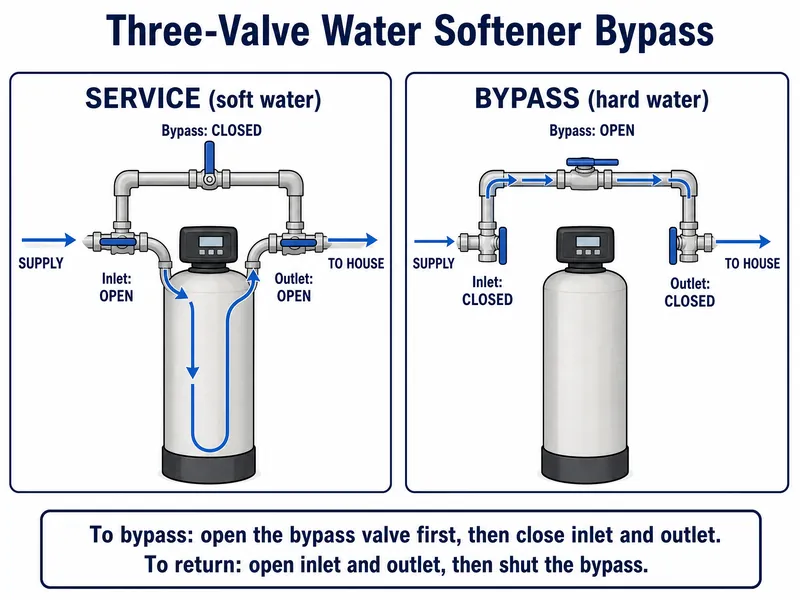
| Three-valve | Inlet and outlet open, bypass line closed | Bypass line open, inlet and outlet closed |
The push/pull and lever rules come from SoftPro's bypass positions guide (SoftPro, our store), which says a handle rotated perpendicular to the pipe signals a closed or bypassed path. A three-valve bypass is three ordinary shutoff valves on the pipes: one on the inlet, one on the outlet and one on a crossover between them.
On Fleck valves, the service manual lists three bypass part numbers:
| Part number | Bypass |
|---|---|
| 60049 | Plastic, 3/4-inch |
| 60040 | Brass, 3/4-inch |
| 60041 | Brass, 1-inch |
For a metal replacement on a Fleck valve, Quality Water Treatment sells a stainless 3/4-inch Fleck bypass (sold by Quality Water Treatment, our store) with 3/4-inch female NPT connections that, by the store's description, fits most Fleck 5600, 5800, 2510 and 9000 valves, from $120 (October 2026).
How do you put a softener in bypass and back in service?
- Find the style. Match your valve to the table above before turning anything.
- Fleck plastic bypass. Quality Water Treatment's guide says to rotate both knobs clockwise, in the direction marked BYPASS, until they lock.
- Three-valve bypass. The Fleck manual gives the order: open the valve in the bypass line first, then close the inlet and outlet valves at the softener.
- Do the work. If you are opening the control, unplug it too; the Fleck service steps relieve pressure and unplug the cord before taking parts off.
- Return to service. Turn Fleck knobs counter-clockwise until fully open. On a three-valve setup, open the inlet and outlet, then be sure to shut off the bypass line, as the manual's note says.
- Flush. SoftPro suggests running cold taps for several minutes before you use hot-water appliances, which clears air and stirred-up sediment.
On a new install, Pentair's manual has you work both handles back and forth two or three times before opening the main, so the O-rings seat and do not leak. SoftPro's Elite guide notes the red handles may be stiff at first and that the included Allen wrench can be used for leverage. The installation guide has the full start-up order.
When should you use the softener bypass?
Use the bypass whenever you need to stop water passing through the softener, or when the water you are about to use does not need softening:
- Service work. The Fleck injector cleaning procedure starts with the bypass; see cleaning the injector.
- Emergencies. SoftPro lists a water leak, a broken brine float, a stuck regeneration or a control valve fault as reasons to bypass at once.
- Resin beads in the taps. See resin beads in the water for what to close and flush.
- Long trips. SoftPro's vacation guide (SoftPro, our store) says to leave the softener running for trips under two weeks and to keep bypass under 30 days. See vacation mode.
- Outdoor water. The EPA WaterSense guide suggests bypassing when you water the lawn, wash the car or fill a pool, which saves salt, water and energy, as long as you switch back. NDSU Extension says softened water is not recommended for house plants, lawns and gardens because of its sodium.
A bypass you never have to touch is better still. The WQA's softener booklet asks installers to bypass outside sill cocks whenever feasible, and Penn State Extension says toilets, outside spigots and basement sinks can be bypassed. Our page on where to install a water softener shows how to plumb those lines around the unit.
Why is a softener bypass valve leaking or stuck?
Leaks. SoftPro's leak guide (SoftPro, our store) names damaged or dry bypass O-rings as a common cause of leaks near the valve, along with loose fittings, cracked valve parts, a faulty float and pressure above 60 lbs. Its fix starts with water and power off, then fresh seals and a regeneration while you watch the joints. Pentair's manual allows only 100% silicone grease on these seals, never petroleum grease. Our page on a leaking water softener covers the other leak points.
Stuck handles. Forcing a bypass handle can crack the valve body or damage the internal cartridge, SoftPro cautions. Turn off the water so there is no pressure on the seals, then work the handle gently. If the body shows hairline cracks, corrosion or warping, SoftPro says to replace the whole assembly rather than repair it.
How do you know the bypass is fully in service?
Test the water, not just the handles. A bypass left partly open is one of the simplest causes of hard water: Quality Water Treatment's guide warns that knobs not completely open let unsoftened water through, and the Fleck manual's troubleshooting table starts its hard-water checks with an open bypass. SoftPro's hardness-test guide (SoftPro, our store) says that if raw and treated readings fall within 1 to 2 gpg of each other, water is probably bypassing the softener. Then work through how to tell if a water softener is working.
How we put this page together
Bypass steps and settings come from Pentair's 5600SXT manual and Fleck's service manual for the same valve, Quality Water Treatment's Fleck guide, SoftPro's Elite guide plus its bypass, vacation, leak and hardness-test pages, EPA WaterSense (May 2026), the WQA, Penn State and NDSU; every page was rechecked in October 2026. The bypass price comes from Quality Water Treatment's product page. We left out penetrating-oil fixes for stuck stems, since Pentair allows only silicone on the seals, and ran no trials of our own.
Common questions
Which way do the Fleck bypass knobs turn for bypass?
Clockwise, toward the word BYPASS, until they lock, according to Quality Water Treatment's Fleck guide. Turn them counter-clockwise until fully open to put the softener back in service.
Is it safe to leave a softener in bypass for a month?
SoftPro suggests keeping bypass under 30 days. For absences under two weeks it says to leave the softener running instead. When you return, put the bypass back in service and flush the cold taps.
Why run cold taps after switching the bypass back?
SoftPro recommends running cold taps for several minutes after a bypass change and before using hot-water appliances. It pushes air and loosened sediment out through a cold fixture rather than into the water heater or dishwasher.
Can a plastic bypass be swapped for a stainless one?
On many Fleck valves, yes. Quality Water Treatment describes its 3/4-inch stainless bypass as fitting most Fleck 5600, 5800, 2510 and 9000 valves. Confirm your valve model before you order.
Does a new softener come with a bypass valve?
Usually. Pentair says a bypass valve system is included with its 5600SXT systems, and SoftPro lists a bypass valve among the Elite's included parts. If yours has none, the Fleck manual says to provide one.
Which grease is safe on bypass O-rings?
Only 100% silicone grease, per Pentair's manual, which warns that non-silicone grease can make plastic parts fail over time.
Can you still use water while the softener is bypassed?
Yes. Quality Water Treatment's guide says fixtures and appliances keep working in bypass, but the water you use will be hard, so return to service as soon as the job is done.
Related guides
More help: see our water softener guides.