
Fix
Water Softener Resin Beads in Water
Water softener resin beads in water mean media is escaping the tank, usually through a cracked bottom distributor or a damaged screen or gasket; bypass the softener, repair the tank, then flush the pipes.
By the Water Softener Guide editors · Updated
Disclosure: watersoftenerguide.net is owned by the team behind SoftPro Water Systems and Quality Water Treatment, which sell some of the parts and systems we link to. Our steps follow the makers' manuals and published instructions, checked October 2026. Always check your own model's manual first. Ownership disclosure
View at Quality Water Treatment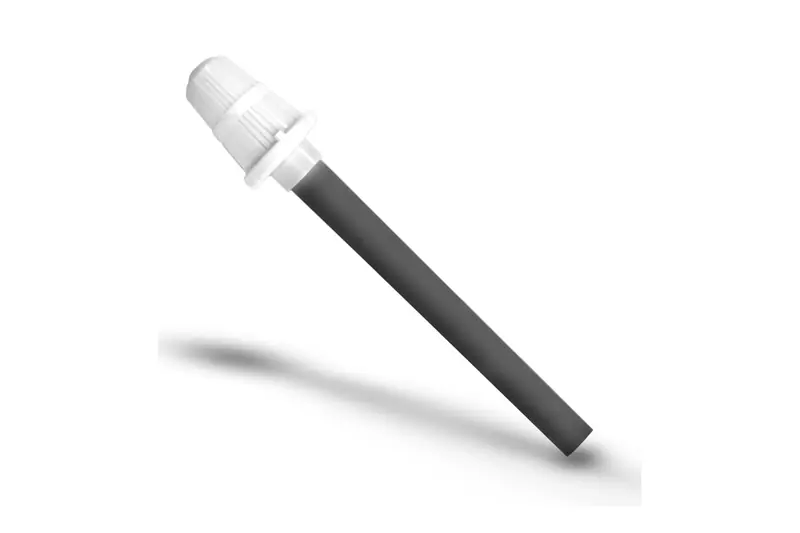
On this page
Key takeaways
- Softener resin is dark, round and about 0.3 to 1.0 mm across, according to SoftPro (SoftPro, our store).
- SoftPro's resin leak guide (SoftPro, our store) names a cracked bottom distributor and damaged screens or gaskets as the usual escape route.
- Its first steps: bypass, close the softener valves, avoid hot water and flush the cold lines.
- Beads in the drain line during regeneration point to air in the water or a wrong drain line flow control (Pentair 5600SXT manual).
- Beads plus hard water point to a leak at the distributor tube or its O-ring, in the same Pentair troubleshooting table.
- Pentair 5600SXT systems hold 1.0 to 2.0 cubic feet of resin, so a slow loss adds up.
What do water softener resin beads look like?
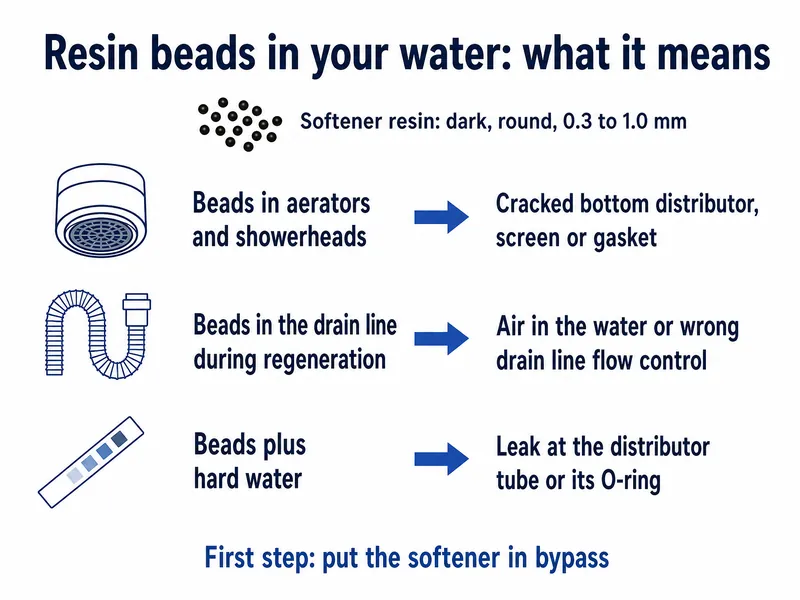
Softener resin looks like tiny, uniform dark balls. SoftPro puts them at roughly 0.3 to 1.0 mm and says to look in faucet aerators and showerheads first; NDSU Extension describes the resin as beads that resemble wet sand.
Unscrew the aerator on a cold tap you use often and tip what's inside onto a white paper towel. Beads that roll and match in size fit the description. Grit that is sharp, flat or uneven is more likely sediment, which belongs in the troubleshooting guide instead.
SoftPro lists other signs that tend to arrive together: brownish water, gritty deposits in fixtures, clogged washing machine and dishwasher screens, and a drop in water pressure as aerators fill up. Because resin is leaving the tank, hardness can creep back too. A strip test on a softened tap, as in our guide on how to tell if a water softener is working, shows whether softening has slipped.
What the sources say
- 0.3–1.0 mmsize of softener resin beadsSoftPro (our store)
- 3/4how full SoftPro says to fill the resin tank after a repairSoftPro (our store)
- 1.0–2.0 cu ftresin in Pentair's three 5600SXT system sizesPentair 4005293 manual
- 30 dayslongest SoftPro suggests leaving a softener in bypassSoftPro (our store)
Why do resin beads get into the water?
Resin escapes when the part that holds it back breaks. A plastic distributor tube runs from the control valve to the bottom of the resin tank, and the slotted basket or screen on its lower end lets water through while keeping the beads in. SoftPro says the usual cause of beads in the plumbing is a cracked bottom distributor or damaged screens or gaskets, and also lists worn seals and an overfilled resin tank.
Handling can do it too. Pentair's 5600SXT manual warns that turning the tank upside down sends media into the valve, and says to fill a media tank slowly, without opening the water valve fully, so media does not leave the tank.
Where the beads turn up narrows the cause. Pentair's troubleshooting table, which matches the Fleck 5600SXT service manual, gives two separate entries: resin lost through the drain line, and hard water from a leak at the distributor tube.
| Where you find beads | Likely cause | Source |
|---|---|---|
| Aerators, showerheads, appliance screens | Cracked bottom distributor, screen or gasket | SoftPro |
| Drain line during regeneration | Air in the water or wrong drain line flow control | Pentair 4005293, Fleck 42684 |
| Beads plus hard water at the taps | Cracked distributor tube, its O-ring or tube pilot | Pentair 4005293, Fleck 42684 |
| Right after a new tank was filled | Media pushed out by filling too fast | Pentair 4005293 |
How do you fix a softener that leaks resin beads?
Seal the tank first, then replace what broke and top up the resin. SoftPro's order is bypass, isolate, then clean up, and it suggests a professional plumber if you aren't comfortable opening the tank.
- Bypass the softener. Move the bypass handles off service and close the softener valves, as covered in the bypass valve guide. The house now runs on unsoftened water.
- Stop using hot water. SoftPro says to avoid hot water until the cleanup is done, which keeps more beads out of the water heater.
- Unplug the valve and relieve pressure. Before opening anything, disconnect power and open a cold tap downstream to bleed off pressure.
- Open the tank and inspect the distributor. Remove the control valve and lift out the distributor tube. Look for cracks along the tube, a split or missing screen at the bottom, and a damaged O-ring at the top.
- Replace the damaged parts. Fit a new tube, screen, seals or gaskets as your manual specifies. The Fleck manual has you cut a new tube to its dimensional drawing, or flush with the top of the tank if there is none. Lubricate O-rings with 100% silicone only.
- Top up or replace the resin. Resin lost to the plumbing has to be replaced, and SoftPro says to fill the resin tank only to about three-quarters. Our guide on how to replace water softener resin covers emptying and refilling the tank.
- Refill slowly. Open the bypass inlet a little at a time so the tank fills without pushing media out, as Pentair directs.
For Fleck 5600 and 2510 valves, Quality Water Treatment sells a replacement distributor tube (sold by Quality Water Treatment, our store) from $52.00 (October 2026); the store lists it as a cut-to-fit 1-inch tube (1.050 inch outside diameter) that suits tanks up to 65 inches. If the bed is short of media, SoftPro sells 10% cross-link softener resin (sold by SoftPro, our store) from $132.55 (October 2026), which the store recommends for chlorinated city water.
How much resin you need depends on the tank. Pentair's own systems show the range.
| Model | Resin | Tank size | Backwash flow |
|---|---|---|---|
| VT-11-01 | 1.0 cu ft | 9 x 48 in | 2.0 gpm |
| VT-17-01 | 1.5 cu ft | 10 x 54 in | 2.4 gpm |
| VT-23-01 | 2.0 cu ft | 12 x 52 in | 3.5 gpm |
If the resin is also old or fouled, Penn State Extension notes that some resins can't be washed clean and need replacing, so a full change may make more sense than a top-up.
What if resin beads come out of the drain line?
Beads in the drain line during regeneration mean the backwash is lifting resin out of the tank, not that the distributor has cracked. Pentair lists two causes: air in the water system and a drain line flow control of the wrong size.
On a well, have the air eliminator and the well's output checked, since Pentair also names a dry well condition. Then confirm the drain line flow control matches your tank; Pentair's correction is simply to check for the proper drain rate, and the table above shows how backwash flow rises with tank size. Our drain line guide covers the fittings.
How do you clear resin beads from the plumbing?
Once the softener is sealed, flush the loose beads out of the house plumbing. SoftPro's resin leak guide gives the steps.
- Flush the cold lines. Open each cold tap fully and let it run, working from the tap nearest the softener outward.
- Clean every aerator and showerhead. Unscrew them, rinse out the beads and refit. Repeat after a day or two, because stragglers keep arriving.
- Flush the water heater. SoftPro says to drain and flush the hot water tank. Turn off the heater's power or gas first, follow the heater maker's instructions, and beware of scalding water. Pentair's table separately says hardness in a hot water tank takes repeated flushing with treated water.
- Run the appliances. SoftPro suggests running the dishwasher and washing machine, then checking their inlet screens for beads.
- Return the softener to service. Open the bypass slowly, run a soft cold tap until it is clear, then test hardness after the next regeneration.
When beads keep showing up after a repair, or the tank and valve are old, the water softener parts guide and the troubleshooting guide can help you decide between another repair and a new softener.
Related guides
Common questions
Can the softener stay in bypass while a new distributor is on order?
Yes. In bypass the house gets unsoftened water and no more beads leave the tank. SoftPro's limit for bypass is 30 days, so plan the repair within that window.
Why do resin beads keep appearing after a new distributor tube goes in?
Beads already in the pipes and water heater take time to work their way out. Keep cleaning aerators and flush the water heater again with its power or gas off. If fresh beads keep arriving, recheck the screen and the O-ring at the top of the tube.
Is resin that leaked into the pipes worth reusing?
No. Beads flushed from faucets and the water heater are mixed with debris and shouldn't go back in the tank. Replace lost media with new resin of the type your softener uses.
Do resin beads mean the whole softener needs replacing?
Not usually. A cracked distributor, screen or O-ring is a repair. Replacement makes more sense when the tank itself is damaged or the resin is near the end of its life anyway.
Are softener resin beads harmful if swallowed?
The sources used here don't address health effects. SoftPro treats escaped beads as a plumbing problem to flush out, and the practical step is to bypass the softener and clear the lines before drinking from affected taps.
Can a brand-new softener release resin beads?
Yes, if the tank was tipped or filled too fast. Pentair warns that turning the tank upside down sends media into the valve and says to fill the media tank slowly with the water valve only partly open.
Why is my water brown as well as full of beads?
SoftPro lists brownish water among the signs of a resin leak. Flush the cold lines and the water heater as described above, then retest; color that stays may point to iron, which needs its own check.
How we put this page together
This page is based on SoftPro's resin leak and low-pressure guides, the Pentair 5600SXT system manual (4005293 Rev B) and its troubleshooting table, the Fleck 5600SXT downflow service manual, NDSU Extension's water softening publication and Penn State Extension's water softening page, each reviewed in October 2026. The distributor tube and resin prices were read from Quality Water Treatment's and SoftPro's listings that month. Deliberately omitted: repair cost estimates, health claims no source makes, user forum stories and lab work.
More help: see our water softener maintenance and repair guides.