
Settings
How Often a Water Softener Should Regenerate
How often should a water softener regenerate? About once a week at an efficient salt setting; Penn State's worked example for four people on 10 gpg water lands at 6 to 7 days.
By the Water Softener Guide editors · Updated
On this page
- How often should a water softener regenerate?
- How do you work out your regeneration interval?
- Why does the salt setting change how often it regenerates?
- How do reserve and day override shape how often a softener regenerates?
- What if a water softener regenerates too often?
- What if it does not regenerate often enough?
- Common questions
Key takeaways
- Penn State Extension works the interval as capacity ÷ daily grains: a 20,000-grain unit, four people, 75 gallons each, 10 gpg = about 6 to 7 days.
- Owned-store guides range from every 2 to 3 days (one SoftPro page) to every 4 to 7 days for two people (Quality Water Treatment).
- A 1 cu ft Pentair 5600SXT system is rated at 11,900 grains with 3 lb of salt but 35,400 with 15 lb, so the salt setting moves the interval as much as household size.
- NDSU Extension warns that recharging too early wastes salt and water, and too late lets performance fall off.
- Quality Water Treatment sets a 14-day override as a backstop, or 7 days for 2 to 3 ppm of iron.
- The Fleck 5600SXT shows Err 2 when more than 99 days pass without a regeneration (manual 42684 Rev B).
The interval in numbers
- 75 galWater per person per day in Penn State's examplePenn State Extension
- 6–7 daysInterval for four people at 10 gpg on 20,000 grainsPenn State Extension
- 4–7 daysInterval Quality Water Treatment gives a two-person homeQuality Water Treatment (our store)
- 4,400Grains removed per pound at Pentair's lowest dosePentair 4005293 Rev B
- 14 daysDay override Quality Water Treatment programsQWT Fleck 5600SXT install guide
How often should a water softener regenerate?
About once a week is the usual target for a home softener that is sized well and set to an efficient salt dose. A unit that runs out of capacity about every seven days can use a lean salt setting and still keep up, and Penn State's worked example lands at 6 to 7 days.
The owned-store guides give a wider spread. One SoftPro troubleshooting page (SoftPro, our store) says "typically every 2-3 days depending on usage", another SoftPro page says every 3 to 5 days, and Quality Water Treatment says every 4 to 7 days for a two-person home. The spread reflects hardness, water use and tank size, so work out your own number rather than copying one.
A metered (demand) valve, such as a Fleck 5600SXT set to a meter control type, decides for itself by counting gallons, so the interval moves with how much water you use. A timer valve regenerates on fixed days whatever you use, so you choose the interval. The settings guide explains which values on the valve control this.
How do you work out your regeneration interval?
Divide the softener's usable capacity by the grains of hardness your household uses each day. You need three numbers: hardness in grains per gallon (gpg), daily water use, and capacity in grains at your salt setting.
- Find your hardness. Use a test result, not a guess. If your report gives mg/L or ppm, divide by 17.1 to get gpg; SoftPro's Elite install guide says to round up. The hardness testing guide covers strips, drop kits and lab tests.
- Estimate daily grains. Multiply people by about 75 gallons a day, then by hardness. With dissolved (ferrous) iron, follow your softener's manual; SoftPro's Elite guide adds 3 gpg where iron runs 2 to 3 ppm.
- Divide capacity by daily grains. The answer is the days between regenerations.
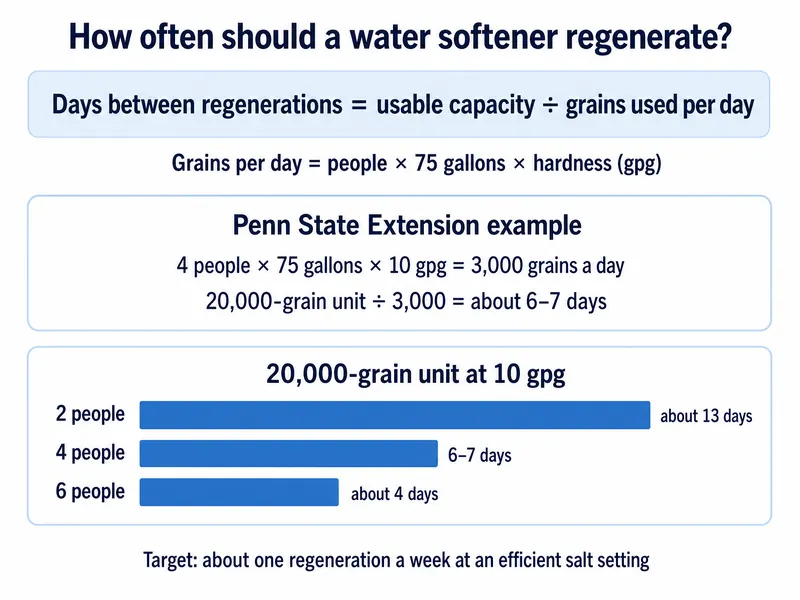
Penn State Extension uses exactly this method: 4 people × 75 gallons × 10 gpg = 3,000 grains a day, and 20,000 ÷ 3,000 gives a regeneration every 6 to 7 days. The same arithmetic for other households:
| Household | Grains per day | Days on 20,000 grains | Days on 32,000 grains |
|---|---|---|---|
| 2 people | 1,500 | about 13 | about 21 |
| 4 people | 3,000 | 6 to 7 | about 11 |
| 6 people | 4,500 | about 4 | about 7 |
A two-person home on a 32,000-grain unit would wait three weeks between cycles. The WQA's softener booklet asks installers to avoid oversizing equipment for that reason, and to start from about 200 gallons a day for a family of four.
Why does the salt setting change how often it regenerates?
Capacity depends on the salt dose, so the same tank lasts longer on more salt. Pentair's 5600SXT manual rates each of its systems at three salt doses:
| System | Resin | Lean salt | Medium salt | Maximum salt |
|---|---|---|---|---|
| VT-11-01 | 1.0 cu ft | 11,900 @ 3 lb (4 days) | 31,100 @ 9 lb (10 days) | 35,400 @ 15 lb (12 days) |
| VT-17-01 | 1.5 cu ft | 17,900 @ 4.5 lb (6 days) | 46,600 @ 13.5 lb (16 days) | 53,100 @ 22.5 lb (18 days) |
| VT-23-01 | 2.0 cu ft | 23,900 @ 6 lb (8 days) | 62,200 @ 18 lb (21 days) | 70,700 @ 30 lb (24 days) |
At the lean dose, Pentair's rating works out to 4,400 grains for each pound, above the WQA's 4,000-grain efficiency target. That is why a weekly cycle on a lean dose is the goal: more frequent, smaller regenerations use salt better than rare, heavy ones. Fleck's 42684 Rev B service manual says the control works out its gallons as unit capacity divided by feedwater hardness, minus the reserve, so the capacity you enter must match the salt dose the system actually uses.
How do reserve and day override shape how often a softener regenerates?
The reserve brings each cycle forward a little, and the day override sets the longest gap allowed. Pentair's manual lets the safety factor run from zero to half of capacity, and the day override (DO) from Off up to 99 days. Quality Water Treatment's 5600SXT install guide programs a 15% safety factor and DO at 14.
On a metered valve, DO is a backstop: the 42684 manual says a metered system regenerates regardless of use once the days since the last cycle equal the DO value. On a time-clock valve, DO is the schedule itself. WQA guidance limits calendar overrides to the cases that need them, such as vacation homes or water that fouls resin while it sits. The Fleck 5600SXT programming guide walks through each screen.
What if a water softener regenerates too often?
Daily or every-other-day cycles in a small household usually mean a setting is wrong. The Fleck 42684 troubleshooting table gives two causes of excess salt use: an improper salt setting, or too much water in the brine tank. SoftPro's troubleshooting page (SoftPro, our store) treats a unit that regenerates too often as a control valve or settings problem.
Check these in order:
- Hardness or capacity value. Compare the H and C settings with a fresh test and the capacity at your salt dose.
- Water use. A leaking toilet or new appliance raises daily gallons; a metered valve follows.
- Brine tank level. Excess water points to the refill or brine valve; see brine tank full of water.
- Timer schedule. On a time-clock valve, the DO value alone sets the interval.
The too-much-salt guide goes through each check.
What if it does not regenerate often enough?
Long gaps are fine only if the water stays soft. If hard water shows up and the salt level barely moves, the softener is either not regenerating or not drawing brine. The Fleck 42684 manual lists these causes of failing to regenerate: power interrupted (check the fuse, plug and switch), a defective timer, or a power failure that needs the time of day reset.
Other common causes:
- Hardness set too low or capacity set too high. The meter thinks more soft water is left than there is.
- Day override off on a metered valve. With DO off, a low-use home can go weeks between cycles. Quality Water Treatment uses 14 days as a backstop.
- Iron in the water. Quality Water Treatment's Fleck guide sets DO to 7 for 2 to 3 ppm of iron and cuts a day more if staining continues; higher iron needs an iron filter.
- Salt not dissolving. Pentair says a bridge lets the valve regenerate without recharging the resin. See the salt not going down guide.
If you are not sure regeneration happens at all, the regeneration guide explains what each step should do, and how to reset a water softener covers a clock lost in an outage.
Related guides
 SettingsWater softener settings explained
 SettingsHow regeneration works
 FixWater softener troubleshooting
How we put this page together
Sources: Penn State and NDSU Extension, the Water Quality Association's Getting Smart with Softeners booklet, the Pentair 5600SXT operation manual, Fleck's 5600SXT service manual (42684), Quality Water Treatment's 2021 Fleck install guide, SoftPro's Elite install guide and guide pages from both owned stores, all checked in October 2026. The intervals in the tables are our own arithmetic from those figures. Household-size rules of thumb without a primary source, and forum anecdotes, were left out.
Common questions
Does a softener regenerate more often with very hard water?
Yes. Each gallon of harder water uses up more of the resin's capacity, so the same tank runs out sooner. At 20 gpg a household uses capacity twice as fast as at 10 gpg, so either the interval halves or you need a larger unit.
Should a metered softener still have a day override?
A day override works as a backstop, so the resin is refreshed even when the house sits empty. Quality Water Treatment programs 14 days on its Fleck units, and Pentair allows anything from Off to 99 days. Your manual's recommendation takes priority.
Does the house get soft water while the softener regenerates?
Not from a single-tank unit, which sends untreated water to the taps until the cycle ends. That is why the regeneration time is usually set in the middle of the night. Twin-tank systems switch to the second tank, so soft water keeps flowing.
Is regenerating every day bad for a softener?
It wastes salt and water more than it harms the unit; NDSU Extension says recharging too early wastes both. Daily cycles in an ordinary home usually mean the hardness or capacity setting is off, so check them against a fresh test.
How often should a softener regenerate for one person?
At 10 gpg and 75 gallons a day, one person uses 750 grains a day, so even a 20,000-grain unit lasts more than three weeks. A day override such as Quality Water Treatment's 14 days keeps the resin from sitting too long.
Does a vacation change how often it regenerates?
A metered valve sees no water use, so only the day override triggers a cycle. A timer valve keeps regenerating on schedule while you are away. Our vacation mode guide covers bypass and longer trips.
What does Err 2 mean on a Fleck 5600SXT?
In the 42684 manual, Err 2 means more than 99 days since the last regeneration, or more than 7 days in day-of-week mode. A regeneration clears it. Other Fleck board versions word their codes differently, so check the manual for your board.
More help: see our water softener guide.