
Install
Water Softener Installation, Step by Step
Water softener installation means cutting the softener into the main line after any well pressure tank and before the water heater, adding a bypass and an air-gapped drain line, then following your manual's start-up.
By the Water Softener Guide editors · Updated
Disclosure: watersoftenerguide.net is owned by the team behind SoftPro Water Systems and Quality Water Treatment, which sell some of the parts and systems we link to. Our steps follow the makers' manuals and published instructions, checked October 2026. Always check your own model's manual first. Ownership disclosure
View at Quality Water Treatment
On this page
Key takeaways
- On a well, SoftPro's Elite install guide says the softener goes after the pressure tank; installed before it, the unit "will not operate properly".
- Pentair's 5600SXT manual asks for at least 10 feet of pipe between the softener and the water heater.
- The Fleck 5600SXT service manual sets a 1/2-inch minimum drain line and 3/4-inch for runs over 20 feet.
- Every manual requires an air gap of 1 inch or 2 pipe diameters, whichever is larger, at the drain.
- Quality Water Treatment and SoftPro both estimate about 4 hours for a homeowner and 3 hours for a plumber or handyman.
- The EPA WaterSense softener guide says to install before the water heater and, where possible, after the branch to outdoor hose bibs.
Install numbers from the manuals
- 10 ftMinimum pipe run from softener to water heaterPentair 5600SXT manual
- 20-125 psiWorking water pressure range for the 5600SXTPentair 5600SXT manual
- 1 inchMinimum air gap at the drain, or 2 pipe diameters if largerPentair 5600SXT manual
- 4 hoursTypical DIY install time (3 hours for a handyman or plumber)Quality Water Treatment install guide
What should you check before a water softener installation?
Check the spot on the main line, your water pressure, the room temperature, and the power and drain nearby before you cut a pipe.
Location. The softener belongs on the main supply line, ahead of the water heater. On a private well it goes after the pressure tank, and SoftPro's Elite guide has you cut in after the tank and after any irrigation tee. Pentair's manual wants at least 10 feet of pipe to the heater so hot water cannot back up into the valve. Sediment filters, iron filters and neutralizers go upstream; SoftPro's guide puts a UV unit after the softener. Outdoor taps can stay hard: the WQA's softener booklet asks installers to bypass outside sill cocks, and Penn State Extension says outside spigots can be bypassed. See where to install a water softener for garages and basements, and the water softener loop page if you have pre-plumbed stubs.
Pressure and temperature. The Fleck 5600SXT manual needs at least 20 psi for the valve to regenerate and caps pressure at 125 psi; if daytime pressure tops 80 psi, it calls for a pressure-reducing valve. The same manual says not to install where it can drop below 32 F or rise above 110 F. Other valves have their own limits, so read your manual.
Power and drain. You need a constant outlet (see the questions below for each maker's rule) and a floor drain, laundry tub or standpipe nearby.
Code and safety. Shut off the water and drain the lines before cutting anything. The Fleck manual notes that permits may be required and that the product should be installed by a plumbing professional; drain connections, air gaps and main-line cuts are code work in many areas. If you are unsure of your local rules, hire a licensed plumber for those parts.
Which tools and parts does the job need?
Quality Water Treatment's Fleck 5600SXT guide and SoftPro's Elite guide list nearly the same kit. Gather it before the water goes off.
| Item | What it is for |
|---|---|
| Teflon tape | Threaded joints; the only sealant the Fleck manual allows on the drain fitting |
| 1/2-inch ID drain tubing and hose clamp | Carries regeneration water to the drain |
| Drain and air gap fittings | Hold the tubing end above the drain (SoftPro list) |
| Bypass valve | Isolates the softener; the Fleck manual says always provide one |
| Quick-connect fittings | Copper, PEX or CPVC connections without soldering |
| PVC primer and glue | Only if your house has PVC supply pipe |
| Ground clamp and #6 copper wire | Keeps the electrical bond when plastic interrupts metal pipe |
| Hose bib and tee (optional) | Gives you a soft-water tap near the unit |
A few rules from Pentair's manual save trouble later. O-rings get 100% silicone grease, never petroleum grease, which can make plastic parts fail and cause leaks. Hand-tighten plastic connections without pliers or pipe wrenches. Make house plumbing changes first and connect to the valve last, letting soldered pipe cool. Where galvanized pipe meets new copper, use dielectric connectors, and never run pipe smaller than your main line.
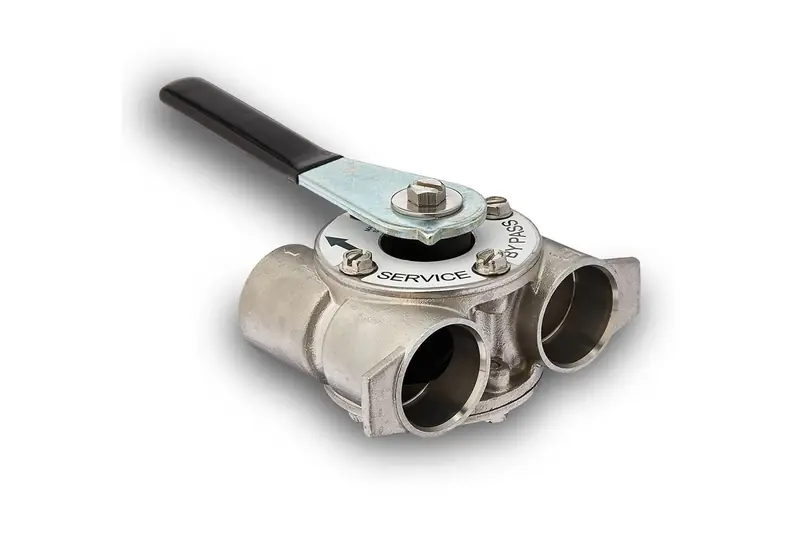
For Fleck 5600, 5800, 2510 and 9000 valves, Quality Water Treatment sells a 3/4-inch stainless Fleck bypass (sold by Quality Water Treatment, our store) with female NPT connections that it says fits most of those valves, from $120 (October 2026). On a SoftPro Elite, the SoftPro quick connect hose (sold by SoftPro, our store) joins the valve to your supply pipe with an FIP swivel nut on one end and a push-to-connect fitting on the other; the hoses are 18 inches long, not for PVC, and start from $79 (October 2026).
How do you install a water softener, step by step?
These steps follow the Fleck and Pentair manuals and the two store guides; where your manual differs, follow it.
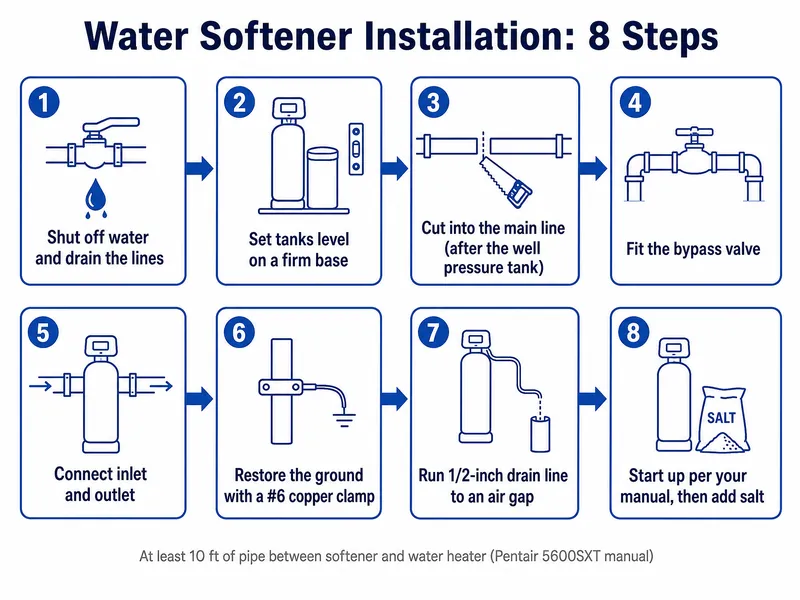
- Shut off and drain. Close the main shutoff, then open a low faucet to relieve pressure and drain the pipes you will cut. On a well, SoftPro's guide also has you switch off the well pump and the water heater breaker first.
- Set the tanks. Put the resin tank level on a firm base with the brine tank beside it. In cold weather, the Fleck manual says to let the valve warm to room temperature before you operate it.
- Cut into the main line. On a well, cut after the pressure tank and after any irrigation tee. If you have a loop, crack the main open slightly; SoftPro's guide says the pipe that flows is the supply, or inlet.
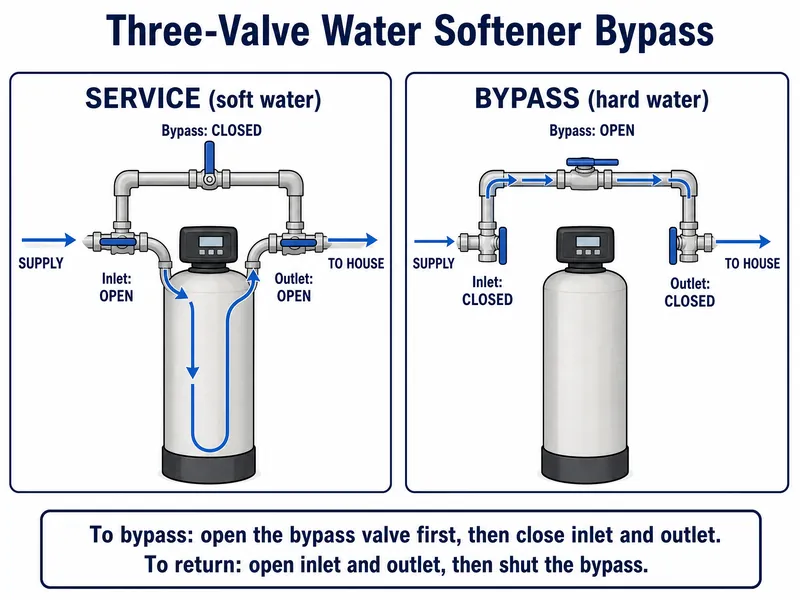
- Fit the bypass. Mount the bypass on the valve. Pentair says to rotate the two handles 2 to 3 times before the water goes back on, which helps seat the O-rings. Our bypass valve guide shows each position.
- Connect inlet and outlet. Run the supply pipe to the valve's inlet port and the house side to its outlet; Pentair warns that a replaced unit's inlet and outlet plumbing may be reversed. Keep solder joints at least 6 inches from the drain line flow control, as the Fleck manual specifies.
- Restore the ground. If plastic now interrupts metal pipe, Quality Water Treatment's guide calls for an approved ground clamp with no less than #6 copper wire across the gap.
- Run the drain line. Clamp 1/2-inch ID tubing to the drain port. The Fleck manual moves you up to 3/4-inch for runs over 20 feet or backwash flow over 7 gpm. On a SoftPro Elite, leave the drain-port barb in place because it holds the flow restrictor. End the line above the drain with an air gap; the drain line guide covers length and lift.
- Run the overflow line. Pentair wants a separate 1/2-inch line from the brine tank overflow to a drain, never higher than the overflow fitting, never tied into the valve's drain line, and with its own air gap.
- Leave the valve unplugged until you reach the start-up steps below.
How do you start up a new softener?
Follow your system's start-up steps; the makers and the stores disagree on whether a first regeneration is needed.
Fleck and Pentair manuals. Put about 1 inch of water above the brine tank grid plate, and no salt yet. With the unit in bypass, turn on the main and run a nearby cold soft-water tap until it clears of debris. Move the bypass slowly to service and let the tank fill; Pentair warns not to open the valve fully, so the media stays in the tank. When flow stops, open a cold tap slowly to purge air, then plug in. Next, cycle the valve by hand: backwash until the drain runs clear or steady for 10 minutes, brine draw until the valve pulls from the brine tank, rapid rinse for 5 minutes or until clear, then brine fill. Replace the cover and add salt.
Pre-charged store systems. Quality Water Treatment says its pre-loaded Fleck units need no manual regeneration because the resin is pre-charged, and SoftPro says the same for the Elite. Both have you open the bypass inlet slowly until the tank fills, then the outlet, and run the nearest cold soft tap until clear. Add water to the brine tank as your guide states (QWT says 2 gallons, SoftPro 3 gallons), then salt, then plug in and program.
Use pellets or solar crystals; the Fleck and Pentair manuals both say not to use rock salt. Then program the valve with your hardness from a real test (see how to test water hardness) and set the time and regeneration options with our water softener settings guide or the Fleck 5600SXT manual walkthrough. If pressure drops sharply on day one, see low water pressure after a softener.
Does a softener installation need a permit or a plumber?
Sometimes. Fleck's manual says the install has to comply with state and local plumbing and electrical code, and that a permit may be needed. SoftPro's code checklist (SoftPro, our store) puts permits at $50 to $300 where they apply, and Quality Water Treatment's guide says Massachusetts installs must follow 248 CMR, whose air gap section requires at least twice the effective diameter of the drain served. The EPA notes that some local jurisdictions prohibit salt-based softeners, so check before you buy. Our installation cost guide covers what a plumber charges.
Where do softener installs go wrong?
Install errors worth avoiding
Softener ahead of the pressure tank
SoftPro's guide is clear that a well softener goes after the pressure tank. Installed before it, the valve will not work properly.
Drain tube pushed into the pipe
Every manual says never insert the drain line into a drain, sewer line or trap, so sewage cannot be back-siphoned into the softener.
Bypass left half open
Quality Water Treatment warns that knobs not fully open let hard water slip past. Turn them until they stop.
If something is off after the install, start with the water softener troubleshooting guide.
How we put this page together
This install guide draws on two maker manuals (Pentair 4005293 for the 5600SXT system and Fleck 42684 for the 5600SXT valve), the install guides from Quality Water Treatment and SoftPro, SoftPro's code checklist, the EPA WaterSense softener guide (May 2026) and Massachusetts 248 CMR 10.12, all checked October 2026. Prices come from the stores' own product pages. We left out cost and time figures without a primary source, store pressure limits that conflict with the manuals, and forum advice; nothing here comes from lab or field testing.
Common questions
How long does it take to install a water softener?
Quality Water Treatment's and SoftPro's install guides both put the job at about 3 hours for a handyman or plumber and about 4 hours for a homeowner.
Does a whole-house filter go before or after the softener?
Before it. Pentair's manual lists sediment, iron and taste-and-odor filters upstream of the softener, and SoftPro's guide calls the softener the final treatment step, with a UV unit as the exception that goes after it.
Can a softener be connected to PEX or PVC pipe?
Yes, with the right fittings. Quality Water Treatment's parts list uses quick-connect fittings for copper, PEX and CPVC, and PVC primer and glue for PVC. The SoftPro quick connect hoses are not made for PVC.
What kind of outlet does the softener need?
A constant one. The Fleck manual requires an uninterrupted supply, Pentair rules out switched outlets, and SoftPro asks for a grounded outlet within 10 feet with no extension cord.
Why must the supply pipe go to the valve's inlet port?
Pentair warns that when an old softener is replaced, the inlet and outlet plumbing may be reversed. Water must enter the valve's inlet port, or the unit cannot soften or regenerate as designed.
Is salt added before or after the first start-up?
It depends on the system. The Fleck manual adds salt only after cycling the valve, while QWT and SoftPro add water and salt to the brine tank before plugging in their pre-charged units.
Related guides
 InstallChoosing the spot for the tanks
 InstallUsing the bypass handles
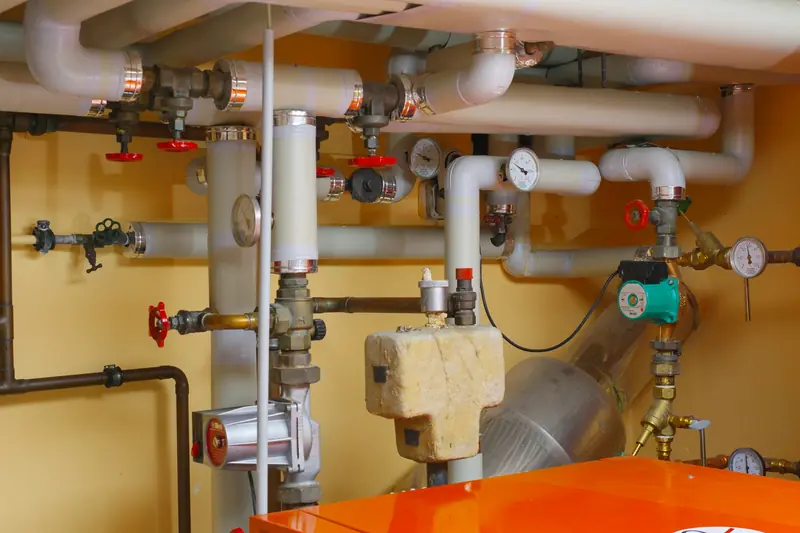 InstallDrain tubing size and lift limits
 InstallSofteners in homes with a septic tank
Parts for this job
Fleck 3/4" Stainless Bypass for 5600, 5800, 2510, 9100 & 9000
Check current options and prices at Quality Water Treatment.
View at Quality Water Treatmentwatersoftenerguide.net is owned by the team behind SoftPro Water Systems and Quality Water Treatment, which sell some of the parts and systems we link to. Ownership disclosure
More help: see our water softener maintenance and repair guides.