
Maintain
Using a Water Softener Resin Cleaner
A water softener resin cleaner removes the iron and fouling that brine leaves on the beads: pour about 4 oz per cubic foot into the brine well, then regenerate.
By the Water Softener Guide editors · Updated
Disclosure: watersoftenerguide.net is owned by the team behind SoftPro Water Systems and Quality Water Treatment, which sell some of the parts and systems we link to. Our steps follow the makers' manuals and published instructions, checked October 2026. Always check your own model's manual first. Ownership disclosure
View at Quality Water Treatment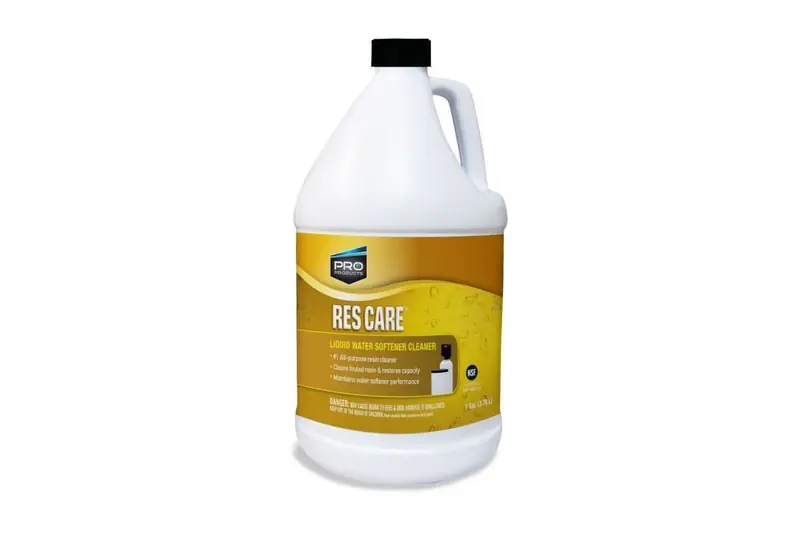
On this page
- What does a water softener resin cleaner do?
- When does softener resin need cleaning?
- Iron cleaners vs general resin cleaners
- How do you dose a resin cleaner?
- How often should you use a water softener resin cleaner?
- Resin cleaner vs bleach: which job is which?
- When cleaning the resin is not enough
- Common questions
Key takeaways
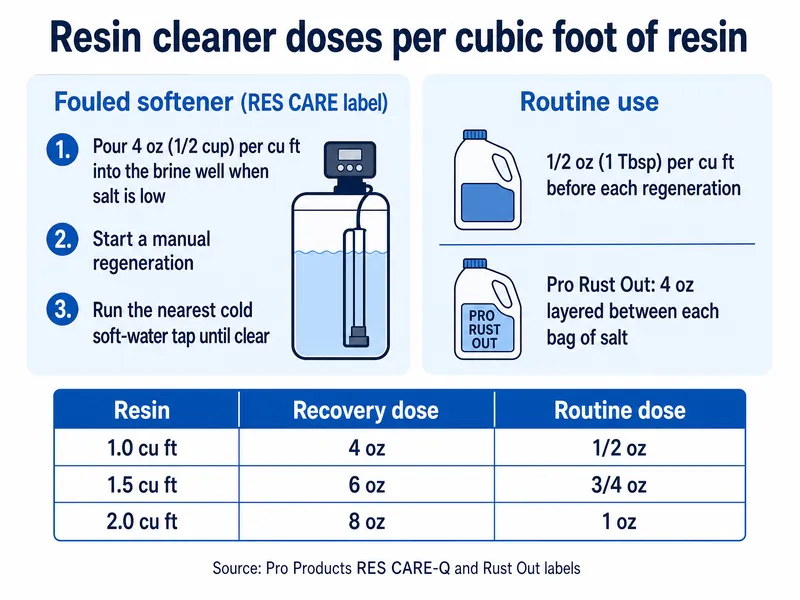
- The RES CARE-Q label doses 4 oz (1/2 cup) per cubic foot of resin for a fouled softener and 1/2 oz per cubic foot before each regeneration for upkeep.
- EPA WaterSense says softener resin beads need cleaning once a year, usually by pouring a maker-approved cleaner into the brine well and regenerating.
- Quality Water Treatment's Fleck 5600SXT guide calls for periodic resin cleaning once iron passes 0.3 ppm, and every six months with clear-water iron.
- Penn State Extension notes that commercial cleaners exist for fouled resin, but some resin cannot be washed clean and must be replaced.
- NDSU Extension says some softeners remove up to 10 ppm of iron and manganese; above that, plan a dedicated iron system.
- Pro Rust Out is layered at 4 oz between each bag of salt, so every regeneration carries some cleaner.
What the labels and agencies say
- 4 ozRES CARE-Q per cubic foot of resin to recover a fouled softenerQuality Water Treatment product label (our store)
- 1/2 ozRES CARE-Q per cubic foot before each regeneration for routine useQuality Water Treatment product label (our store)
- 0.3 ppmIron level above which periodic resin cleaning is neededQuality Water Treatment Fleck 5600SXT guide
- 1 a yearHow often resin beads need cleaning to keep efficiencyEPA WaterSense
- 10 ppmIron and manganese some softeners remove before a dedicated iron system is neededNDSU Extension
What does a water softener resin cleaner do?
A resin cleaner chemically strips iron and other deposits off the resin beads that the normal brine rinse leaves behind. In service, the beads swap calcium and magnesium for sodium; each regeneration flushes the hardness away with brine. Iron is harder to shift. Purolite, a resin maker, explains that iron builds up on the beads slowly and cuts their capacity for calcium and magnesium.
The store text for RES CARE-Q says iron and other contaminants foul the resin and hurt ion exchange, and that the cleaner reduces that fouling and restores exchange capacity. The page for Pro Rust Out says the iron coating on a resin bed is not fully removed during normal regeneration. Penn State Extension adds that red, oxidized iron (iron exposed to air or chlorine) clogs resin, and that commercial cleaners are available once it has.
When does softener resin need cleaning?
Clean the resin when softened water slowly turns harder, rust stains return, or pressure drops while the salt, settings and bypass all check out. The Pentair 5600SXT manual lists iron buildup inside the softener as a cause of lost water pressure, with the fix "add mineral cleaner to mineral bed", plus cleaning the control.
Rule out the simple faults before you buy a cleaner. Our troubleshooting guide walks through salt, injector and settings checks, and the low water pressure guide covers pressure loss. To confirm a hardness problem, compare raw and softened samples as described in how to tell if a softener is working.
Iron cleaners vs general resin cleaners
Liquid cleaners treat general fouling, including iron, while an iron remover layered with the salt is built for homes that fight iron constantly. Both reach the resin with the brine during regeneration.
| Item | RES CARE-Q (liquid) | Pro Rust Out |
|---|---|---|
| Main job | Reduces fouling, including iron | Removes iron and rust from the resin bed |
| Where it goes | Brine well or salt tank | Layered between bags of salt |
| When | Before a regeneration, or by daily feeder | Each time you add salt |
| Store price | from $34.99 (October 2026) | from $230.00 (October 2026), 50-lb bucket |
Most homes start with a liquid: Quality Water Treatment sells RES CARE-Q resin cleaner (sold by Quality Water Treatment, our store) for both recovery and routine dosing through the brine well. Homes on iron-bearing wells that want a little cleaner in every cycle can use the Pro Rust Out 50-lb bucket (sold by Quality Water Treatment, our store), which is meant to be layered into the brine tank with the salt.
Neither raises your softener's iron limit. NDSU Extension puts that ceiling at up to 10 ppm of iron and manganese for some softeners, and Nebraska Extension's G1491 warns that iron above 5 ppm or hydrogen sulfide can reduce softener effectiveness. Red water, iron bacteria or a rotten-egg smell call for an iron or sulfur filter ahead of the softener; follow your softener maker's stated limit.
How do you dose a resin cleaner?
Dose by the cubic feet of resin in your tank, using the label on the container you bought. The steps below are the RES CARE-Q label's recovery method for a fouled softener.
- Let the salt run low. The label says to add the cleaner when the salt level is low.
- Pour 4 oz (1/2 cup) per cubic foot into the brine well. The brine well is the tube in the brine tank that holds the float and brine line.
- Regenerate by hand. A Fleck 5600SXT begins regenerating immediately when Extra Cycle is held down for 5 seconds; the Fleck 5600SXT programming guide shows the buttons.
- Repeat if needed. If the discharge still shows taste, odor or color, run another regeneration.
- Flush. Run the cold soft-water tap nearest the softener until the odor or taste is gone.
For upkeep, the label switches to 1 tablespoon (1/2 oz) per cubic foot, poured into the brine well ahead of every regeneration; automatic feeders dose 0.5 or 1.0 oz a day. Pro Rust Out goes in at 4 oz between each bag of salt.
Your resin volume is on the tank label or in the manual. Pentair's data sheet is a useful cross-check for common sizes.
| System (tank) | Resin | Recovery dose | Routine dose |
|---|---|---|---|
| VT-11-01 (9 x 48 in) | 1.0 cu ft | 4 oz | 1/2 oz |
| VT-17-01 (10 x 54 in) | 1.5 cu ft | 6 oz | 3/4 oz |
| VT-23-01 (12 x 52 in) | 2.0 cu ft | 8 oz | 1 oz |
How often should you use a water softener resin cleaner?
Once a year is the baseline, and homes with iron clean more often. The sources set different intervals, so match yours to your water.
| Source | Interval |
|---|---|
| EPA WaterSense | Annually, using the maker's recommended cleaner |
| Quality Water Treatment maintenance page | Quarterly |
| SoftPro | Pro Rust Out every 3 to 12 months |
| Quality Water Treatment Fleck guide, clear-water iron | Every six months, sooner if iron shows in treated water |
The Quality Water Treatment maintenance page (Quality Water Treatment, our store) gives the quarterly figure, and SoftPro's flushing guide (SoftPro, our store) gives the 3-to-12-month range. A city home with no iron on its water report sits at the long end; a well home with clear-water iron sits at the short end. Routine label dosing before each regeneration, or Rust Out with every bag of salt, means you are cleaning continuously. Fold the job into your softener maintenance schedule.
Resin cleaner vs bleach: which job is which?
Resin cleaner removes iron and mineral fouling; bleach disinfects against bacteria and odor. Pentair's manual explains that softeners can foul with organic matter or bacteria and gives a separate disinfection dose of 1.2 fl oz of 5.25% bleach per cubic foot of polystyrene resin. Our sanitizing guide covers that procedure. Do the two jobs on separate regenerations, and keep vinegar out of the brine tank, as Quality Water Treatment warns.
When cleaning the resin is not enough
If hardness keeps coming through after two or three cleanings, the beads may be past saving. Penn State says that in some cases resin cannot be washed of contaminants and needs replacing, and Purolite notes that iron fouling and chlorine attack together can shorten resin life to under a year in extreme cases. At that point, see how to replace water softener resin, and check the hardness number in your softener settings once the new bed is in.
How we put this page together
Sources: the RES CARE-Q and Pro Rust Out product labels on Quality Water Treatment's store, Quality Water Treatment's Fleck 5600SXT install guide and maintenance page, SoftPro's flushing guide, the Pentair 5600SXT manual (4005293 Rev B), EPA WaterSense, Penn State, NDSU and Nebraska Extension, and Purolite's resin-life note, checked October 2026. Doses for 1.5 and 2.0 cubic feet are the label's per-cubic-foot rate multiplied out. We left out cleaners the stores do not sell, forum dosing tips and any lab testing of cleaner performance.
Common questions
Can resin cleaner fix orange water from a well?
Only when the iron is the dissolved, clear-water kind and within your softener's limit. Orange or red water usually means oxidized iron, which needs an iron filter ahead of the softener. Cleaner keeps iron the softener already caught from building up; it does not raise the limit.
Does resin cleaner go in the brine tank or the resin tank?
The brine tank side. RES CARE-Q is poured into the brine well, and Pro Rust Out is layered with the salt. The cleaner then travels to the resin with the brine during regeneration.
Is the water safe to use after a resin cleaning?
The RES CARE-Q label says to run the nearest cold soft-water tap after the regeneration until the odor or taste is gone. If the discharge still shows taste, odor or color, repeat the regeneration before going back to normal use.
Does a softener on city water need resin cleaner?
EPA WaterSense advises cleaning the beads once a year on any cation softener. Quality Water Treatment ties more frequent cleaning to iron above 0.3 ppm, so a city supply with little iron can usually stay on the yearly routine.
How much RES CARE-Q does a 48,000-grain softener take?
Check the resin volume on the tank first. As a guide, Pentair rates its 1.5 cubic foot system at 46,600 grains on 13.5 lb of salt, so a bed that size takes 6 oz for recovery and 3/4 oz for routine use.
Can vinegar clean the resin instead?
No. Quality Water Treatment rules out vinegar in the brine tank; it uses a weak vinegar solution only on small parts removed from the valve. Use a cleaner made for softener resin.
Is a cleaner worth trying before replacing the resin?
Yes, when iron fouling is the likely cause. Penn State notes that commercial cleaners exist for fouled resin, but also that some resin cannot be washed clean. If hardness still leaks through after repeated cleanings, plan a re-bed.
Keep the resin working

More help: see our water softener guides.