
Test
Choosing a Water Hardness Test Kit
A water hardness test kit comes in three formats: dip strips give a quick color-band estimate, drop-count titration kits a numeric grains-per-gallon reading, and a lab test the most accurate result.
By the Water Softener Guide editors · Updated
Disclosure: watersoftenerguide.net is owned by the team behind SoftPro Water Systems and Quality Water Treatment, which sell some of the parts and systems we link to. Our steps follow the makers' manuals and published instructions, checked October 2026. Always check your own model's manual first. Ownership disclosure
View at Quality Water Treatment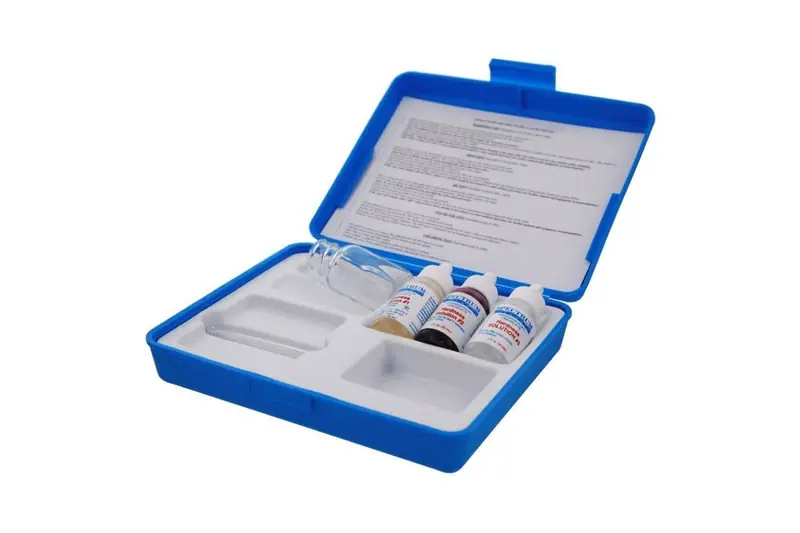
On this page
Key takeaways
- Penn State Extension prices hardness strips at about $15 for 50 and a titration kit at about $40 for enough reagent for 50 tests.
- Nebraska Extension G1491 warns that home test kits vary in accuracy and advises lab verification when a large purchase depends on the result.
- Titration kits use the same color-change chemistry as the laboratory EDTA method, AOAC 973.52B.
- A TDS meter does not measure hardness: Montana State University Extension notes softening exchanges calcium and magnesium for sodium or potassium without lowering total dissolved solids.
- Pentair's 5600SXT valve accepts hardness settings from 1 to 199 gpg, so a kit's result must end up in grains per gallon.
- Quality Water Treatment's Pro Products 2403 drop kit holds three 1 oz hardness reagents, from $150 (October 2026).
What hardness kits cost and read
- $15About 50 hardness test stripsPenn State Extension
- $40Titration kit with reagent for about 50 testsPenn State Extension
- 17.1 mg/LEqual to 1 grain per gallonMontana State University Extension
- 1–199 gpgHardness range a Pentair 5600SXT valve acceptsPentair 5600SXT manual 4005293 Rev B
What types of water hardness test kit are there?
There are three: dip strips, drop-count titration kits and laboratory tests. What changes is how the result is read and how fine the answer is. The full sampling method is in the hardness testing guide.
| Format | How it reads | Cost guide | Best for |
|---|---|---|---|
| Dip strips | Pad color matched to a chart, in bands | Roughly $15 per 50 (Penn State) | Quick raw vs softened checks |
| Drop-count titration kit | Drops counted to a color change, in gpg | Roughly $40, reagent for ~50 tests (Penn State) | A number to program the valve |
| Laboratory test | Measured value on a report | Lab fee (Nebraska G1274) | Sizing, buying, well water |
| TDS meter | Total dissolved solids, not hardness | About $20 (Penn State) | Not a hardness test |
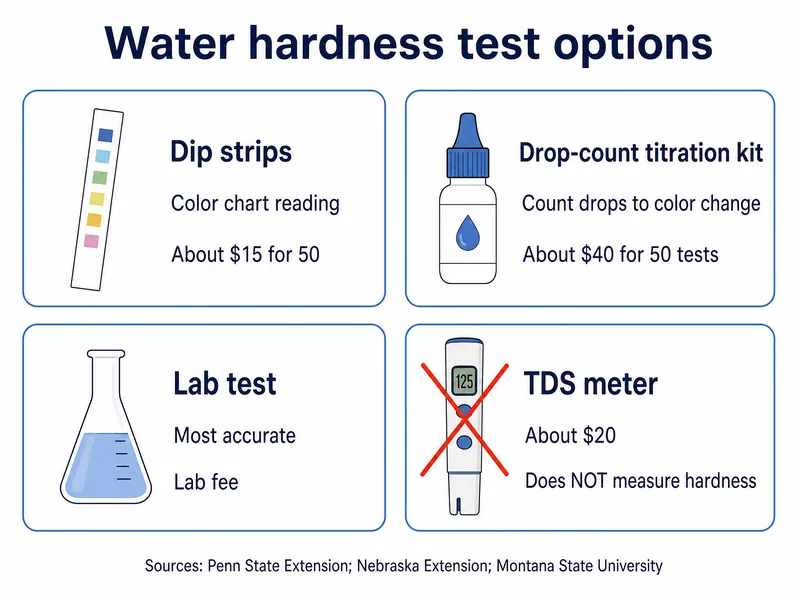
Dip strips. A pad on a paper strip changes color in the water and you match it to a printed chart. SoftPro's method reads strips in grains per gallon after a 20 to 30 second wait.
Drop-count (titration) kits. Reagent is added a drop at a time to a measured sample until the color changes; the drop count gives the hardness. Quality Water Treatment's Pro Products 2403 is an example: its listing says the case holds Hardness #1, #2 and #3 reagents of 1 oz each, one square test bottle plus a measuring tube. Quality Water Treatment sells this 2403 hardness field test kit (sold by Quality Water Treatment, our store) for reading hardness as a number at home, from $150 (October 2026), and replacement Hardness #3 reagent from $7.95.
Lab tests. A sample bottle goes to a laboratory, which reports hardness, usually alongside other results. Nebraska Extension G1274 says most water testing laboratories offer hardness tests for a fee.
How accurate is each water hardness test kit?
A lab is the most accurate, a drop kit gives a finer number than strips, and strips give an estimate. Nebraska's G1274 calls home kits and dip strips simple and affordable with a reasonable estimate, and recommends a lab when more accurate measurements are needed. Its G1491 adds that home kits vary in accuracy. Penn State Extension advises a third-party lab over a dealer's free test, noting it is not expensive and guards against being oversold.
Drop kits are worth the extra cost because of their chemistry. The laboratory EDTA titration method (AOAC 973.52B) binds calcium and magnesium until an indicator turns from wine-red to blue, and home titration kits work the same way on a smaller scale.
Three things affect how close any home kit gets:
- Water temperature. SoftPro says hot water skews strip results, so draw from a cold tap.
- How long the tap ran. SoftPro flushes about 30 seconds; Quality Water Treatment runs well water at least 5 minutes. Pick one routine and keep it.
- Reading the scale. Strips sort the result into color bands, so the answer is a range; a drop kit gives a count you convert directly.
Results convert at 17.1 mg/L per grain per gallon. Using the classes Nebraska credits to the Water Quality Association and the Interior Department, under 1 gpg is soft, 7 to 10.5 gpg is hard and over 10.5 gpg is very hard. A kit only needs enough range to place your water on that scale and give the softener a number; the settings guide explains where it goes.
Does a TDS meter measure water hardness?
No. A TDS meter estimates total dissolved solids from electrical conductivity, so it reports everything dissolved in the water, not calcium and magnesium alone. Penn State's toolkit describes these meters as measuring the current that dissolved ions carry, with basic models from about $20.
Montana State Extension explains why that makes a TDS meter the wrong tool for a softener: softening exchanges calcium and magnesium for sodium or potassium, so total dissolved solids stay about the same. A TDS reading cannot tell you how hard your water is, and a high TDS number does not mean the softener failed. For hardness, use a strip, a drop kit or a lab. If softened water seems hard, follow the checks in signs a softener is working.
Which water hardness test kit should you use when?
Match the kit to the job: a lab before buying, a drop kit for programming, strips for routine checks.
Before buying or sizing a softener. Use a lab test, as Penn State and NDSU both advise before purchasing equipment. NDSU Extension notes that private well owners are responsible for their own testing. Well owners who also want other results can use a broader kit: SoftPro sells a well water test kit (sold by SoftPro, our store) for homeowners checking a private well for common contaminants, from $159 (October 2026). City customers can start with the annual Consumer Confidence Report.
When programming the valve. A drop-count kit gives the numeric gpg the hardness screen asks for. If you only have a mg/L figure, divide by 17.1 and round up, as SoftPro's Elite install guide advises.
For routine checks. Strips are enough to compare raw and softened water every few months. Treated water should read far below the raw sample; if the two come out close, look at the bypass, salt and settings.
When something seems wrong. Run both samples through one kit within minutes of each other. If they match, see the troubleshooting guide or how to reset a softener.
How do you keep strips and reagents reliable?
Store them dry, closed and out of heat and sunlight. Penn State's toolkit says to keep meters and strips away from sunlight, temperature and humidity extremes, and dust. Check the date on each pack, and if results suddenly change for no reason, try a fresh pack before blaming the water or the softener.
Common questions
Do hardness test strips expire?
Strips and reagents age, so check the date on the pack and keep the container closed and dry. Penn State's toolkit adds that heat, humidity and sunlight shorten their usefulness.
Will a hardness kit also show iron?
A hardness-only kit will not. Quality Water Treatment's 2403 case lists only hardness reagents. Iron changes how you set and size a softener, so well owners usually need a broader well-water test or a lab report that lists iron and manganese.
Is a drop-count kit worth it over strips?
It is when you need a number to program a softener or to track small changes. Penn State's prices put a titration kit at about $40 against $15 for strips, both for about 50 tests.
Where can you buy a hardness test kit?
Penn State Extension notes that kits are sold at hardware, pool and pet supply stores and by water-testing suppliers. Check that the kit reads total hardness in gpg or mg/L.
Why does my TDS reading stay the same after softening?
Because softening trades ions rather than removing them. Montana State Extension explains that calcium and magnesium are exchanged for sodium or potassium, so total dissolved solids barely move. An unchanged TDS number says nothing about whether the softener works; a hardness test does.
Will a salt-free conditioner change my hardness test?
Usually not. Virginia Cooperative Extension notes that with magnetic and electrical devices the hardness before and after treatment is not changed, so a kit will read about the same either side of them.
How we put this page together
This page is based on Penn State Extension's water quality toolkit and water softening guide, Nebraska Extension G1274 and G1491, NDSU Extension WQ1031, Montana State University Extension, Virginia Cooperative Extension 442-664, NEMI's summary of the AOAC 973.52B method, the Pentair 5600SXT manual, plus the owned stores' testing pages and listings, reviewed in October 2026. Not included: brand accuracy claims that no primary source supports, store claims that a TDS meter reads hardness, forum anecdotes, and any kit trials of our own.
Related guides
More help: see our guide to water softener care.