
Maintain
How to Drain a Water Softener
How do you drain a water softener? Shut off the supply, bypass and unplug it, empty the brine tank away from plants, drain the resin tank as its manual directs, then drain the hoses.
By the Water Softener Guide editors · Updated
On this page
Key takeaways
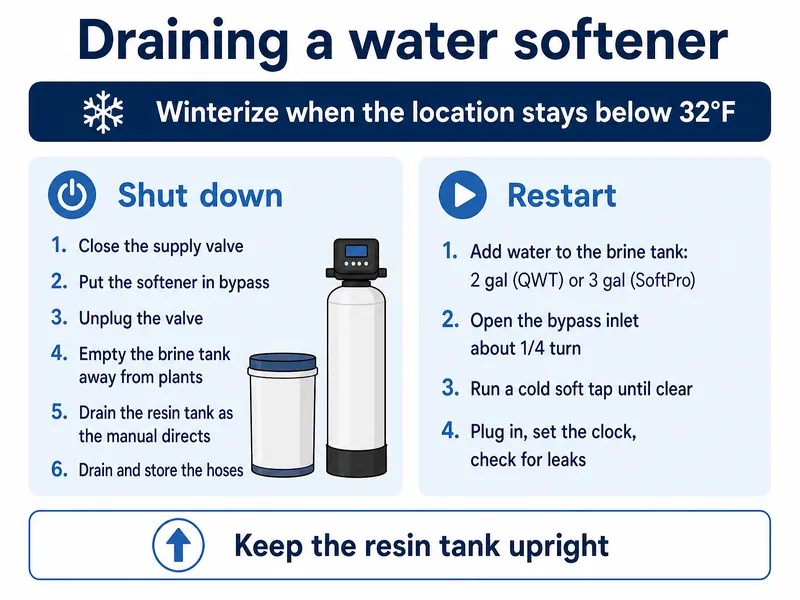
- SoftPro says to winterize a softener once its location consistently drops below 32°F: shut off the supply, bypass, drain both tanks per the manual, and drain and store the hoses.
- The Fleck 5600SXT service manual says the unit cannot be subjected to freezing and must be depressurized before any connection is removed.
- The Pentair 5600SXT manual warns that frozen water damages the valve's internal parts and the plumbing, and that a media tank tipped on its side can push resin into the valve.
- Quality Water Treatment drains brine away from plants; SoftPro leaves a little salt in the brine tank of a drained vacation home.
- At restart, add water to the brine tank as your guide states: 2 gallons in Quality Water Treatment's guide, 3 gallons in SoftPro's.
- SoftPro refills the resin tank with the bypass inlet opened only about a quarter turn.
Numbers for draining and restarting
- 32°FTemperature at which SoftPro says to winterize, when the location stays below itSoftPro (our store)
- 20 to 70 galWater a typical softener uses per regenerationEPA WaterSense
- 3 galWater SoftPro's Elite guide adds to the brine tank at start-upSoftPro Elite install guide
- 1/4 turnHow far SoftPro opens the bypass inlet while the resin tank refillsSoftPro Elite install guide
When do you need to drain a water softener?
Drain a softener only when it will freeze, move, or be opened for cleaning or a re-bed; in normal use it sits full of water for years. The Pentair 5600SXT manual explains why cold is the big one: freezing temperatures freeze the water in the valve and physically damage its internal parts and the plumbing.
| Situation | What to do | Source |
|---|---|---|
| Heated home, trip under two weeks | Leave it running | SoftPro |
| Trip longer than two weeks | Bypass, for under 30 days | SoftPro |
| Location consistently below 32°F | Drain both tanks and the hoses | SoftPro |
| Moving the softener | Drain it and keep the resin tank upright | Pentair |
| Cleaning the brine tank | Empty the brine tank only | Quality Water Treatment |
| Replacing the resin | Empty the resin tank | SoftPro |
Short absences rarely need draining; the vacation guide explains when bypass alone is enough. For the brine tank alone, see how to clean a brine tank, and for a new resin bed, how to replace water softener resin.
What should you do before draining?
Take the softener out of service so the house keeps water and nothing in the valve is under pressure or power. Fleck's manual requires depressurizing the softener before you loosen a single fitting.
- Close the supply valve that feeds the softener.
- Put it in bypass. The bypass valve guide shows which way each handle type turns.
- Relieve the pressure. The Fleck and Pentair manuals bleed it off by stepping the control briefly to the Backwash position and back to In Service.
- Unplug the valve. Never open a softener that still has power.
How do you drain the brine tank?
Disconnect the brine line, then siphon or bail out the brine and scoop out the salt. These steps follow Quality Water Treatment's brine tank cleaning method (Quality Water Treatment, our store).
- Disconnect the lines. Remove the brine line between the brine tank and the valve, and the overflow line if there is one.
- Remove the brine. Siphon or bail it into a household drain, away from plants and lawn.
- Take out the old salt and any sludge at the bottom.
EPA WaterSense suggests letting the salt level run down before you empty the tank, which leaves less to scoop. If the tank is staying in a vacation home, SoftPro leaves a small amount of salt in it, so a complete emptying is not always needed.
How do you drain the resin tank?
Drain the resin tank the way your owner's manual describes, since methods differ by valve and tank. The resin tank is the tall tank with the control valve on top; it holds the beads and stays full of water even when the brine tank is empty. The general approach:
- Keep the softener bypassed, depressurized and unplugged.
- Disconnect the inlet, outlet and drain line from the valve, following your manual.
- Let the water out by the route your manual allows; SoftPro's resin guide drains through a drain feature or by siphoning.
- Keep the tank level and upright. SoftPro notes that slight inclines leave pockets of water behind, and Pentair warns that a media tank turned upside down or laid back quickly can push resin into the valve.
Each regeneration already sends a lot of water to drain: EPA WaterSense puts a typical cycle at 20 to 70 gallons, and Penn State Extension at about 50. Your drain point has to cope with that flow in any case.
Winterizing a water softener in an unheated space
Winterize when the softener's location consistently drops below 32°F, and do it before a hard freeze. The Fleck manual says the unit cannot be subjected to freezing conditions. SoftPro's winterizing guide (SoftPro, our store) gives these steps:
- Close the shut-off valve to the softener.
- Engage the bypass.
- Drain the resin and brine tanks as the owner's manual directs.
- Disconnect, drain and store the hoses somewhere they cannot freeze and crack.
- Bring the softener indoors if possible, or put a weatherproof cover over it.
For a vacation home, SoftPro also drains the low points, leaves a little salt in the brine tank, and suggests shutting off and draining the whole house. In a heated garage or basement, it insulates the tanks and pipes instead. If you think the unit froze, SoftPro says not to turn it on: look for cracks, bulges and leaks, and call a plumber or softener technician. In cold weather, the Fleck manual also warms the valve to room temperature before operating it.
How do you restart a softener after draining?
Restart it like a new installation: water in the brine tank, a slow fill of the resin tank, then your system's start-up routine.
- Reconnect everything with the bypass still in bypass.
- Add water to the brine tank as your guide states: Quality Water Treatment's guide calls for 2 gallons and SoftPro's for 3, with salt after the water.
- Fill the resin tank slowly. SoftPro's Elite guide opens the bypass inlet only about a quarter turn until the tank fills, then fully; Pentair warns that opening the water valve fully can push media out of the tank.
- Run a cold soft-water tap until it runs clear.
- Plug in and set the clock, then run your start-up routine. Fleck and Pentair step the valve through a regeneration by hand; SoftPro and Quality Water Treatment say their pre-charged systems need no first regeneration. After a winter shutdown, SoftPro's spring checklist adds sanitizing and a manual regeneration.
- Check for leaks at the valve, bypass and drain connection.
Then confirm the hardness and time in the settings guide, and go back to your normal softener maintenance.
Where should the drained water go?
Send brine to a floor drain, laundry tub or other household drain, never onto lawns or gardens. SoftPro's Elite guide lists accepted drain points as an existing softener drain, a floor drain, a laundry tub, a washing-machine drain, or a sanitary sewer line with a P-trap and an air gap.
On a septic system, views differ. University of Maryland Extension advises against connecting softener discharge to the septic tank, while the Water Quality Association says efficiently run softeners do not harm septic tank performance. Check local rules, and see our septic guide.
How we put this page together
Sources: SoftPro's winterizing guide, Elite install guide and resin replacement guide; Quality Water Treatment's brine tank cleaning page and Fleck install guide; the Fleck 5600SXT service manual and Pentair 5600SXT manual on pentair.com; EPA WaterSense; Penn State and University of Maryland Extension; and the WQA septic toolkit, checked October 2026. We left out antifreeze and RV-style "pickling" advice, which no maker source we read supports, and we did no freeze testing.
Common questions
Where should the salty water from a brine tank go?
Into a floor drain, laundry tub or other household drain, not onto the lawn or garden. Quality Water Treatment's cleaning steps drain the brine away from plants.
Does draining a softener damage the resin?
Draining for storage is part of SoftPro's winterizing method, so it is an accepted step. The damage comes from freezing with water inside, which Pentair says harms the valve's internal parts and the plumbing.
Can salt stay in the brine tank over winter?
SoftPro leaves a small amount of salt in the brine tank of a drained vacation home and says it can help prevent cracking if a little water freezes. If you are moving the tank, empty it first so it is light enough to carry.
Should a softener in an unheated garage be drained every winter?
If temperatures there consistently drop below 32°F, SoftPro's advice is to winterize it. The Fleck manual also says the unit cannot be subjected to freezing, so a heated spot is the long-term fix.
Can the resin tank be laid down to drain it faster?
No. Pentair warns against turning a media tank on its side or upside down, because resin can shift into the valve. Quality Water Treatment adds that a tank laid on its side may need a backwash at start-up to reclassify the media.
What if the softener froze before it was drained?
Leave it off. SoftPro says not to run a softener you think is frozen; inspect it for cracks, bulges and leaks, and have a plumber or softener technician check it before restarting.
Do the hoses need draining too?
Yes. SoftPro's winterizing steps disconnect the drain and brine hoses, drain them fully and store them where they cannot freeze and crack.
Before and after draining

More help: see our water softener guide.