
Settings
Water Softener Settings Explained
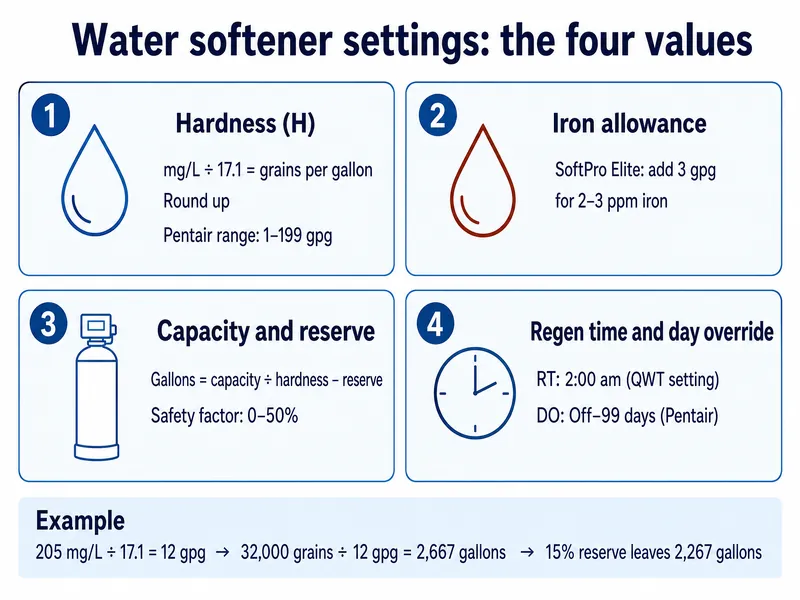
Water softener settings come down to four values: hardness in grains per gallon, an iron allowance, capacity with its reserve, and the regeneration time with a day override.
By the Water Softener Guide editors · Updated
Disclosure: watersoftenerguide.net is owned by the team behind SoftPro Water Systems and Quality Water Treatment, which sell some of the parts and systems we link to. Our steps follow the makers' manuals and published instructions, checked October 2026. Always check your own model's manual first. Ownership disclosure
View at Quality Water Treatment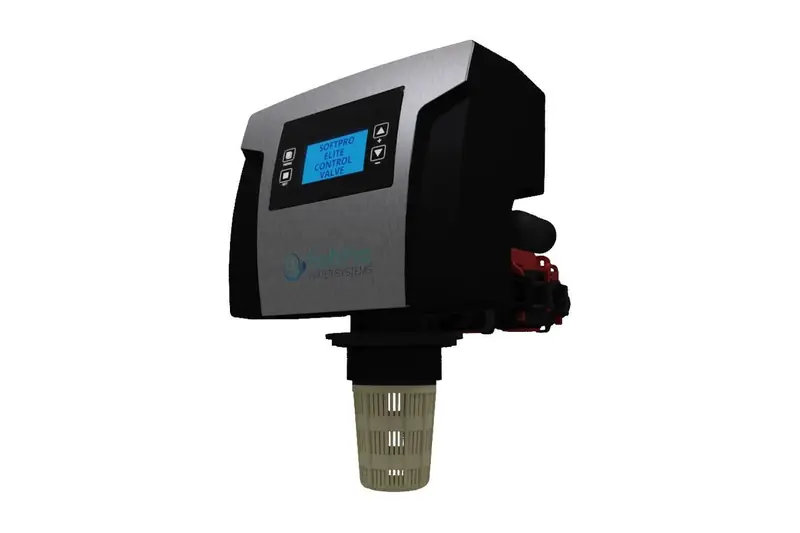
On this page
- What water softener settings does a softener need?
- How do you set the hardness on a water softener?
- How much should iron raise the hardness setting?
- How do capacity and reserve settings work?
- What regeneration time and day override should you set?
- A worked water softener settings example
- How do you check water softener settings are right?
- Common questions
Key takeaways
- Hardness is entered in grains per gallon: divide mg/L by 17.1 and round up, as the SoftPro Elite install guide directs.
- Pentair's 5600SXT manual accepts hardness from 1 to 199 gpg and a safety-factor reserve from 0 to 50%.
- SoftPro's Elite guide adds 3 gpg to the hardness setting when iron runs 2 to 3 ppm.
- The Fleck 5600SXT divides unit capacity by hardness and subtracts the reserve to get gallons between regenerations (manual 42684 Rev B).
- Quality Water Treatment programs its Fleck units with a 15% safety factor, a 14-day override and a 2:00 am start.
- The Water Quality Association asks for 4,000 grains removed per pound of salt and calendar overrides only when necessary.
Numbers behind the settings
- 17.1mg/L in one grain per gallon; divide and round upSoftPro Elite install guide
- 1–199 gpgHardness range the 5600SXT control acceptsPentair 4005293 Rev B
- 0–50%Safety-factor reserve rangePentair 4005293 Rev B
- +3 gpgAdded to hardness for 2–3 ppm of ironSoftPro Elite install guide
- Off–99 daysDay override rangePentair 4005293 Rev B
What water softener settings does a softener need?
A metered softener needs your water's hardness, the resin's grain capacity, a reserve, a regeneration time and a day override. From hardness and capacity the control works out how many gallons it can soften; the reserve, start time and override decide when the cycle actually runs. Everything else on the menu describes the hardware and is set once at the factory or by the installer.
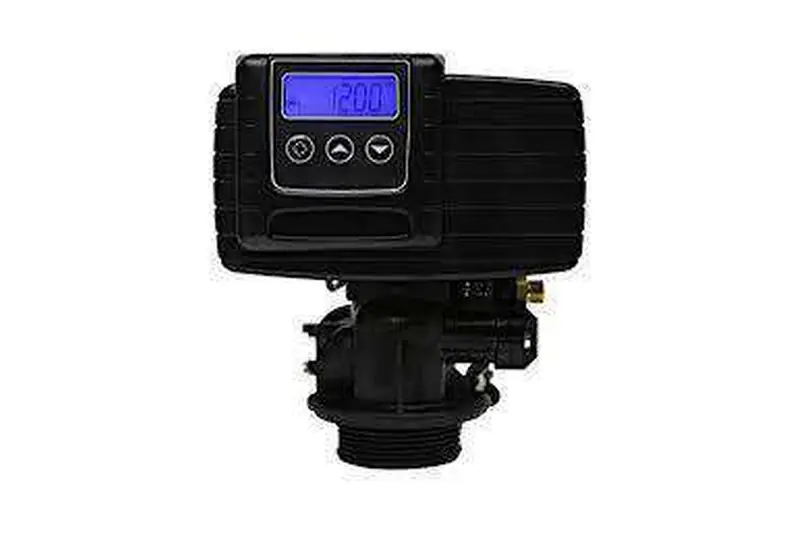
Names vary by valve. In the Fleck 5600SXT service manual (P/N 42684 Rev B), Master Programming runs in this order: display format, valve type, control type, number of tanks, unit capacity (C), hardness (H), reserve type, safety factor or fixed reserve, day override (DO), regeneration time (RT), the cycle step times and the flow meter. The everyday values also sit in a shorter user menu. Our Fleck 5600SXT manual guide walks through each screen, and the control valve guide explains how the valve acts on them.
How do you set the hardness on a water softener?
Measure the raw water, convert the result to grains per gallon and enter it as the H value. Hardness drives every other number, so a guess here throws off the whole schedule.
- Test the raw water. Sample a tap ahead of the softener, or put the softener in bypass first, and use cold water. City customers can read hardness from the utility's annual Consumer Confidence Report, which Nebraska Extension notes utilities must publish. The hardness testing guide compares strips, drop-count kits and lab samples.
- Convert to grains per gallon. A reading in mg/L (the same as ppm) becomes gpg when divided by 17.1; SoftPro's Elite guide says to round up. 205 mg/L ÷ 17.1 = 12 gpg.
- Enter it. Pentair's 5600SXT manual accepts feedwater hardness from 1 to 199 gpg.
- Check the result. After the next regeneration, test a softened cold tap beside the raw water. SoftPro's test-kit page (SoftPro, our store) reads a wide gap as a working softener, and raw and treated readings within 1 to 2 gpg as a sign of bypass.
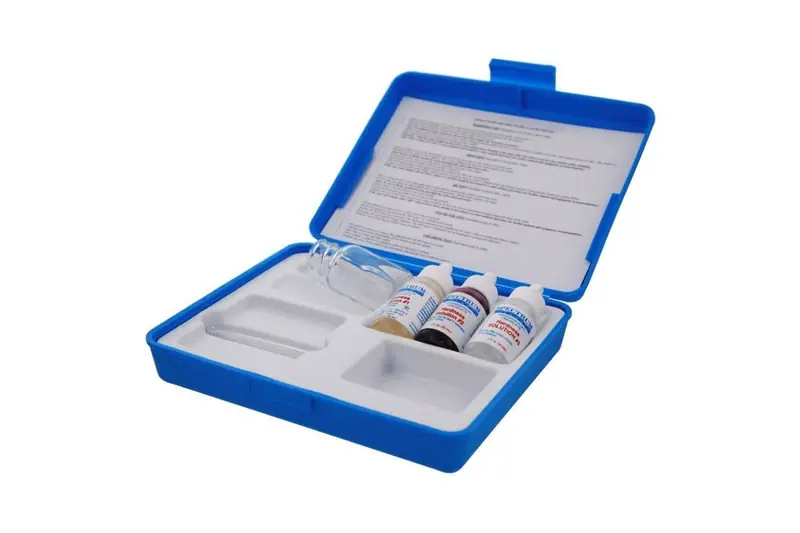
Nebraska Extension's NebGuide G1274 calls home kits and strips a good estimate and suggests a lab test when more accuracy is needed. For a raw-water figure before you program the valve, the Pro Products 2403 field test kit (sold by Quality Water Treatment, our store) is from $150.00 (October 2026) at Quality Water Treatment. Its listing describes three 1 oz hardness reagents, a square sample bottle plus a measuring tube, packed in a sturdy plastic case.
| Class | mg/L | gpg to enter |
|---|---|---|
| Soft | under 17 | under 1 |
| Slightly hard | 17 to 60 | 1 to 3.5 |
| Moderately hard | 60 to 120 | 3.5 to 7 |
| Hard | 120 to 180 | 7 to 10.5 |
| Very hard | over 180 | over 10.5 |
The classes follow the WQA-based table in Nebraska Extension's NebGuide G1491.
How much should iron raise the hardness setting?
Follow your own softener's guide, because makers publish different allowances. SoftPro's Elite install guide adds 3 gpg to the hardness setting when iron is 2 to 3 ppm and no iron filter is fitted. Quality Water Treatment's Fleck guide handles the same iron range by shortening the day override to 7 days, and one more day if staining continues.
Dissolved (clear-water) iron uses up resin capacity the same way calcium and magnesium do. Penn State Extension recommends a softener for iron only when dissolved iron is under 5 mg/L and pH is above 6.7, and warns that oxidized iron fouls the resin. Above that, an iron filter goes ahead of the softener. Iron also coats resin over time; the resin cleaner guide covers doses.
How do capacity and reserve settings work?
The control divides unit capacity by hardness and subtracts the reserve; the answer is the gallons it softens before the next regeneration. The Fleck 42684 manual describes this calculation for both metered control types.
Capacity (C). Enter the grains the resin holds at the salt dose your system uses. Pentair's own 5600SXT system with 1 cubic foot of resin is rated at 11,900 grains on 3 lb of salt, 31,100 on 9 lb and 35,400 on 15 lb. The lean setting removes 4,400 grains per pound of salt, so less salt per cycle is more efficient, but the tank runs out sooner.
Reserve. The reserve holds back soft water for use between the moment capacity runs out and the overnight start. Pentair's valve takes it as a safety factor of 0 to 50% of capacity, or a fixed number of gallons no more than half the calculated capacity. Quality Water Treatment's guide sets a 15% safety factor.
| Code | Setting | Range (Pentair 4005293) | Quality Water Treatment guide |
|---|---|---|---|
| H | Feedwater hardness | 1–199 gpg | 20 in its example; enter your own |
| C | Unit capacity | set for the tank | 32,000 grains for that system |
| SF | Safety factor | 0–50% | 15 |
| RC | Fixed reserve | up to half the calculated capacity | not used |
| DO | Day override | Off–99 days | 14 (7 for 2–3 ppm iron) |
| RT | Regeneration time | any time of day | 2:00 am, or whenever suits you |
What regeneration time and day override should you set?
Pick a regeneration time when nobody draws water, and a day override that only acts as a backstop. Nebraska Extension says automatic units generally regenerate in low-use hours, such as between midnight and 4 a.m., and Quality Water Treatment programs 2:00 am "or your suitable time". The Fleck manuals give no factory default time, so check your screen.
Regeneration time (RT). Pentair's manual defines RT as the time a delayed, manually queued or day-override regeneration starts. A single-tank house gets unsoftened water during the cycle, which is why the start sits in the night.
Day override (DO). DO caps the days between cycles. On a time-clock valve it is the schedule itself; on a metered valve it forces a cycle when that many days pass first. Pentair allows Off to 99, Quality Water Treatment enters 14, and the WQA asks installers to use calendar overrides only when necessary, for instance a vacation home, or a supply whose resin fouls when water stands.
On a SoftPro Elite valve the install guide also sets a refill rate: 0.2 for city water and 0.7 for well water. Settings lost after an outage or error can be restored with the steps in how to reset a water softener.
A worked water softener settings example
Here is the arithmetic for a family of four, using the numbers above.
- Hardness. The lab report says 205 mg/L; 205 ÷ 17.1 = 12 gpg, so H = 12.
- Capacity. The system is rated at 32,000 grains at its salt setting, so C = 32,000.
- Gallons. 32,000 ÷ 12 = 2,667 gallons.
- Reserve. A 15% safety factor holds back 400 gallons, leaving 2,267.
- Interval. At Penn State Extension's planning figure of 75 gallons per person a day, four people use 300 gallons, so a cycle comes about every 7 to 8 days.
That lands near the once-a-week target. The guide on how often a water softener should regenerate works through other households, and the regeneration guide covers what happens in each step.
How do you check water softener settings are right?
Watch the interval, the salt and the water for a few weeks. A cycle every week or so, salt that drops steadily and soft water at the taps mean the numbers fit. Regenerating daily in a two-person house points to a hardness or capacity value that is off; the too-much-salt guide lists the checks. The WQA's booklet asks installers to "always check" regeneration settings and adjust them for salt and water efficiency.
Related guides
 SettingsWhat happens in a regeneration
 SettingsChoosing a regeneration interval
 SettingsProgramming the Fleck 5600SXT
 TestTesting hardness at home
How we put this page together
We built this page from two maker manuals (Pentair 4005293 Rev B and Fleck 42684 Rev B), two store install guides (SoftPro Elite v2023-6 and Quality Water Treatment's Fleck guide v2021a), the WQA's best-practice booklet for softeners, plus Penn State and Nebraska Extension, all read in October 2026. The test-kit price is from the store's own product page. Iron rules of thumb no maker or extension source states, factory defaults the manuals omit, and forum advice were left out, and no lab work was done.
Common questions
Should the hardness setting be higher than the test result?
Enter your measured hardness, rounded up to the next whole grain, plus any iron allowance your manual calls for. Padding the number further makes the softener regenerate more often than it needs to and burns more salt.
Which hardness setting should a city home use without a test kit?
Read the hardness figure from your utility's annual water quality report and convert mg/L to gpg by dividing by 17.1. A home test is still worth doing, since hardness can change with the source.
Does the salt setting change the softener's capacity?
Yes. Every capacity rating assumes a salt dose, which is why Pentair quotes each model with its pounds of salt. A smaller dose recharges less of the resin but removes more grains per pound.
What reserve should a family of four set?
Follow your manual or installer. Quality Water Treatment uses 15% on its Fleck systems, well inside the 0 to 50% Pentair's valve accepts. A bigger reserve suits homes that use a lot of water in the evening.
Does a time-clock softener use the hardness setting?
No. The Fleck 42684 manual shows unit capacity and hardness only when the control type is one of the metered options. A time-clock valve regenerates when the day override count is reached, whatever the hardness.
How do you set hardness on a SoftPro Elite?
SoftPro's install guide has you enter hardness in gpg, rounded up after dividing mg/L by 17.1, and add 3 gpg for 2 to 3 ppm of iron. The same menu sets the refill rate: 0.2 on city water, 0.7 on a well.
Do settings change if you switch to potassium chloride?
The hardness value stays the same, but the regenerant needs a stronger dose. NDSU Extension puts the extra potassium chloride at about 10%, and the WQA gives a 13 to 15% higher concentration; ask your installer how to adjust your valve.
Parts for this job
Pro Products Water Hardness Field Test Kit
Check current options and prices at Quality Water Treatment.
View at Quality Water Treatmentwatersoftenerguide.net is owned by the team behind SoftPro Water Systems and Quality Water Treatment, which sell some of the parts and systems we link to. Ownership disclosure
More help: see our water softener how-to guides.