
Fix
Is My Water Softener Working?
How do you tell if a water softener is working? Test raw and softened cold water with the same kit; softened water should read under 1 gpg, well below the raw sample.
By the Water Softener Guide editors · Updated
Disclosure: watersoftenerguide.net is owned by the team behind SoftPro Water Systems and Quality Water Treatment, which sell some of the parts and systems we link to. Our steps follow the makers' manuals and published instructions, checked October 2026. Always check your own model's manual first. Ownership disclosure
View at Quality Water Treatment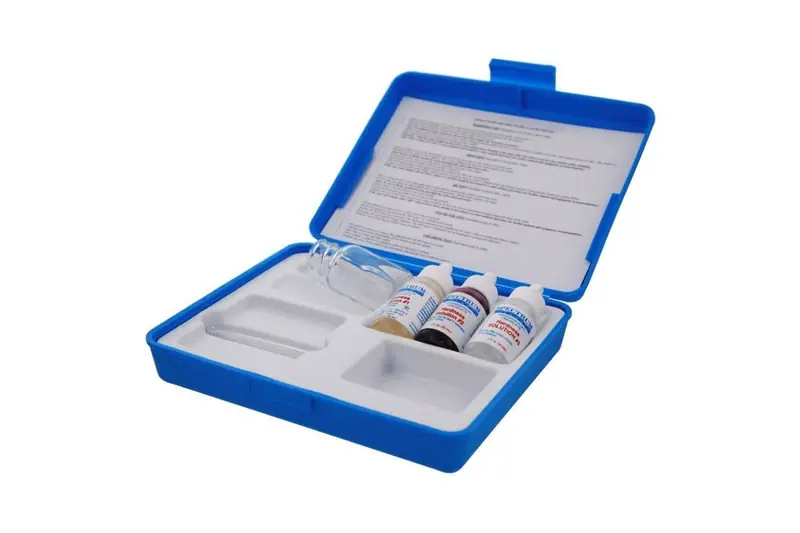
On this page
- How do you tell if a water softener is working?
- What hardness reading means a water softener is working?
- What are the signs a water softener is working?
- What are the signs a water softener isn't working?
- Can a TDS meter tell if a water softener is working?
- What should you check if the softener fails the test?
- Common questions
Key takeaways
- Soft water is 0 to 1 gpg (0 to 17.1 mg/L) on the WQA and U.S. Interior Department scale published by Nebraska Extension.
- Test kits and dip strips give a good estimate; Nebraska Extension suggests a lab test when you need accuracy.
- A TDS meter cannot confirm softening, because softening swaps ions without lowering dissolved solids (Montana State Extension).
- On a Fleck 5600SXT the flow indicator flashes when water runs, and the service icon flashes when a regeneration is queued.
- A regeneration takes 60 to 120 minutes for brine to pass through and flush the tank, according to Nebraska Extension G1491.
- Penn State Extension's sizing example regenerates about every 6 to 7 days, so salt should drop steadily, not stand still.
How do you tell if a water softener is working?
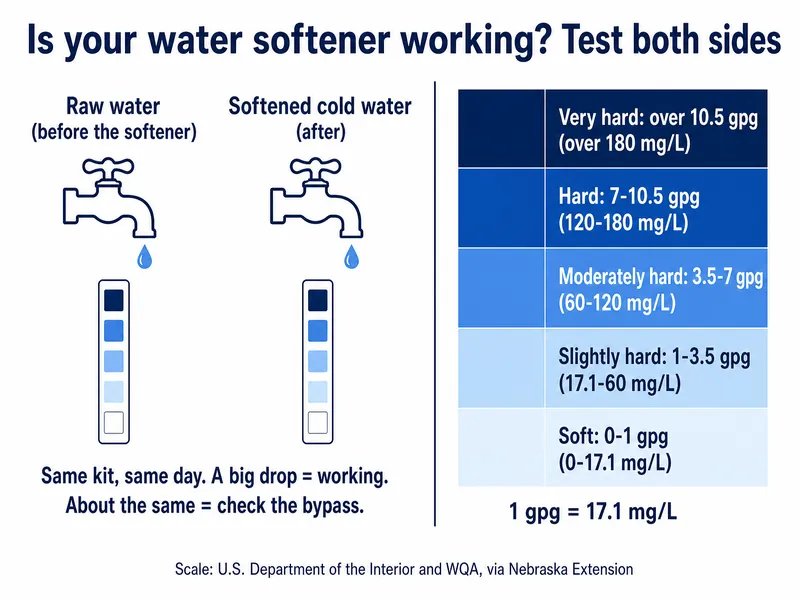
You tell by measuring hardness on both sides of the softener at the same time. SoftPro's hardness test kit method (SoftPro, our store) compares a raw sample with a softened one from the same kit: a wide gap means the resin is removing hardness, and two similar readings mean water is going around the resin or the resin is spent.
- Find a raw-water tap. Use an outside spigot or a tap plumbed before the softener. Many systems leave outside faucets on hard water; Pentair's 5600SXT manual shows them that way.
- Find a softened tap. The kitchen cold tap is usual. Use cold water only, because a water heater can hold hard water for a while after a repair.
- Flush each tap. Run each one long enough to clear standing water from the pipe; follow the flush and dip times printed on your kit.
- Test both samples the same way. Use one kit, one method and the same timing for both, so the only difference is the softener.
- Compare and write it down. Note both readings in grains per gallon (gpg) with the date. If your kit reads in mg/L, divide by 17.1.
For a reagent kit, Quality Water Treatment sells the Pro Products 2403 hardness field test kit (sold by Quality Water Treatment, our store) for checking softened and raw water at home, from $150 (October 2026). Per the store, the plastic case carries three 1-oz hardness reagents plus a square test bottle and measuring tube. See choosing a water hardness test kit for other options and how to test water hardness for the full method.
What hardness reading means a water softener is working?
A working softener brings water into the soft class, 0 to 1 gpg. Nebraska Extension's G1274 table, adapted from WQA and Interior Department figures, sets these classes:
| Class | Grains per gallon | mg/L |
|---|---|---|
| Soft | 0–1 | 0–17.1 |
| Slightly hard | 1–3.5 | 17.1–60 |
| Moderately hard | 3.5–7.0 | 60–120 |
| Hard | 7.0–10.5 | 120–180 |
| Very hard | Above 10.5 | Above 180 |
The raw sample should sit well above the softened one. If raw water is already in the soft class, the softener has little to remove. City households can find raw-water hardness in the annual Consumer Confidence Report, which Nebraska Extension notes may list it.
What the sources say
- 0–1 gpgsoft water (0–17.1 mg/L)Nebraska Extension G1274
- 17.1 mg/Lequals 1 grain per gallonMontana State Extension
- 60–120 minfor brine to pass through and flush the tankNebraska Extension G1491
- 6–7 daysbetween regenerations in a worked examplePenn State Extension
What are the signs a water softener is working?
- Softened water tests soft. The softened sample reads in the 0 to 1 gpg band while the raw sample reads higher.
- Salt goes down. SoftPro's performance testing page (SoftPro, our store) says the salt level should visibly drop over time.
- The valve regenerates on schedule. On a Fleck 5600SXT the step display flashes while the valve moves between cycles. In Penn State Extension's example, a 20,000-grain unit for 4 people on 10 gpg water regenerates about every 6 to 7 days.
- Water use registers. On a metered Fleck valve, the flow indicator flashes when water runs. Holding Up with Extra Cycle for 5 seconds opens diagnostics, where flow rate and gallons used appear.
What are the signs a water softener isn't working?
- Raw and softened readings match. This points first to the bypass. Quality Water Treatment warns that bypass knobs not completely open let unsoftened water through.
- Salt level hasn't moved in weeks. Unchanged salt plus hard water points to a regeneration problem. Check for a salt bridge first; see why a softener isn't using salt.
- Hardness creeps back before the next regeneration. The hardness setting may be too low for your water, so the valve thinks it has capacity left when it doesn't.
- The display is blank or the time flashes. The Fleck manual says the time flashes after a power failure, and missed regenerations wait for the next set time.
- Hard water only from hot taps. The Fleck 5600SXT manual lists hardness held in the water heater; flush it repeatedly. Cut the heater's power or gas before you flush, watch out for scalding water, and use the heater manufacturer's steps.
Can a TDS meter tell if a water softener is working?
No. Montana State Extension explains that softening does not reduce total dissolved solids; it swaps calcium and magnesium for sodium or potassium. A TDS meter does not measure hardness, so a high reading does not mean the softener failed. Use a hardness test.
What should you check if the softener fails the test?
Work through these in order. Each links to a fuller guide.
- Bypass. Turn it fully to service. On a Fleck plastic bypass the knobs line up with the inlet and outlet pipes.
- Salt and bridges. The tank should be a quarter to half full with pellets sitting higher than the brine. Break any crust with a broom handle; steps are on the salt bridge page.
- Hardness setting. Enter your raw-water reading in gpg. Our settings guide covers iron compensation and reserve.
- Brine draw. If salt is present but never used, the injector or brine line may be clogged.
- Regenerate and retest. Run a manual regeneration, then test again the next day.
If none of that fixes it, the full troubleshooting guide covers valve seals and resin in order.
How we put this page together
What you read here rests on Nebraska Extension guides G1274 and G1491, Montana State University Extension's hardness page, Penn State Extension's water softening publication, the Fleck 5600SXT service manual and Pentair's 5600SXT operation manual, plus SoftPro's testing guides, all checked in October 2026. We left out store strip-timing and pass-mark figures because the store pages disagree with each other, and no water samples were tested for this page.
Related guides
Common questions
How soon after a regeneration should softened water test soft?
Wait until the valve is back in service and you have run the cold tap clear. Nebraska Extension says brining and flushing generally take 60 to 120 minutes, so testing the morning after an overnight cycle is simplest.
Is there any way to judge a softener without a test kit?
Only roughly. Falling salt and a valve that regenerates on schedule are good signs, but they don't prove the resin is removing hardness. A test of raw and softened water gives a clear answer.
Why does my softened water still leave spots on glasses?
Softened water can still leave marks from other dissolved minerals, because softening swaps hardness minerals rather than removing everything. Test the water first; if it reads soft, the spots are not a softener fault.
Does a hot-tap sample give a fair hardness reading?
No, use cold. A water heater can hold hard water for some time after the softener is repaired or restarted, which makes a working softener look broken.
Is the kitchen tap or the softener outlet better for the softened sample?
Either works for the softened sample, as long as it is cold and on the softened line. Testing at the softener outlet rules out hard-water branches, such as outside taps, that some installs leave unsoftened.
How often is it worth retesting a softener that works?
A check every few months, or whenever salt use changes or spots return, is enough to catch drift. Keep the dated readings so you can see when hardness starts to climb.
Can a lab test confirm what my strips show?
Yes. Nebraska Extension calls home kits a good estimate and recommends a laboratory test when you need an accurate number, such as before setting the hardness on a new valve.
More help: see our guide to water softener care.