
Settings
The Water Softener Regeneration Cycle
Water softener regeneration recharges the resin in four steps (backwash, brine draw and slow rinse, rapid rinse, brine refill) and takes roughly 60 to 120 minutes, usually at night.
By the Water Softener Guide editors · Updated
On this page
- What happens during water softener regeneration?
- What are the regeneration steps in order?
- How long does water softener regeneration take?
- How much water and salt does a regeneration use?
- Metered vs timed water softener regeneration
- What's normal to hear and see during regeneration?
- How do you start a regeneration by hand?
- Common questions
Key takeaways
- A single-backwash downflow Fleck 5600SXT runs backwash, then brine draw with slow rinse, then rapid rinse, then brine tank fill, before returning to service (manual 42684 Rev B).
- Nebraska Extension says 60 to 120 minutes are generally needed before soft water is available again.
- Penn State Extension and Nebraska Extension both put water use at about 50 gallons per regeneration.
- Each 5600SXT step can be set from 0 to 199 minutes, or OFF, per Pentair's 5600SXT manual.
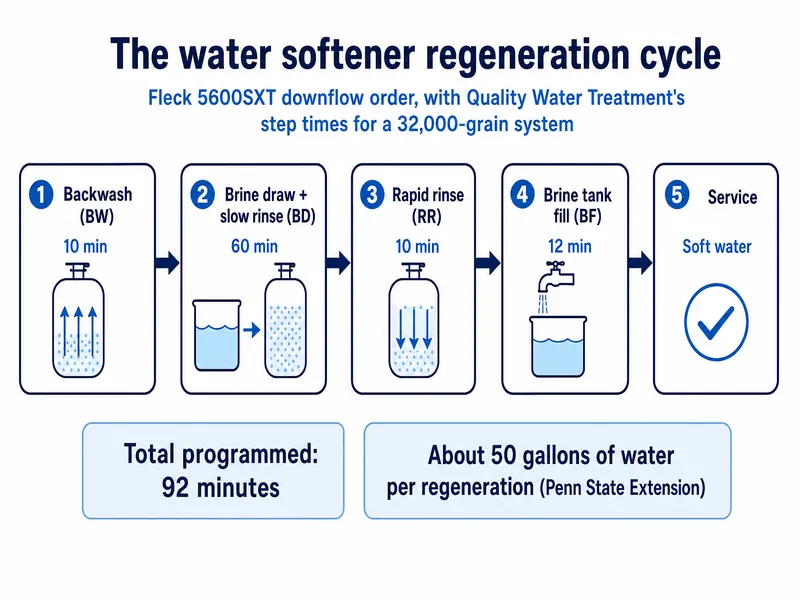
- Quality Water Treatment programs 10, 60, 10 and 12 minutes for the four steps on a 32,000-grain system: 92 minutes in all.
- The WQA asks for no more than 5 gallons of regeneration water per 1,000 grains removed.
Regeneration by the numbers
- 60–120 minBefore soft water is available againNebraska Extension G1491
- 50 galWater used per regeneration cyclePenn State Extension
- 0–199 minAdjustable range for each 5600SXT stepPentair 4005293 Rev B
- 5 galMost water per 1,000 grains in WQA best practiceWater Quality Association
What happens during water softener regeneration?
Regeneration flushes the resin with salty brine so the beads give up the calcium and magnesium they collected and take on sodium again. In service, resin beads trade sodium (or potassium) for hardness until they are saturated. Nebraska Extension's NebGuide G1491 describes the brine pushing hardness off the resin, which is then flushed out with the wastewater.
How often this happens depends on hardness, water use, softener size and resin capacity, in G1491's list. Our guide to how often a water softener should regenerate works out the interval, and the settings guide explains the values that trigger it.
What are the regeneration steps in order?
For a single-backwash downflow valve, Fleck manual 42684 Rev B lists this order:
- Backwash (BW). Water flows up through the resin bed, the reverse of normal service. It lifts and loosens the bed and carries trapped sediment out to the drain.
- Brine draw and slow rinse (BD). The valve's injector pulls brine from the brine tank and passes it slowly through the resin. This is where the hardness comes off. Once the brine is used up, fresh water keeps moving slowly through the bed to push the spent brine out.
- Rapid rinse (RR). Water runs quickly down through the bed to repack it and flush out the last of the brine, so the first water you draw isn't salty.
- Brine tank fill (BF). The valve sends a timed amount of water back to the brine tank, where it dissolves salt for the next regeneration. On a Fleck SXT, this refill is set by the BF time rather than a float.
- Service. The valve returns to normal softening.
Not every valve runs this order. Pentair's SXT timer manual (42713 Rev K) notes that on a filter or upflow unit the step order may change. Twin-tank systems run the same steps but alternate tanks; G1491 notes that one tank can soften while the other recharges.
How long does water softener regeneration take?
Expect about one to two hours. Nebraska Extension says 60 to 120 minutes generally pass before soft water is available again, and SoftPro's reset guide (SoftPro, our store) puts a manual cycle at 60 to 90 minutes. The exact length is the sum of the step times programmed into the valve.
The 5600SXT accepts 0 to 199 minutes per step, plus OFF. In the 42684 manual's terms, a zero skips only that step, while OFF ends the cycle there and cancels the steps that follow. The Fleck manuals list no factory default step times; the job sheet is left blank for the installer. Quality Water Treatment's install guide shows the times it programs:
| Step | Standard resin, 32,000 grains | SST-60 resin |
|---|---|---|
| Backwash (BW) | 10 min | 6 min |
| Brine draw / slow rinse (BD) | 60 min | 60 min |
| Rapid rinse (RR) | 10 min | 6 min |
| Brine refill (BF) | 12 min | 7 min |
| Total | 92 min | 79 min |
The guide's SST-60 settings change only the backwash, rinse and refill. Quality Water Treatment notes that the refill time depends on system capacity, so use the times in your own valve's paperwork rather than copying another system's.
How much water and salt does a regeneration use?
About 50 gallons of water per cycle, by Penn State Extension's estimate; G1491 gives the same figure, about one laundry load in an older washer or two in a high-efficiency one. Salt per cycle depends on the brine refill and the capacity the system is set for.
The WQA's best-practice booklet sets two efficiency targets: remove 4,000 grains of hardness per pound of salt, and use no more than 5 gallons of water per 1,000 grains, as tested under NSF/ANSI 44. Pentair rates its own 5600SXT systems at 4,400 grains per pound on their lowest salt setting.
Frequency matters as much as dose. NDSU Extension warns that recharging too early wastes salt and water, while recharging too late lets performance fall off. On a septic system, Penn State says the 50 gallons may or may not overload it hydraulically; our septic guide covers the rules.
Metered vs timed water softener regeneration
A metered control regenerates on water used; a timer regenerates on a calendar. The 42684 manual lists four control types:
| Code | Control type | What starts a regeneration |
|---|---|---|
| Fd | Meter delayed | Capacity used up; waits for the set regeneration time |
| FI | Meter immediate | Capacity used up; starts at once |
| tc | Time clock | Days since the last cycle reach the day override |
| dAY | Day of week | Days set to "on" in the schedule |
Both metered types still regenerate when the day override count passes first. Penn State notes that timed models suit regular water use but waste more water and salt, because they regenerate whether the resin needs it or not. The WQA asks installers to avoid time clocks for starting regeneration. The control valve guide covers valve types in more depth.
What's normal to hear and see during regeneration?
Water running to the drain for most of an hour or more is normal, and so are a few flashing symbols.
- Water running to the drain. Backwash and rinse send water down the drain line. If it runs into a laundry tub or floor drain, you will see and hear it.
- The step number flashing. The 42684 manual says the step number flashes until the valve finishes driving to that position.
- The service icon flashing. A cycle is queued for tonight's start time.
- Hard water during the cycle. On a single-tank softener, water drawn during regeneration is not softened, which is why the start time is set for the night.
- Brine level changes. The brine tank level drops during brine draw and rises again at refill.
Some signs are not normal. The 42684 troubleshooting table reads a drain that flows continuously as a valve that is not positioning properly, debris inside the control, or a leak within the valve. A brine tank that keeps filling, or salt that never goes down, points to a brine draw problem; see brine tank full of water and water softener not using salt.
How do you start a regeneration by hand?
On a Fleck 5600SXT, the 42684 manual gives these steps with the valve in service:
- Start. Hold Extra Cycle for 5 seconds; the valve moves to step 1, backwash, and counts down.
- Advance. Press Extra Cycle once to move to brine draw, once more for rapid rinse, and once more for brine refill.
- Finish. Press Extra Cycle again to return the valve to service.
Pressing it briefly once, instead, queues a cycle for the next regeneration time; a second brief press cancels it. If the clock was reset by a power cut, follow how to reset a water softener first.
Related guides
 SettingsHardness, iron and reserve settings
 SettingsPicking a regeneration interval
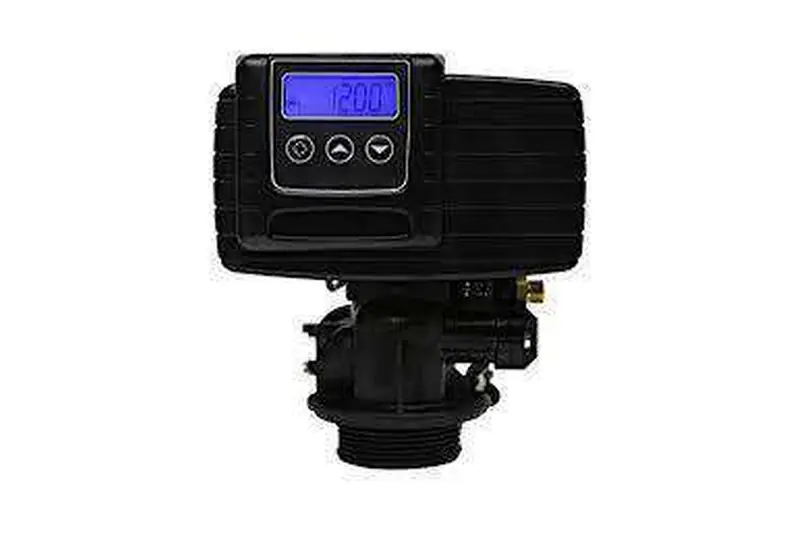 SettingsThe 5600SXT display and menus
How we put this page together
This page draws on Fleck manual 42684 Rev B, Pentair manuals 4005293 Rev B and 42713 Rev K, the v2021a Fleck install guide from Quality Water Treatment, SoftPro's reset guide, the Water Quality Association's softener booklet, and Penn State, Nebraska and NDSU Extension, all checked in October 2026. Factory default step times are missing because the Fleck manuals do not give them; product-specific water-per-cycle claims and forum reports were also left out.
Common questions
Why does my softener regenerate at 2 in the morning?
Overnight regeneration means nobody draws hard water while the resin is offline. Quality Water Treatment programs its Fleck systems for 2:00 am, and Nebraska Extension mentions midnight to 4 a.m. as typical, but any quiet hour works.
Is it normal to hear water running for an hour at night?
Yes. Backwash, brine draw and rinse send water to the drain for most of the cycle, which SoftPro puts at 60 to 90 minutes in total.
What happens if the power goes out mid-regeneration?
Per the 42684 manual, the control records where the valve stopped and picks the cycle up from there once power is back. A cycle missed during an outage waits until the next start time comes round, typically a day late.
Does the brine draw step use all the salt in the tank?
No. The valve draws the brine made by the last refill, not the dry salt above it. The refill time, set by the BF step on a Fleck SXT, controls how much water goes in to dissolve salt for each cycle.
Can a softener skip the backwash step?
On a 5600SXT, setting a step to 0 skips it and keeps the later steps, per the 42684 manual. Backwash loosens the bed and clears sediment, and G1491 calls adequate backwashing important to efficient regeneration, so change it only on your installer's advice.
Why is the water hard right after a regeneration?
Water drawn during the cycle bypasses the resin on a single-tank unit, and a few minutes of rinse water may still be in the lines. If hardness stays after the cycle ends, check salt, the brine draw and the hardness setting.
Does an upflow softener regenerate in a different order?
It can. Pentair's SXT timer manual notes that the cycle step order may change on upflow or filter units, so follow the order printed in your valve's manual.
More help: see our water softener maintenance and repair guides.