
Install
Setting Up a Water Softener Drain Line
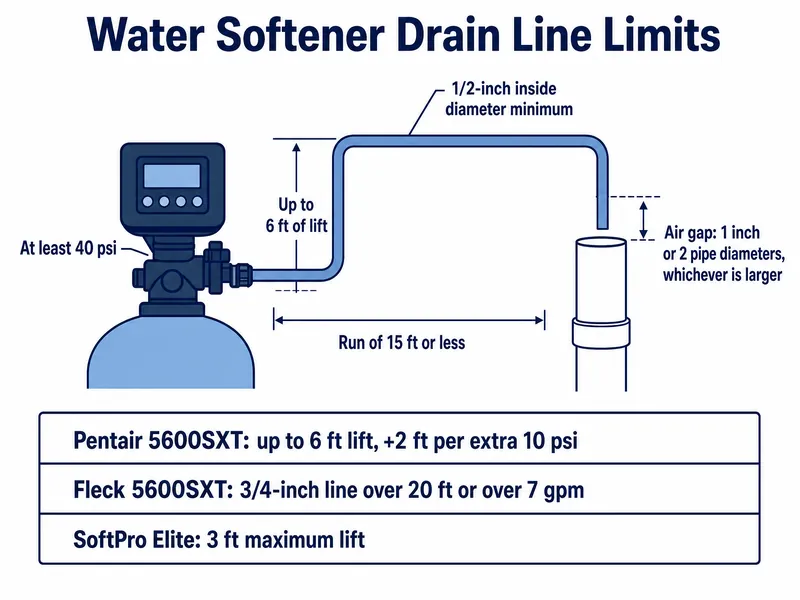
A water softener drain line is 1/2-inch tubing that carries backwash and rinse water from the control valve to a drain, kept within your manual's length and lift limits and ending above the drain with an air gap.
By the Water Softener Guide editors · Updated
On this page
Key takeaways
- The Fleck 5600SXT service manual sets a 1/2-inch minimum for residential drain lines and steps up to 3/4-inch above 20 feet of length or 7 gpm of backwash.
- Pentair's 5600SXT manual allows up to 6 feet of lift on a run of 15 feet or less at 40 psi or more, plus 2 feet per extra 10 psi.
- SoftPro's Elite install guide caps drain elevation at 3 feet above the drain port.
- Leave open air above the drain of at least 1 inch, or twice the pipe diameter if that is more; never push the tube into the drain.
- The EPA WaterSense guide says a typical softener sends 20 to 70 gallons down the drain per regeneration.
- University of Maryland Extension and Purdue Extension disagree on routing softener discharge to a septic system, so check local rules.
Drain line limits
- 1/2 inMinimum inside diameter for a residential drain linePentair 5600SXT manual
- 6 ftMaximum lift with a run of 15 ft or less and at least 40 psiPentair 5600SXT manual
- 3 ftMaximum drain elevation above the port on a SoftPro EliteSoftPro Elite install guide
- 20-70 galWater a typical softener uses per regenerationEPA WaterSense
What does a water softener drain line carry?
It carries every drop of regeneration water the softener sends away: backwash, spent brine and rinse water. Pentair's 5600SXT manual describes the sequence: backwash reverses flow to lift the resin bed and flush debris to the drain, brine draw and slow rinse push salty brine through the resin and carry the displaced hardness out, and fast rinse clears the leftover brine before the brine tank refills. Our regeneration guide explains each step.
That adds up to a fair amount of water. Penn State Extension puts it at about 50 gallons per regeneration, and the EPA WaterSense guide gives 20 to 70 gallons for a typical softener, with some larger systems using up to 200. The flow rate matters for sizing the line: Pentair's 5600SXT backwash rates run 2.0, 2.4 and 3.5 gpm for its 1.0, 1.5 and 2.0 cubic foot models.
Every drain port also has a small part that sets that flow: the drain line flow control (DLFC). The Fleck manual's troubleshooting table links a plugged DLFC to a brine tank full of water and to a softener that fails to draw brine.
What size should a softener drain line be?
Use 1/2-inch inside diameter tubing at minimum. The Fleck 5600SXT service manual sets that minimum for residential lines and calls for 3/4-inch when backwash flow is over 7 gpm or the line is longer than 20 feet. Pentair's manual connects 1/2-inch plastic tubing to the drain fitting, and SoftPro's Elite guide uses 1/2-inch ID vinyl tubing on the drain-port barb. A SoftPro web page mentions 3/8-inch hose, but the manuals' 1/2-inch figure is the one to follow on a Fleck valve.
How far and how high can the drain line run?
As far and as high as your valve's manual allows, because the valve has to push the water there. The numbers depend on the valve:
| Source | Limit |
|---|---|
| Fleck 5600SXT manual | 1/2-inch minimum; 3/4-inch over 20 ft or over 7 gpm backwash |
| Pentair 5600SXT manual | Unit above the drain and no more than 20 ft from it |
| Pentair 5600SXT manual | Lift up to 6 ft if the run is 15 ft or less and pressure is at least 40 psi |
| Pentair 5600SXT manual | Add 2 ft of lift for each extra 10 psi at the drain connector |
| SoftPro Elite guide | Maximum 3 ft above the drain port; contact SoftPro if higher |
Follow the manual for your own valve; Pentair notes that local codes may require changes to its suggestions. If your drain is farther or higher than the manual allows, you may need a closer drain point, a larger line, or a plumber's help.
Siphon protection. When an elevated line comes back down to a drain below the valve, Pentair says to form a 7-inch loop at the far end, with the bottom of the loop level with the drain connection. Where the line empties into an overhead sewer pipe, it calls for a sink-type trap instead.
Where can a softener drain line empty?
SoftPro's Elite guide lists the accepted drain points: an existing softener drain, a pre-plumbed loop drain, a floor drain, a washing-machine standpipe, a laundry tub or sink, or a sanitary sewer pipe fitted with a P-trap, a riser and an air gap. At a floor drain it ends the tube at the drain's mouth; at a laundry tub it drains into the open bowl. It also says not to tee into any other existing drain line.
Whatever you choose, the tubing must stop above the drain. Pentair, Quality Water Treatment and SoftPro all forbid sliding it down into the drain, sewer pipe or trap, which could let wastewater siphon back into the valve, and all three want a gap at least twice the pipe diameter and never under 1 inch. Massachusetts code, for one, sets the indirect-waste air gap at twice the effective diameter of the drain served. The air gap guide covers fittings, and local plumbing code has the final say; if you are unsure, ask a licensed plumber.
Septic systems. The views differ. University of Maryland Extension says softener backwash should not be connected to the waste plumbing or septic tank. Purdue Extension explains Indiana's rule: recharge water must pass through a soil absorption field but not necessarily the septic tank, and may not go to the soil surface, a field tile or groundwater. The WQA's septic toolkit says efficiently run softeners improve septic tank performance. Our page on softeners and septic systems sets these out in full.
How do you secure the drain line?
A drain line that pops off or flips out of the drain during a night-time backwash floods the floor, so fasten both ends.
- At the valve. Following Pentair's steps, slide a hose clamp 1 to 2 inches onto the tubing, push the tubing over the ribbed drain fitting, then move the clamp up to pinch it. On a SoftPro Elite, leave the barb in place because it holds the required flow restrictor.
- Threads and solder. The Fleck manual allows only Teflon tape as a sealant on the drain fitting, and asks for at least 6 inches between the DLFC and any solder joint so heat does not damage it.
- Along the run. Keep the tubing free of kinks and sags; a pinched line restricts flow the same way a plugged DLFC does.
- At the drain. Pentair says to secure the discharge end so it cannot move. Fix it above the drain so it cannot drop into the pipe or jump out, keeping the air gap.
- Overflow line. The brine tank overflow is a second, separate 1/2-inch tube in Pentair's manual. Keep it below the overflow fitting all the way down, give it its own air gap, and do not join it to the valve's drain tubing.
Once it is connected, the Fleck manual says to check the drain seal for leaks with the control in backwash. Shut off the water and unplug the valve before you loosen any drain fitting later.
What goes wrong with softener drain lines?
Most drain line faults show up as water where it should not be. In the Fleck manual's table, nonstop flow to the drain comes from the valve failing to reach its programmed position, dirt lodged inside the control, or an internal leak. Resin beads at the drain end point to air in the water system or a wrong-size DLFC; see resin beads in the water. A brine tank that stays full often traces back to a plugged DLFC. Start with the troubleshooting guide for each.
How we put this page together
Drain figures here come from the Pentair 4005293 and Fleck 42684 manuals for the 5600SXT, SoftPro's Elite install guide, EPA WaterSense (May 2026), Penn State Extension, Massachusetts 248 CMR 10.12, University of Maryland and Purdue Extension and the WQA septic toolkit; each was reopened in October 2026. We left out the 3/8-inch hose size on one SoftPro web page, which conflicts with the manuals, and state codes we could not open; no drain runs were measured for this page.
Common questions
Can the drain line share a standpipe with the washing machine?
SoftPro's Elite guide lists a washing-machine drain as an accepted drain point and suggests an optional air gap kit. Keep the tubing end above the standpipe with an air gap, and follow local code.
Is 3/8-inch tubing big enough for a softener drain?
The Fleck and Pentair manuals set 1/2-inch as the minimum, and the Fleck manual calls for 3/4-inch on long runs or high backwash flow. Use at least 1/2-inch on a Fleck valve.
Why does water run down the drain line constantly?
In the Fleck manual's table, nonstop drain flow comes from one of three faults: the valve failing to reach its programmed position, dirt lodged inside the control, or a leak inside the valve. Start with the troubleshooting guide.
Can the drain line run up to a ceiling sewer pipe?
Within limits. Pentair allows up to 6 feet of lift with a short run and at least 40 psi, and calls for a sink-type trap where the line empties into an overhead sewer. SoftPro's Elite guide caps lift at 3 feet.
Can two softeners share one drain line?
The Fleck manual says the drain from twin tank units may be run through a common line. For two separate systems, follow each manual; SoftPro's guide says not to tee into other existing drain lines.
Does the drain line need a trap at the softener end?
Not at the valve. Pentair calls for a 7-inch loop at the far end when the drain sits below the valve, and SoftPro's guide puts a P-trap with a riser on a closed sewer connection, both with an air gap.
How much water goes down the drain each year?
It depends on how often the unit regenerates. At the EPA's 20 to 70 gallons per regeneration, a softener that regenerates once a week sends roughly 1,040 to 3,640 gallons a year to the drain.
Related guides
More help: see our water softener guides.